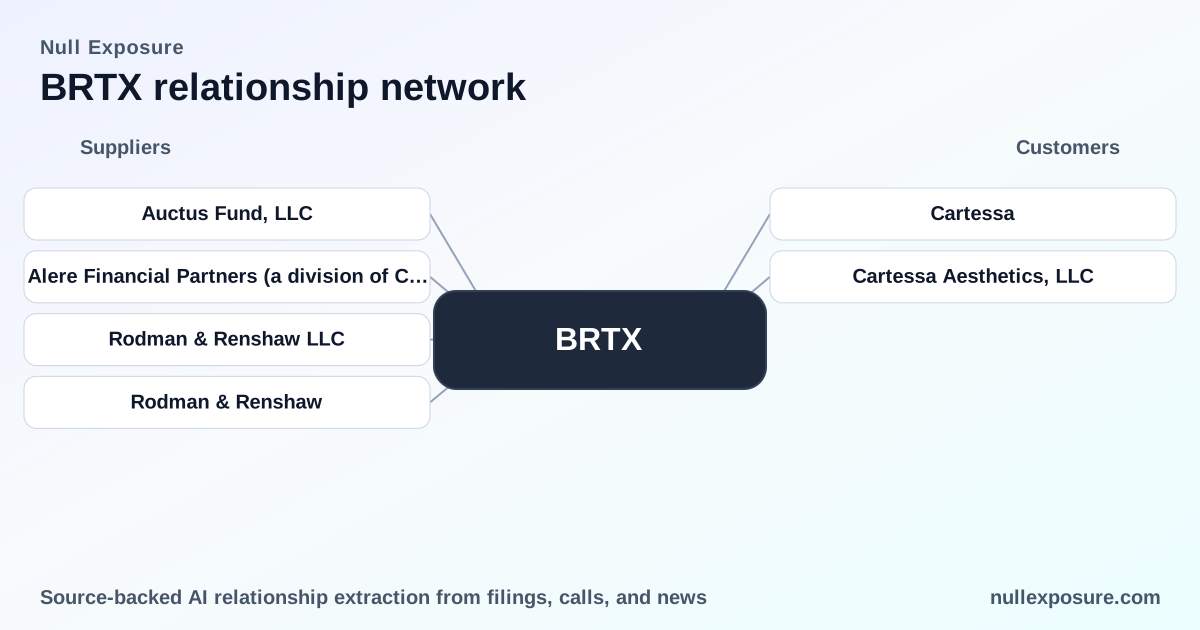
BRTX Customer Map: Cartessa Dominates BioRestorative’s Commercial Footprint
BioRestorative Therapies (NASDAQ: BRTX) operates as a small-cap regenerative-medicine developer that monetizes through a combination of product sales, contract manufacturing and royalty arrangements. The company’s current commercial revenue is concentrated in biocosmeceuticals that it manufactures and supplies under private-label arrangements, while licensing and royalty income is recorded as usage occurs; these revenue streams are supplemented by R&D-stage asset work. For investors evaluating customer risk, the decisive fact is concentration: a single commercial partner underpins the bulk of product and royalty receipts. For a concise profile and data-driven customer intelligence, visit https://nullexposure.com/.
Executive thesis: product supply plus royalties, anchored to one partner
BioRestorative’s operating model combines cGMP contract manufacturing of a cell-based serum with IP licensing that generates usage-based royalties. Commercial monetization is primarily through an exclusive, multi-year supply agreement and related private-label sales, while royalty lines reflect licensing arrangements that are concentrated with a single customer. That structure creates asymmetric operational exposure—stable minimum volumes from a long-term contract but meaningful concentration risk in near-term revenue.
The relationships you need to know (all results covered)
Cartessa
BioRestorative reported that a significant portion of its Q3-2024 and ongoing revenue derived from biocosmeceutical sales tied to an exclusive supply agreement with Cartessa; the company disclosed the five-year arrangement in April 2024. According to an earnings call transcript and the company’s Q3 2025 report, Cartessa is the recipient of private-label finished vials under the Chronos ExoCR mark and drives most product-sales revenue. Source: InsiderMonkey earnings call transcript (citing Q3-2025 commentary) — https://www.insidermonkey.com/blog/biorestorative-therapies-inc-nasdaqbrtx-q3-2025-earnings-call-transcript-1645501/.
Cartessa Aesthetics, LLC (GlobeNewswire disclosure)
In its third-quarter 2025 financial results press release, BioRestorative reiterated that Q3-2024 revenue of $233,600 consisted primarily of BioCosmeceutical sales under an exclusive supply agreement with Cartessa Aesthetics, LLC, confirming the commercial linkage and its materiality to reported product revenue. This release formalized the tie between the company’s biocosmeceutical product line and Cartessa’s North American distribution. Source: Company press release on GlobeNewswire (Nov 12, 2025) — https://www.globenewswire.com/news-release/2025/11/12/3186776/0/en/BioRestorative-Therapies-Reports-Third-Quarter-2025-Financial-Results-and-Provides-Business-Update.html.
Cartessa Aesthetics, LLC (StockTitan republication)
A market news outlet republished the company’s Q3-2025 financial statements noting the same revenue composition: the Q3-2024 comparables were driven primarily by the exclusive supply relationship with Cartessa, reinforcing the public narrative that Cartessa is the primary commercial customer for BioRestorative’s cosmeceuticals. This republication mirrors the company’s own disclosures. Source: StockTitan news republication (Mar 9, 2026) — https://www.stocktitan.net/news/BRTX/bio-restorative-therapies-reports-third-quarter-2025-financial-ov3q55ie7iqo.html.
What the disclosed constraints reveal about the operating model
BioRestorative’s public disclosures and extracted constraints produce a coherent picture of how the company runs its commercial business:
- Contracting posture: The company entered a five-year exclusive supply agreement with Cartessa in April 2024, creating a long-term, minimum-volume commitment that stabilizes product sales. This is a relationship-level fact tied explicitly to Cartessa.
- Revenue recognition mix: Product sales are recognized at the point of customer control transfer (spot recognition), while royalty receipts are recognized as usage-based royalties when underlying sales occur. The company reports that all royalty revenue is derived from a single customer, a company-level concentration signal that amplifies counterparty risk.
- Role and criticality: BioRestorative functions as seller, contract manufacturer and supplier of finished vials (using its cGMP ISO-7 clean room) for Cartessa, making the relationship operationally critical to the firm’s commercial segment.
- Geographic footprint: The contract specifically targets a North American market, while the company states an intention to market products globally—so immediate commercial exposure is North America-led, with optional expansion risk/opportunity elsewhere.
- Relationship maturity and status: The relationship is active and formally staged as multi-year, shifting the risk profile from one-off spot sales to longer-duration supply dynamics.
Collectively these signals point to a manufacturing-centric commercial rhythm with high counterparty concentration: predictable minimums from the long-term supply agreement offset the downside of having a single dominant buyer for both product sales and royalty flows.
Investor implications: concentrated upside, concentrated risk
- Revenue concentration: With product and royalty receipts materially tied to one customer, near-term top-line variability is subject more to counterpart performance and order cadence than to broad market adoption.
- Contract durability: The five-year exclusive supply agreement provides revenue visibility and minimum supply obligations, improving predictability for manufacturing throughput and working-capital planning.
- Operational exposure: As contract manufacturer and private-label supplier, BioRestorative’s cost base and margin profile are sensitive to production scale and any disruptions in Cartessa’s ordering or distribution.
- Licensing economics: Usage-based royalties create scalable upside if the partner expands market penetration, but the fact that all royalty revenue stems from a single customer concentrates licensing risk and reduces diversification benefits.
- Strategic optionality: The company’s stated intent to market globally is a structural upside; however, current commercial traction is North America-focused via the Cartessa relationship.
Key takeaways for operators and allocators
- Concentration is the defining commercial risk and strength: long-term contract provides stability, but single-customer reliance amplifies counterparty and demand risk.
- Operational role is manufacturing-first: expect capital allocation and operational attention to remain focused on production compliance, minimum-volume delivery and quality controls.
- Royalties are usage-based and concentrated: revenue can scale with partner success, but investors should treat royalty lines as tied to a narrow counterparty base until new licensors/customers emerge.
If you need a fast, shareable intelligence brief for portfolio diligence, NullExposure compiles these signals into investor-ready relationship maps — explore the platform at https://nullexposure.com/.
By combining the company’s public releases and third-party reporting, the relationship profile for BRTX is clear: Cartessa is the commercial anchor, the agreement is multi-year and active, and the company-level economics hinge on maintaining and scaling that partnership while diversifying future customer and royalty sources.