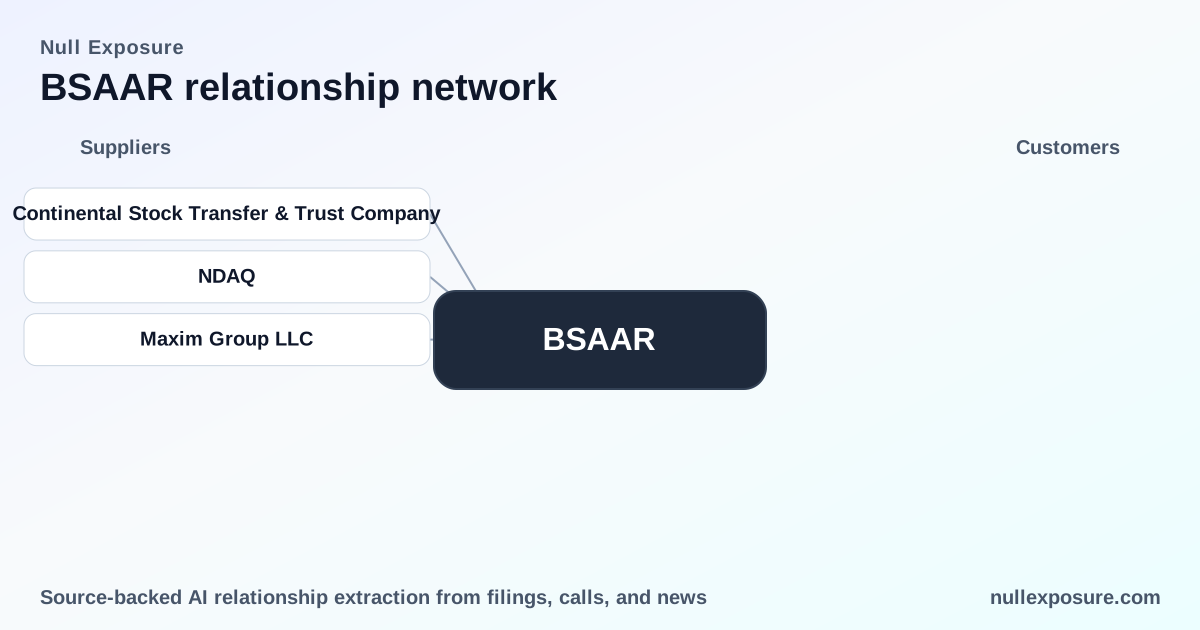
BSAAR: A SPAC rights vehicle with limited operating history — what investors and operators need to know
BEST SPAC I Acquisition Corp. (BSAAR) is a special-purpose acquisition vehicle that monetizes by selling IPO units and trading rights while seeking an initial business combination that will convert public capital into operating equity in a target company. BSAAR currently holds no operating revenue and derived its capital base from a $55.0 million IPO of 5.5 million units priced at $10.00 each; the economic story for investors is therefore entirely dependent on the success of a future merger or asset acquisition. For more on how BSAAR’s customer signals map to potential deal outcomes, visit https://nullexposure.com/.
How this SPAC is structured and where the value comes from
BEST SPAC I sold standard SPAC units in mid‑June 2025 and lists rights as a separate tradable instrument (BSAAR). The immediate economic mechanics are straightforward: the sponsor raised cash via the unit sale, and public investors hold rights and shares that will convert upon a successful business combination. According to the company’s IPO registration statement, the registration was declared effective June 12, 2025, and the offering was consummated on June 16, 2025, generating total gross proceeds of $55,000,000 from the sale of 5,500,000 units. This capital sits as the SPAC’s runway to pursue an acquisition; the rights instrument trades independently and captures optionality around the ultimate deal terms. The public profile shows no reported revenue, a book value of $0.341, and zero shares outstanding reported in the summary—consistent with a pure SPAC/rights structure without operating assets.
Customer relationships reported — one match and what it means
The customer-scope review returned a single relationship: the National Health Service (NHS).
- The National Health Service (NHS): A news item identifies Britain’s NHS as a primary customer in FY2021. A Nanalyze article published in June 2021 stated that “the primary customer back then was Britain’s National Health Service (NHS).” This item is recorded against BSAAR’s customer-scope results as a detected relationship (FY2021). (Source: Nanalyze coverage, June 2021.)
Why this single match is notable: the NHS is a large, creditworthy purchaser whose involvement can signal commercial validation for healthcare-related targets. However, BSAAR itself reports no operating revenue, so this customer match should be interpreted as an external commercial signal tied to target‑level activity rather than evidence of BSAAR’s own revenue stream.
Operating model signals and business model constraints investors must weigh
The available constraints and corporate profile point to several concrete operating characteristics for BSAAR:
- Contracting posture — seller: Public filings show BSAAR acted as an issuer in an IPO, selling 5.5 million units at $10.00 per unit and raising $55 million (registration statement effective June 12, 2025; offering consummated June 16, 2025). This confirms BSAAR’s immediate role is capital provider and sponsor vehicle rather than an operating vendor or service provider.
- Concentration — low observable customer diversity: Only a single customer relationship was detected in the customer-scope scan (the NHS). That narrow visibility suggests limited observed commercial footprint at the SPAC level; any meaningful revenue concentration would come from the business combination target, not BSAAR today.
- Criticality — low to the SPAC’s balance sheet today: With no reported revenue and zero operating margins, customer contracts carry no present criticality to BSAAR’s balance sheet; their importance is forward‑looking—relevant only if and when BSAAR consummates a merger and inherits or generates contract cash flows.
- Maturity — early stage / pre-combination: The corporate metrics and the rights instrument indicate a classic pre‑combination SPAC posture: capital raised, rights outstanding, and an acquisition mandate to be executed. Investors should treat BSAAR as an early-stage capital vehicle rather than a mature commercial operator.
These constraints are company-level signals derived from the IPO registration and the public profile rather than being attributable to any specific customer relationship.
(For deeper relationship analysis and aggregation across SPACs and targets, see https://nullexposure.com/.)
How to read the NHS match in context
Interpreting the NHS link for investment or operational decisions requires framing:
- Commercial validation potential: If the NHS match connects to a target that BSAAR will acquire, it implies potential access to a major public purchaser and the possibility of stable, large-scale contracting. That can materially de‑risk revenue forecasts for a healthcare or digital-health target. (Source: Nanalyze, June 2021.)
- Not an immediate cash driver for BSAAR today: Because BSAAR reports no revenue and functions as an acquisition vehicle, the NHS relationship does not translate to current cash flows for BSAAR’s public shareholders until a combination closes and the merged entity recognizes those contracts as revenue.
Risk factors, upside scenarios, and monitoring checklist
Investors and operators should prioritize the following items when evaluating BSAAR exposure:
- Redemption and timing risk: As with any SPAC, a high redemption rate at the point of combination can shrink deal proceeds and destroy expected upside. Monitor shareholder redemption trends leading up to any announced business combination.
- Deal identity and customer continuity: The single customer signal highlights how critical it is to know the target company; the value proposition depends on whether the target's customer base (for example, NHS) transfers to the merged public entity intact.
- Sponsor track record and governance: The sponsor’s ability to close a value-accretive combination and to manage post-merger integration directly governs shareholder outcomes. Review sponsor disclosures and related-party arrangements in deal filings.
- Balance sheet runway vs. transaction size: With $55 million raised at IPO, assess whether available cash is adequate for the intended target size or whether additional financing will be required, with dilution or leverage implications.
Bottom line: positioning for a binary payoff with detectable signals
BSAAR is a classic SPAC right — a capital-raising vehicle whose public valuation is contingent on a future acquisition event. The customer-scope review returned a single meaningful commercial signal — the NHS in FY2021 — which is relevant only as a potential indicator of target market access, not as current revenue for BSAAR. Company-level filings confirm the issuer role and the $55 million IPO proceeds (June 12–16, 2025), reinforcing that investors are buying deal optionality rather than operating cash flow today.
If your mandate is to evaluate acquisition risk and post-combination cashflow, prioritize diligence on the announced target’s customer contracts, NHS continuity (if applicable), and the sponsor’s execution plan. For ongoing monitoring of relationship-level intelligence and deal outcomes, check the analysis hub at https://nullexposure.com/.