Bolt Projects Holdings (BSLK): Customer Relationships That Drive Revenue and Risk
Bolt Projects Holdings monetizes proprietary sustainable materials—principally its Vegan Silk Technology platform and products like b-silk and xl-silk—by manufacturing and supplying specialty ingredients to large beauty and fashion brands and by selling finished materials for consumer goods. The company generates revenue through supply agreements with annual minimums, direct product sales to brand partners, and access to capital markets to fund scale-up; investor activity (including equity purchase arrangements) is an active lever for near-term liquidity. Learn more about our coverage at https://nullexposure.com/.
How Bolt operates in the commercial ecosystem
Bolt is positioned as a materials supplier and manufacturing partner for large consumer brands that want sustainable alternatives to conventional silk and leather. Revenue comes from product sales under supply contracts and purchase commitments rather than licensing alone, which creates operational exposure to production scale, fulfillment reliability and customer purchasing patterns. The company’s disclosures show high customer concentration and sizable minimum purchase commitments, a contracting posture that provides predictability but concentrates commercial risk.
Key company-level signals:
- Concentration: For the year ended December 31, 2024, one unnamed customer accounted for approximately 88% of revenue, indicating heavy dependence on a single counterparty.
- Contracting posture: Bolt reports a three-year supply agreement with annual minimum order quantities, consistent with a supplier role to enterprise customers.
- Spend bands and scale: Public excerpts reference minimum purchase requirements in the $1M–$10M range for multiple years, implying material but mid-sized account spend rather than purely token commercial trials.
- Geographic focus: The company’s commercially binding arrangements reference customers that operate primarily in North America, signaling a regional concentration in its near-term revenue base.
Customers and partners: what the public record shows
Below are the relationships captured in the public record, each with a short plain-English summary and a source for verification.
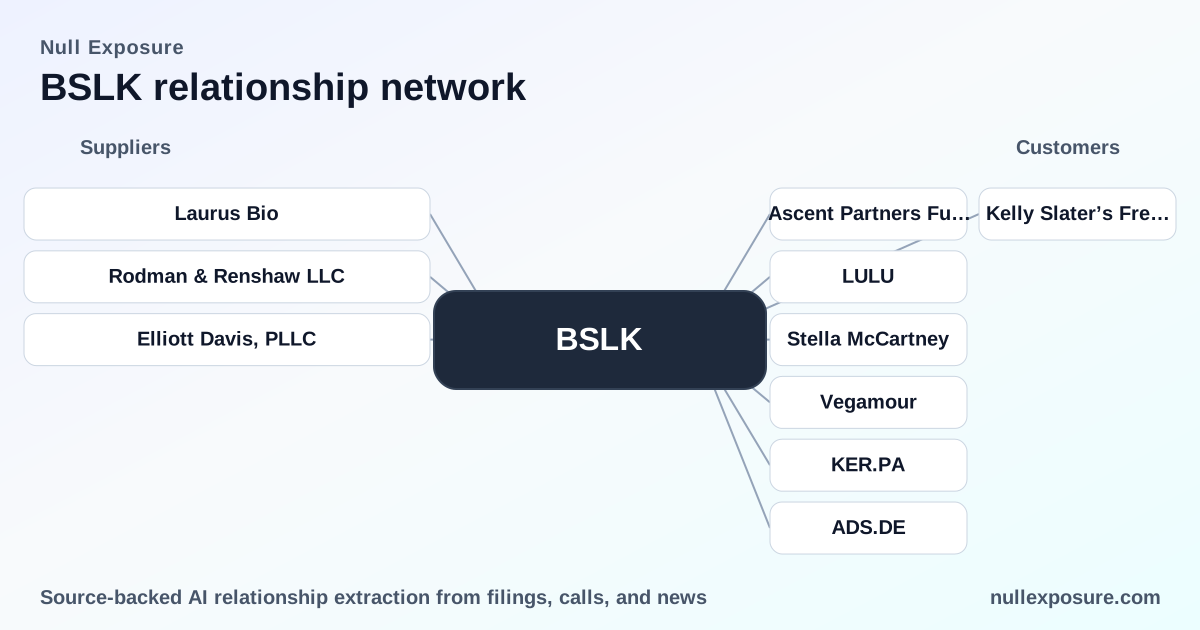
Ascent Partners Fund LLC
Bolt entered into an equity purchase agreement with Ascent Partners Fund LLC that allows the company to sell up to $20 million of common stock; this is a capital-market relationship that directly impacts Bolt’s funding runway and potential dilution for existing shareholders. (Globe and Mail press release, Sept 12, 2025 — https://www.theglobeandmail.com/investing/markets/stocks/BSLK/pressreleases/34848348/bolt-projects-holdings-secures-20m-equity-purchase-agreement/)
LULU
Lululemon has been named among fashion brands experimenting with Bolt’s mycelium-derived material Mylo in consumer products, indicating commerce and co-development interest from leading activewear labels. (Yahoo Lifestyle coverage of Bolt’s public listing, FY2023 context — https://www.yahoo.com/lifestyle/bolt-threads-goes-public-ceo-202840770.html)
Lululemon
The company appears in reporting both as LULU (ticker) and spelled out; coverage reiterates Lululemon’s involvement with Mylo for bags and mats, signaling multiple product use-cases within the brand’s assortment. (Same Yahoo Lifestyle article, FY2023 — https://www.yahoo.com/lifestyle/bolt-threads-goes-public-ceo-202840770.html)
Stella McCartney
Stella McCartney used a Mylo-based version of her Frayme bag on the Paris runway, demonstrating Bolt’s material has reached high-profile fashion placements and runway validation. (Yahoo Lifestyle reporting on Mylo at Paris Fashion Week, FY2023 — https://www.yahoo.com/lifestyle/bolt-threads-goes-public-ceo-202840770.html)
Vegamour
Bolt’s b-silk product has been commercially incorporated into consumer formulations, with Vegamour listed among brands featuring b-silk in products such as haircare or cosmetic lines since at least 2020. This is an example of Bolt’s materials being adopted by beauty retailers and direct-to-consumer brands. (SynBioBeta report on Bolt’s public debut, FY2024 — https://www.synbiobeta.com/read/bolt-threads-completes-merger-with-golden-arrow-debuts-as-publicly-traded-company)
Kering
Kering is reported as part of a consortium of major fashion groups that evaluated Mylo for commercialization, reflecting strategic industry-level interest from high-end luxury conglomerates. (Yahoo Lifestyle article describing a consortium of brands evaluating Mylo, FY2023 — https://www.yahoo.com/lifestyle/bolt-threads-goes-public-ceo-202840770.html)
Adidas
Adidas is cited as experimenting with Mylo (for example, a mushroom-clad Stan Smith prototype), indicating product development collaborations in athletic and lifestyle footwear. (Yahoo Lifestyle coverage, FY2023 — https://www.yahoo.com/lifestyle/bolt-threads-goes-public-ceo-202840770.html)
ADS.DE
The ADS.DE listing in the records corresponds to the same Adidas references above; reporting uses both corporate and market ticker nomenclature to describe Adidas’ engagement with Mylo. (Yahoo Lifestyle, FY2023 — https://www.yahoo.com/lifestyle/bolt-threads-goes-public-ceo-202840770.html)
Kelly Slater’s Freaks of Nature
Bolt’s b-silk has been incorporated into formulations like the Freaks of Nature sunscreen, showing cross-category adoption of Bolt’s silk-derived ingredients beyond apparel and into personal care. (SynBioBeta report on Bolt’s merger and product placements, FY2024 — https://www.synbiobeta.com/read/bolt-threads-completes-merger-with-golden-arrow-debuts-as-publicly-traded-company)
(If you want a consolidated view of these commercial ties and material adoption across categories, visit https://nullexposure.com/.)
Commercial implications and constraints for investors and operators
Bolt’s commercial model combines long-term supply contracts with a small number of materially important customers, which yields both revenue visibility and execution risk.
- Revenue concentration creates valuation sensitivity. With one customer contributing roughly 88% of revenue in 2024, a single contract renewal or purchase behavior change would meaningfully affect topline performance. This is a strategic vulnerability for investors and an operational priority for operators.
- Contractual minimums improve predictability but increase delivery risk. Three-year supply terms and annual minimum purchase commitments provide forward revenue visibility, but they impose capacity and fulfillment obligations that require reliable manufacturing scale-up.
- Spend band signals indicate mid-single-digit million-dollar account economics. Minimums in the $1M–$10M range signal meaningful commercial traction while leaving room for both upsell and churn.
- North America concentration limits geographic diversification. Reported customer operations tied to the United States concentrate demand and expose Bolt to regional market cycles and sourcing/regulatory shifts.
What to watch next
- Contract renewals and any disclosure naming the customer that drove ~88% of revenue. A formal naming or loss would materially re-rate revenue risk.
- Execution on manufacturing scale and fulfillment timelines tied to multi-year minimums. Missed deliveries would trigger revenue shortfalls.
- Commercial launches and shelf placements with the brands listed above—proof of broader retail adoption will reduce concentration risk.
- Capital activity such as the $20M equity purchase agreement with Ascent Partners Fund LLC that affects liquidity and dilution. (Globe and Mail press release, Sept 12, 2025 — https://www.theglobeandmail.com/investing/markets/stocks/BSLK/pressreleases/34848348/bolt-projects-holdings-secures-20m-equity-purchase-agreement/)
Final takeaway: Bolt has demonstrable commercial placements with major fashion and beauty brands and a supplier business model that can scale revenue predictably if manufacturing and customer diversification follow suit. The current financial profile is dominated by a single large customer and short-term capital actions, so progress on customer diversification and operational delivery will determine whether Bolt’s materials transition from niche proof points to a durable revenue base.
For deeper diligence and ongoing coverage, visit https://nullexposure.com/.