Black Stone Minerals (BSM): Customer Map and What It Means for Investors
Black Stone Minerals monetizes subsurface mineral and royalty interests by collecting royalties and non‑operated working‑interest proceeds as third parties develop wells on its acreage. The partnership sells oil and natural gas when control transfers to the purchaser and extracts value from multi‑year development agreements that convert previously idle acreage into predictable future cash flows. For investors, the key levers are acreage conversion through development agreements, diversified operator exposure across >1,000 counterparties, and pockets of concentrated revenue tied to large operators. Learn more about our coverage at https://nullexposure.com/.
Why customer relationships matter for a minerals LP
Black Stone’s business is not exploration risk; it is portfolio management of mineral ownership and contract capture. Operators bring capital, crews and drilling programs; BSM collects a slice of production without operating risk. The economics therefore hinge on operator commitments (drilling obligations), commodity prices on sale dates, and the geographic focus of acreage that attracts repeat developers. Recent development agreements moved large tracts of acreage into active programs and materially increase drilling visibility for the next five years.
The counterparties turning acreage into cash
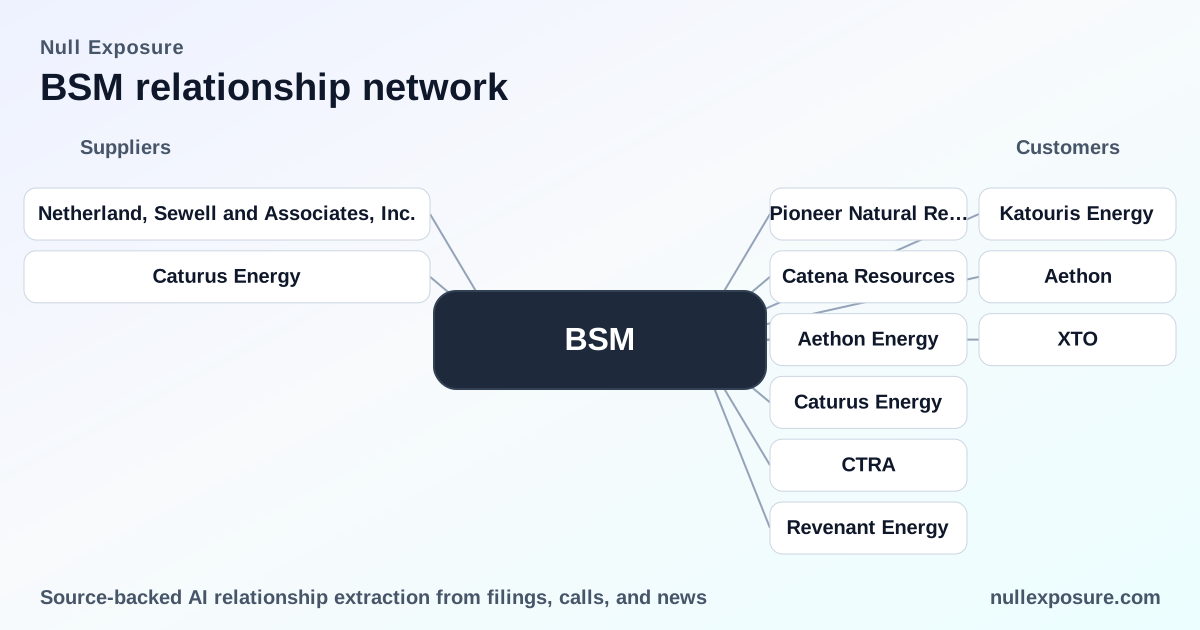
Below I catalogue every counterparty mentioned in the source material and summarize the relationship in plain English. Each short entry links the claim to the filing or press coverage that disclosed it.
-
Pioneer Natural Resources — According to Black Stone’s 2024 Form 10‑K, Pioneer (along with XTO Energy) represented a material portion of oil and gas revenues, together accounting for roughly 13% of oil and natural gas revenues in FY2024, signaling meaningful revenue concentration among large operators. (Form 10‑K, FY2024)
-
XTO Energy (XTO) — ExxonMobil’s XTO Energy is named alongside Pioneer in the 2024 Form 10‑K as a major purchaser of BSM production, forming part of the 13% revenue slice noted for FY2024 and underscoring reliance on major integrated operators for mid‑cycle cash flows. (Form 10‑K, FY2024)
-
Aethon Energy (Aethon) — Management disclosed development agreements with Aethon in the Q4 2025 earnings transcript published in February 2026 and in the Q4 results release, where Aethon operated rigs across BSM acreage in the Shelby Trough; Aethon’s programs contribute to a roughly 50‑well aggregate program mentioned by management. (Q4 2025 earnings transcript, Feb 24, 2026; InvestingNews Q4 2025 release)
-
Catena Resources — Black Stone highlighted a signed development agreement with Catena in its Q4 2025 earnings discussion, placing Catena among active developers that will convert acreage to producing wells under contract terms disclosed in management remarks. (Earnings transcript press release, Feb 24, 2026)
-
Caturus Energy — In December 2025 Black Stone announced a multi‑year development agreement with an affiliate of Caturus covering 220,000 gross acres in the Shelby Trough and Haynesville expansion, positioning Caturus as a strategic partner for large‑scale Haynesville development. (SahmCapital coverage; Q4 2025 commentary)
-
Coterra Energy (CTRA) — Management singled out high interest activity from Coterra and ongoing development in the Southern Delaware, indicating Coterra is actively developing BSM acreage and is a notable non‑operated developer for the partnership. (Q4 2025 earnings call transcript; InvestingNews)
-
Revenant Energy (Revenant) — Black Stone executed a development agreement with Revenant covering 270,000 gross acres (BSM controls ~122,000 undeveloped net acres within that area) and contractually committed Revenant to minimum drill counts that escalate to 25 wells per year over the next five years—making Revenant critical to forecasted gas production growth. (Q3 and Q4 2025 results commentary; InvestingNews)
-
Katouris Energy — Management stated it signed a development agreement with Katouris that, combined with other partners, brings approximately 500,000 gross acres under development commitments, adding another mid‑sized operator into BSM’s active development cohort. (MarketBeat coverage of Q4 2025 highlights)
Each of the relationships above is corroborated in public filings and investor releases or in earnings call transcripts and market reports cited in the relevant Q4 2025 and FY2024 disclosures.
What these relationships imply about operating risk and upside
Black Stone’s counterparties convert acreage into production; the quality of those counterparty agreements drives visibility on future volumes and distributable cash flow.
-
Concentration and counterparty scale. While Black Stone reports revenue from over 1,000 operators, a small number of large partners account for a meaningful share of revenues—evidenced by the Pioneer/XTO 13% disclosure in the FY2024 10‑K. That dynamic concentrates some revenue risk with large, creditworthy operators but amplifies upside when those operators increase activity.
-
Contracting posture: primarily spot sales with development overlays. The company recognizes sales when control transfers and references prevailing purchaser prices at delivery, a posture consistent with transactional (spot) sales on production while layering multi‑year development agreements that impose drilling obligations. This mix preserves price exposure but injects programmatic development optionality via acreage deals.
-
Geographic focus and scale. All production is U.S.‑based, concentrated in basins where BSM owns minerals and royalties (Shelby Trough, Haynesville, Southern Delaware, Culberson County). That concentrated geography helps operators plan contiguous development programs and underpins the multi‑acreage development agreements that add predictability.
-
Maturity and stage. The evidence shows active relationships and multi‑year development commitments rather than one‑off transactions—Revenant’s phased drilling minimums and Caturus’s 220k‑acre agreement are examples of committed programs that accelerate maturity of BSM’s undeveloped inventory.
Risks and what investors should watch
-
Operator execution risk. Development agreements carry drilling minimums, but actual well timing and productivity affect near‑term cash flow. Investors must watch operators’ capital plans and rig activity on Shelby Trough and Haynesville acreage.
-
Commodity price exposure at sale date. BSM sells production when control transfers, so realized prices track purchaser pricing on delivery, exposing cash flows to short‑term price swings even as acreage contracts provide some volume visibility.
-
Concentration shifts. While management cites revenue from 1,000 operators, large operators still account for outsized shares; any change in activity from a top operator will have a measurable effect on distributable cash flow.
Bottom line and how to monitor the thesis
Black Stone is not a producer in the conventional sense; it is a portfolio owner whose earnings scale with operator activity on its acreage and with the terms of development agreements that convert inventory into production. Recent multi‑year agreements with Revenant, Caturus, Aethon, Katouris and others place ~500,000 gross acres into development, materially improving volume visibility and the partnership’s growth optionality (Q4 2025 disclosures). For a concise tracker of counterparty developments and to read these source documents directly, visit https://nullexposure.com/.
For investors evaluating BSM, focus on operator drilling pace, rig counts on the Shelby Trough and Haynesville, and quarterly disclosures that report realized volumes and counterparties contributing to revenue; those signals determine whether the development agreements translate into sustained distributable cash flow growth.