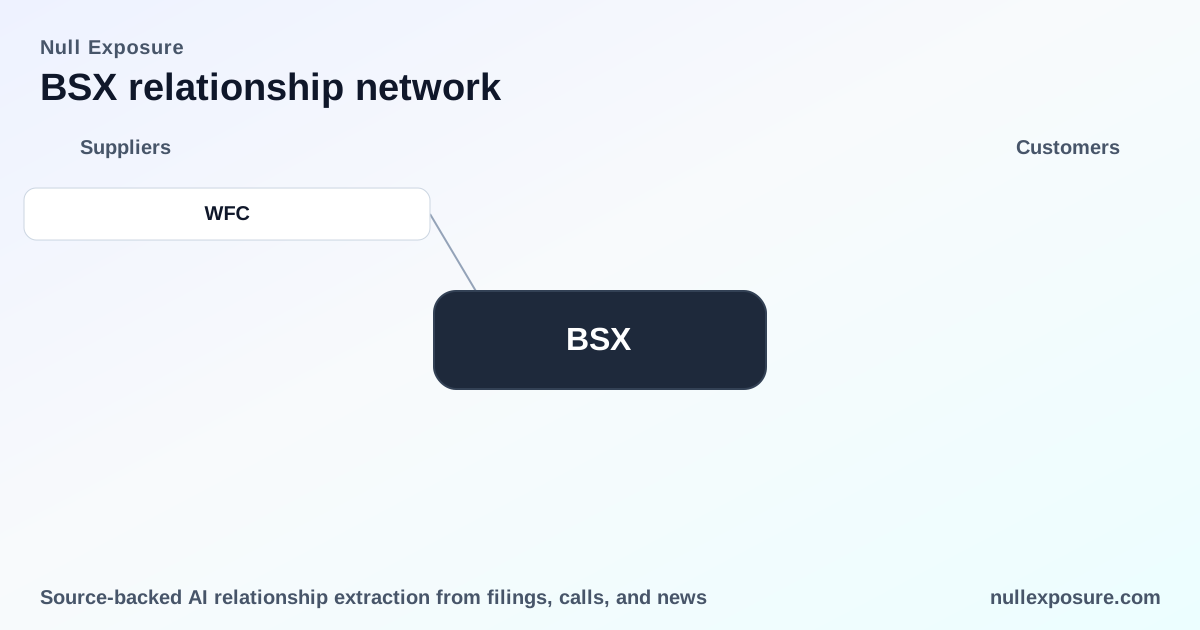
Boston Scientific (BSX): Customer Relationships, Commercial Constraints, and What Investors Should Watch
Boston Scientific designs and sells interventional medical devices across a broad set of specialties and monetizes through direct device sales, recurring service arrangements (notably remote patient management subscriptions), and an extensive mix of distributors and hospital group contracts that capture large institutional spend. The company's commercial model blends high-margin implantable devices with subscription-style service revenue and channel partnerships, with cardiology products accounting for roughly half of consolidated sales. For a deeper look at how these customer relationships translate into commercial advantage and risk, visit https://nullexposure.com/.
Quick read: what matters for investors
- Scale and concentration: Boston Scientific generates meaningful scale — $20.6 billion TTM revenue — with Cardiology representing ~50% of consolidated sales, making customer dynamics in that segment strategically critical.
- Mixed contracting posture: Revenue combines one-off device sales and subscription-like deferred revenue for patient-management services, which smooths cash flow but requires multi-year service commitments.
- Channel complexity: The company sells direct, through a global distribution network, and via hospital group purchasing organizations (GPOs) and dealers, creating both breadth and counterparty complexity.
- Geographic footprint: Operations and fulfillment are global, with major presence in North America, EMEA, APAC, and LATAM — each region carries different payment and procurement behaviors that affect working capital.
How Boston Scientific works with partners — the Elutia example
Boston Scientific acts as a sales agent for Elutia, leveraging its commercial field organization to accelerate Elutia's market access. A MedTech Dive report in May 2026 noted that BSX provides Elutia access to approximately 900 sales representatives and clinical specialists to complement Elutia’s direct sales force, a relationship structured to expand reach without BSX absorbing product ownership. (MedTech Dive, May 2, 2026: https://www.medtechdive.com/news/boston-scientific-88m-elutia-deal/759711/)
This relationship typifies how Boston Scientific monetizes channel leverage: the company converts commercial coverage into incremental revenue or partnership economics while preserving capital-light access to adjacent technologies.
Company-level constraints that shape customer economics
Investors should view several constraints as structural signals of how Boston Scientific contracts and manages customers. These are company-level characteristics drawn from public filings and disclosures.
- Contract type — subscription elements present and material: Boston Scientific recognizes deferred revenue from services such as the LATITUDE™ Patient Management System, recognizing revenue over the service life tied to device and patient longevity. This creates recurring revenue that improves visibility but requires ongoing service delivery and lifecycle management. (Company filing excerpts on LATITUDE service revenue recognition.)
- Counterparty mix — government and large enterprise exposure: Sales to government-owned or supported customers (notably in southern Europe) exhibit longer receivable cycles, elevating working-capital risk in certain geographies. Additionally, large group purchasing organizations, hospital networks, and buying groups represent a substantial portion of net sales, concentrating commercial exposure to a relatively small set of institutional buyers. (Company filing excerpts on government customers and GPOs.)
- Geographic coverage — truly global with regional idiosyncrasies: Boston Scientific markets in 127 countries and uses fulfillment centers in Massachusetts, the Netherlands, Malaysia, and Japan. Revenue footprints show significant sales in North America, EMEA, APAC, and LATAM, each with distinct payment and procurement practices. (Company filing excerpts on global footprint and distribution centers.)
- Materiality and segment concentration: Cardiology products generated $8.344 billion and accounted for 50% of consolidated net sales in 2024, a structural concentration that amplifies the importance of cardiology customers and reimbursement trends. (Company filing excerpt on Cardiology net sales.)
- Channel roles — buyer and distributor dynamics: Boston Scientific both buys through and sells into GPOs and distributors; it also operates as a distributor/agent in certain markets, creating two-way channel exposure that can compress margins or shift risk depending on contract terms. (Company filing excerpts on distributors and buying groups.)
Commercial implications and runway
The combination of a large direct salesforce, recurring service offerings, and partnership-led distribution creates predictable levers for growth and margin expansion. Key operational realities for investors:
- Salesforce leverage lowers customer-acquisition cost for partners. Acting as a sales agent for early-stage technology companies (as with Elutia) allows BSX to capture downstream economics without the capital intensity of in-house product development.
- Subscription revenue increases lifetime value but requires retention and device durability. LATITUDE-style service streams deliver recurring revenue but demand sustained clinical performance and ongoing software/service support.
- Regional payment behavior drives working capital. Collections cycles in government-dominated markets (southern Europe) lengthen DSO and increase receivable risk; in contrast, North American institutional payers settle faster but demand high compliance and documentation.
- Fulfillment architecture supports global scale but necessitates supply-chain resilience. Primary distribution centers across continents mitigate geographic risk but create complexity in inventory management and regulatory compliance.
For investors wanting a consolidated view of BSX’s partner strategy and its implications for revenue durability and receivables, explore full coverage at https://nullexposure.com/.
Risks to monitor (operational checklist)
- Counterparty concentration risk: Heavy reliance on GPOs and hospital networks concentrates negotiating power and could compress realized pricing.
- Government receivable exposure: Slow payment cycles in certain regions can spike working-capital needs and affect short-term liquidity metrics.
- Subscription retention risk: Declines in remote-patient monitoring adoption or device longevity shifts will reduce deferred-revenue tails.
- Channel conflict and margin leakage: Agent/distributor arrangements—useful for market access—can dilute margins or complicate warranty and liability chains.
- Geographic regulatory and reimbursement shifts: Changes in reimbursement policy across EMEA or APAC could materially alter demand for cardiology devices.
Closing read: what this means for valuation and monitoring
Boston Scientific combines scale in high-value cardiology devices with recurring service revenue and a flexible commercial model that includes acting as an agent for third-party innovators. This mix creates durable revenue streams but concentrates business risk in a few institutional channels and geographic payment behaviors. For investors, the most impactful monitors are: cardiology procedure volumes and reimbursement trends; growth and retention of LATITUDE-like services; receivable days in government-heavy markets; and the success of channel partnerships in converting coverage into incremental, profitable revenue.
If your diligence requires mapping customer-driven cash-flow sensitivity or tracking partner-based rollouts, detailed relationship coverage is available at https://nullexposure.com/.