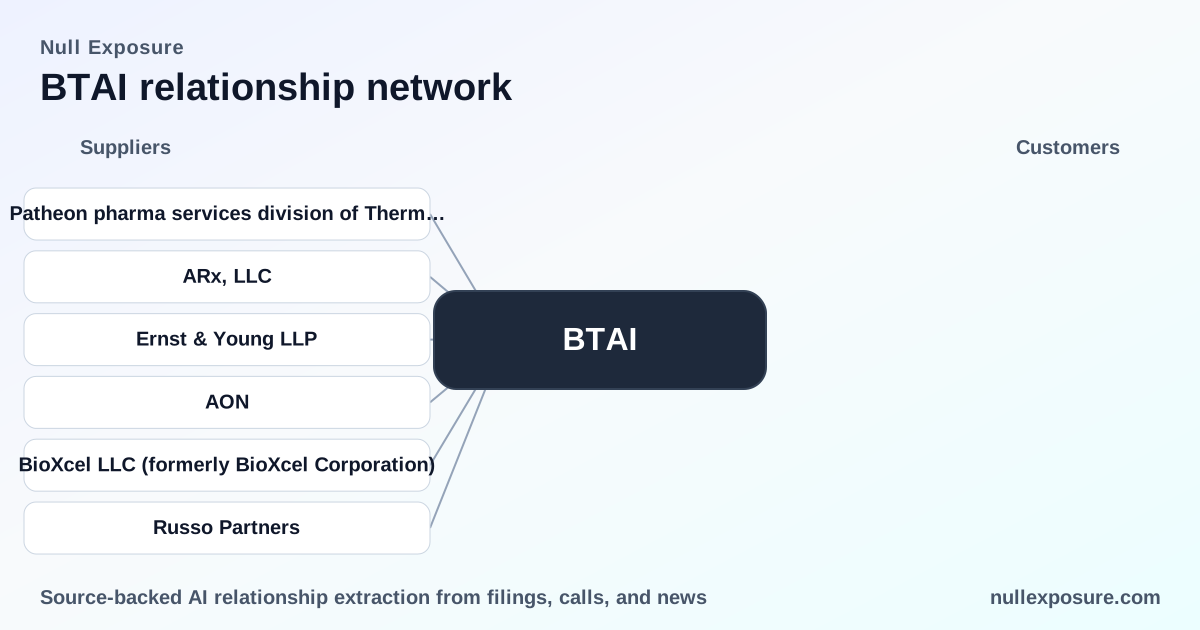
BioXcel Therapeutics (BTAI): Customer Relationships and Commercial Implications
BioXcel Therapeutics develops and commercializes neuroscience-focused therapeutics and monetizes through product sales (most notably IGALMI®) and clinical supply agreements. The company sells IGALMI through distributors, wholesalers, and GPO channels in North America while supplying clinical-stage compounds such as BXCL501 for investigator-initiated and government-funded trials, creating a hybrid revenue and strategic-collaboration model that blends early commercial receipts with research-driven supply relationships. For detailed, source-linked customer mapping visit https://nullexposure.com/.
Investment thesis up front
BioXcel combines a small but growing commercial franchise (IGALMI) with ongoing clinical collaborations that expand clinical evidence and market access. Commercial revenues are currently concentrated and modest—IGALMI product sales generated roughly $2.3 million in 2024—while clinical supply agreements and government-funded studies provide strategic validation of pipeline candidates and potential demand signals for later commercialization. The company’s revenue base will scale only if distribution, reimbursement, and hospital/IDN contracting convert trial- and supply-driven recognition into sustained uptake.
What the UNC collaboration means for investors
- University of North Carolina at Chapel Hill (UNC) Institute for Trauma Recovery — The UNC Institute is leading a double-blind, placebo-controlled trial (NCT06943404) that will enroll 100 patients with acute stress reactions after motor vehicle collisions, and BioXcel is supplying BXCL501 for the study. This collaboration represents a non-commercial, clinical-supply relationship that advances clinical evidence for BXCL501 in acute stress reactions. (GlobeNewswire press release, April 8, 2026.)
The full set of customer/partner relationships covered
The available records list a single named customer/partner relationship in the monitoring window: the UNC Institute for Trauma Recovery. That relationship is a clinical collaboration in which BioXcel supplies investigational product for a government-funded trial. According to the GlobeNewswire announcement on April 8, 2026, the trial is funded by the U.S. Department of Defense and is designed to evaluate sublingual dexmedetomidine (BXCL501) for acute stress reactions following motor vehicle collisions, with BioXcel providing study drug supply.
How customer signals map to BioXcel’s operating model
The relationship evidence and corporate disclosures generate a coherent set of operating characteristics that matter for credit and commercial diligence:
- Contracting posture — short-term commercial payment terms. Company disclosures indicate customer payment terms generally range from 30 to 75 days, which signals transactional, invoice-driven settlement rather than extended financing arrangements. This reduces receivables duration but preserves cash dependency on near-term product uptake.
- Counterparty mix — government and large enterprise exposure. BioXcel participates in U.S. government pricing programs (including the Medicaid Drug Rebate Program) and structures commercial distribution through large institutional channels (distributors, wholesalers, GPOs and Integrated Delivery Networks). These buyers and payors exert pricing pressure and administrative complexity but also enable scale when reimbursement and contracting succeed.
- Concentration and materiality — a meaningful single-customer share. One customer accounted for approximately 32% of net product revenue in 2024 (39% in 2023), a sign that sales are concentrated and revenue is sensitive to a small number of large purchasers.
- Role clarity — seller to hospitals and distributor intermediaries. The company positions itself as the product supplier and contract counterparty while relying on third-party distributors and wholesalers to process and fulfill hospital orders, consistent with a hub-and-spoke commercial model tailored to institutional customers.
- Geographic go-to-market — North America first, EMEA as a future expansion. Sales and distribution are currently U.S.-focused with mention of regulatory and reimbursement challenges for EU/EMEA commercialization; the company must secure separate approvals and payer arrangements to replicate U.S. revenue abroad.
- Maturity profile — early commercial plus active clinical programs. IGALMI launched commercially in July 2022 and generated low-single-digit millions in revenue in 2024, while the BXCL501 program remains clinically active through investigator- and government-funded studies that the company supports via product supply.
These signals combine into a profile of a therapeutics company with modest current commercialization, material customer concentration, dependency on institutional contracting, and strategic use of clinical collaborations to de-risk indications and generate market interest.
Financial and commercial context investors need to keep front of mind
- Revenue scale: IGALMI net product revenue was approximately $2.3 million in 2024, up from $1.4 million in 2023, indicating initial commercial traction but still limited scale.
- Distribution model: The company distributes through a network of distributors, wholesalers and GPOs and is pursuing IDN contracting with a Corporate Account Director team to take a top-down contracting approach with large hospital systems.
- Reimbursement exposure: Participation in federal and state pricing programs (including Medicaid rebates) is a structural element of U.S. commercialization and a necessary precondition for hospital uptake; it also constrains net pricing.
- Short payment cycle: Payment terms of 30–75 days suggest low financing risk from receivables but high reliance on near-term sales performance.
Risks and upside drivers, stated plainly
- Key risks: High customer concentration, slow IDN contracting and adverse federal/state pricing decisions will compress margins and stall growth; limited revenue scale increases sensitivity to any single distributor or hospital purchasing decision. Clinical results from BXCL501 trials are binary catalysts that will affect regulatory and commercial prospects.
- Upside drivers: Positive clinical data from government- or investigator-funded studies, broader IDN contracts converting into recurring hospital adoption, and favorable payer reimbursement outcomes would materially increase revenue scale from current levels.
Relationship-by-relationship takeaway (concise)
- UNC Institute for Trauma Recovery — The UNC-led, Department of Defense-funded double-blind trial (NCT06943404) will enroll 100 patients with acute stress reactions; BioXcel is supplying BXCL501 to the study, providing clinical validation and potential demand signal if results are favorable. (GlobeNewswire press release, April 8, 2026.)
For a consolidated view of BioXcel’s customer exposures, revenue concentration, and source links to filings and press releases, see the company page at https://nullexposure.com/. If you need a custom breakdown of customer risk by spend band and contracting posture, explore our research portal at https://nullexposure.com/.
Bold takeaway: BioXcel is transitioning from early commercial sales toward scale, but current revenue remains concentrated and highly dependent on distributor/IDN conversion and positive clinical outcomes.