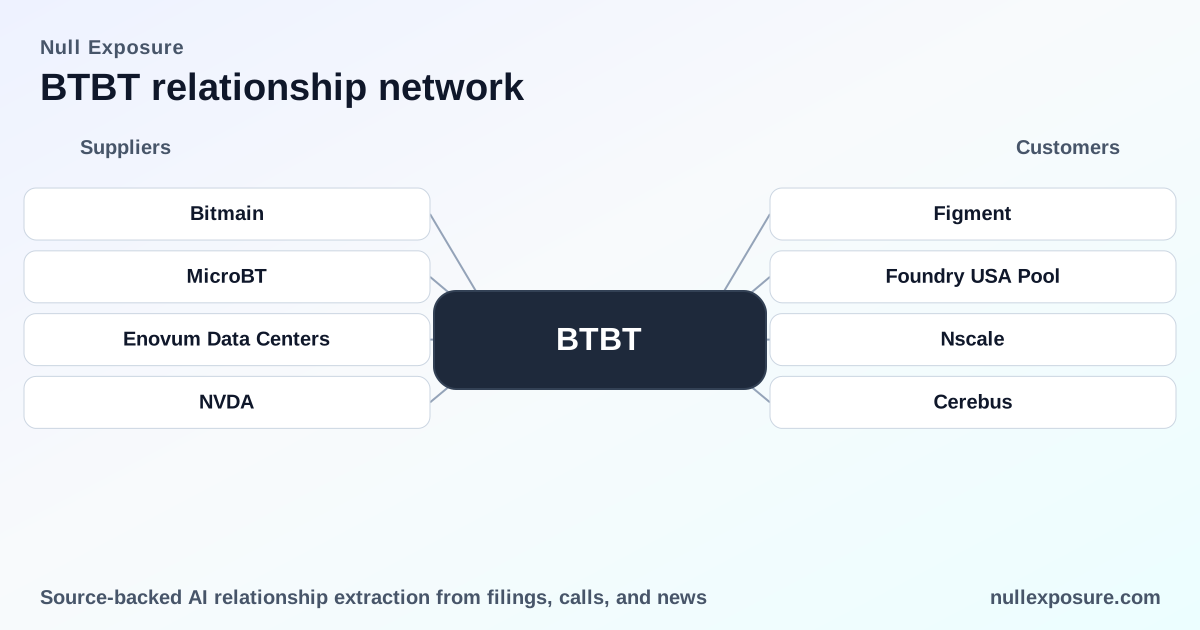
Bit Digital (BTBT) — customer relationships that anchor a transition from mining to cloud
Bit Digital monetizes by operating as a vertically integrated crypto-mining and high-performance computing (HPC) services provider: it generates revenue from digital asset mining (bitcoin receipts and staking rewards) while concurrently building a cloud/GPU colocation and managed HPC business that sells time, space and compute under a mix of multi-year and short-term contracts. The company’s go-forward economics are anchored by mining payouts and a growing book of cloud contracts, including large, multi‑year GPU supply and hosting commitments that materially shape revenue visibility. For a full customer map and signals, see https://nullexposure.com/.
Why the customer list matters to investors
Bit Digital operates in two distinct revenue modalities that produce different risk/return profiles. Mining revenue is inherently price-volatile and paid in digital assets, while the cloud/HPC business is contract-driven, with explicit evidence of both long-term, high-value deals and shorter, usage-based arrangements that create mixed predictability.
- Contract posture: The company’s filings describe average cloud contract terms ranging from 1–5 years and specific enterprise/AI contracts anticipated at 4–12 years, alongside month-to-month and six-month GPU orders. This structure gives Bit Digital a hybrid revenue base: meaningful recurring revenue from longer leases and sensitivity to utilization and spot demand from short-term GPU customers.
- Concentration and materiality: In FY2024 the company reported two customers that together represented over 96% of consolidated revenue (54.2% and 42.6% respectively), an acute concentration that elevates counterparty and renewal risk.
- Scale of commitments: The filing documents a contemplated supply of 4,096 GPUs over three years worth ~$275 million, and constraints data also flag at least one contract in the $100m+ spend band, indicating very large enterprise counterparties.
- Geography and footprint: Revenue and operations span the U.S., Europe (Iceland) and Asia (Hong Kong), providing operational diversification but also exposing the business to multiple regulatory and power-cost regimes.
- Role complexity: Company-level signals show Bit Digital is both a service provider (mining pool participant, colocation and cloud services vendor) and an active hardware counterparty — sourcing, provisioning and capitalizing GPU capacity to meet contractual obligations.
These facts convert into a clear investor tradeoff: high upside if large, multi-year cloud contracts retain utilization and pricing, and ongoing mining yields benefit from crypto cycles; high downside if the major customers do not renew or crypto prices fall.
Customer relationships called out in public sources
Foundry USA Pool — mining pool counterparty (FY2024)
Bit Digital received 949.9 bitcoins from the Foundry USA mining pool during the year ended December 31, 2024, reflecting the company’s role as a mining pool contributor and a direct source of digital-asset revenue. This disclosure is documented in the company’s FY2024 Form 10‑K.
Source: Bit Digital FY2024 Form 10‑K (reporting period: year ended December 31, 2024).
Figment — Ethereum staking operator (FY2024)
Bit Digital stakes ETH with Figment using network-based smart contracts to validate transactions and earn staking rewards, evidencing a staking/revenue model in addition to proof-of-work mining. This activity is described in the FY2024 Form 10‑K.
Source: Bit Digital FY2024 Form 10‑K (FY2024).
Nscale — large GPU/cloud contract announced by management (FY2026)
Management publicly stated that Bit Digital signed an $865 million contract with Nscale, positioning this as a major enterprise commitment in the company’s pivot to AI and GPU compute services. The disclosure came during management commentary reported in March 2026.
Source: Management remarks reported by Proactive Investors (March 9, 2026).
Cerebus — named enterprise client referenced by management (FY2026)
Management also listed Cerebus as a client in the same March 2026 public remarks, signaling customer adoption among institutional AI/compute users concurrent with the Nscale announcement. The mention is part of the same news report covering management’s commercial updates.
Source: Management remarks reported by Proactive Investors (March 9, 2026).
How relationship signals translate to operating constraints
Company-level constraints drawn from filings and disclosures give investors actionable context about the business model rather than isolated metrics:
- Contract mix and durability: The paperwork establishes a mix of long-term enterprise leases (multiple years and explicit 3–12 year planning horizons) alongside short-term/month-to-month and six-month orders; management also recognizes usage-based billing for GPU hours, which resolves revenue recognition variability on a daily basis. This combination drives a revenue curve that is partly predictable and partly elastic to demand.
- High customer concentration: The FY2024 disclosure that two customers generated 54.2% and 42.6% of revenue is a corporate-level signal of concentration risk that supersedes any single contract line item and compresses margin levers if pricing pressure emerges.
- Material enterprise spend: Evidence of a $275 million, three-year GPU supply and an $865 million contract referenced by management indicate Bit Digital’s revenue profile includes very large enterprise deals that materially affect near‑term top-line and capacity planning.
- Geographic and segment diversification: Cloud and mining revenue spans U.S., EMEA (Iceland) and Asia, and operating segments include digital asset mining, Ethereum staking, cloud services and colocation, which mitigates single-market chokepoints while introducing cross-jurisdictional operational complexity.
- Active stage and maturity: Filings show the cloud services business commenced in January 2024 and is already generating multi‑million-dollar revenue lines, demonstrating early commercial traction but limited track record, which investors should weigh against the scale of headline contracts.
Investor takeaway and actionable outlook
Bit Digital is consolidating a hybrid business that combines commodity-exposed mining receipts and contractual, enterprise-grade GPU/cloud services. The combination yields asymmetric outcomes: successfully executed long-term GPU contracts and sustained utilization would de-risk a high-fixed-cost base, while the current extreme customer concentration and crypto price exposure present clear downside.
- Key strengths: large multi‑year commercial commitments, geographic footprint across power-advantaged regions, and multiple monetization channels (bitcoin mining, ETH staking, cloud services).
- Key risks: revenue concentration, dependence on crypto prices for mining economics, and execution risk in scaling GPU colocation margins to match the headline contract values.
For an investor or operator tracking counterparties and contractual signals, Bit Digital’s public disclosures and management statements are decisive: the company is moving from a pure mining play to a scale-oriented HPC services provider anchored by a handful of large contracts — a shift that transforms both upside potential and concentration risk. Learn more about customer-level signals and relationship mapping at https://nullexposure.com/.
Bold focus on contract retention, utilization metrics and customer diversification will determine whether Bit Digital’s transition delivers durable enterprise revenue or amplifies volatility from its digital-asset legacy.