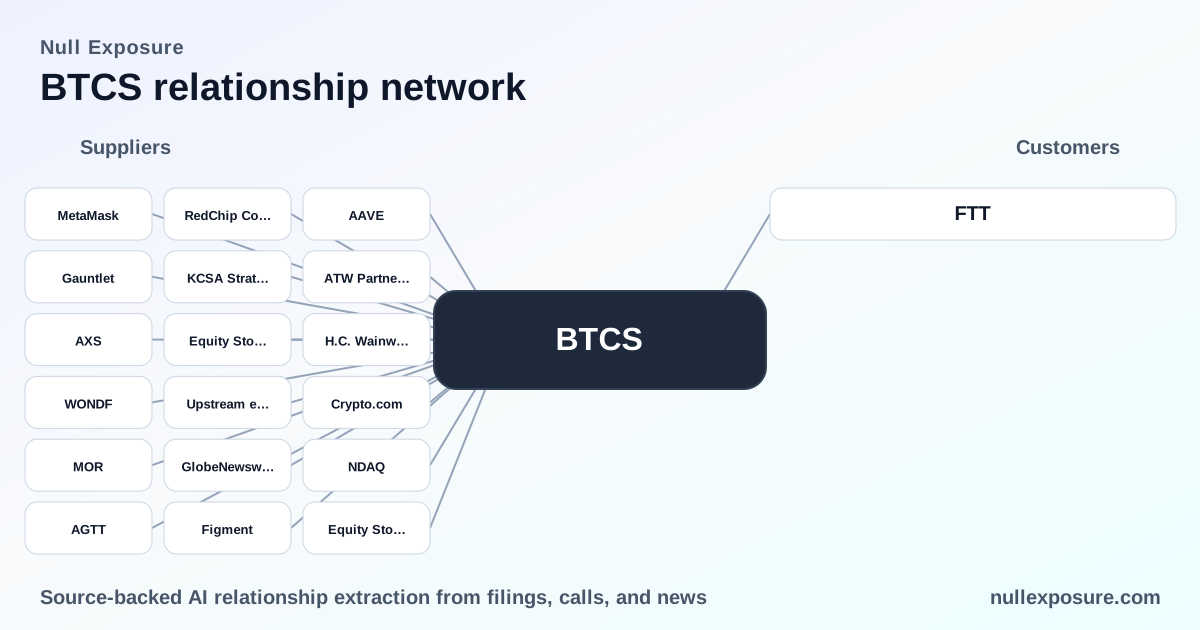
BTCS Inc.: An investor-focused read on customer relationships and operational posture
BTCS operates as a focused blockchain infrastructure company that monetizes two core activities: Validator Node Operations (NodeOps) through staking and validator fees, and Ethereum block building (Builder+) by capturing transaction-fee revenue. The company generates revenue by charging validator fees on delegated assets and by extracting MEV/transaction value from block-building, positioning BTCS as a service provider to token holders and to the broader Ethereum execution/consensus ecosystem.
How BTCS actually makes money — the operating model in plain English
BTCS’s business model is concentrated and infrastructure-centric. NodeOps collects a percentage of staking rewards as recurring revenue when third parties delegate assets to BTCS’s validator nodes, while Builder+ sells block-building services that directly capture transaction fees in the Ethereum block production market. According to BTCS’s filings for the year ended December 31, 2024, revenue grew to approximately $4.07 million from $1.34 million in 2023, driven by Builder+ contributing roughly $2.45 million and NodeOps about $1.62 million — demonstrating the commercial emergence of both lines of business.
Key operational characteristics investors should track:
- Short-term contracting posture: many of BTCS’s economic relationships (staking/delegation and block-building) operate on short liquidity or lock-up cycles, which creates revenue variability tied to network staking periods and builder contracts.
- Service-provider role and scalability: BTCS operates as a Service-as-a-Stake/validator and a block-builder, enabling scalable fee capture with limited incremental fixed costs once infrastructure is in place.
- Segment concentration: the company operates a single reportable segment—blockchain infrastructure—so customer concentration and technology-market dynamics are material to cash flow.
- Stage and maturity: NodeOps is active and generating revenues; Builder+ is a ramping, fast-growing initiative that materially changed year-over-year revenue mix.
If you want regular updates on BTCS’s evolving partner signals and customer relationships, visit https://nullexposure.com/ for continuing coverage.
What public records say about counterparty exposure
BTCS has publicly addressed its exchange custody posture and counterparty exposure in management presentations and press releases. In investor communications, the company has emphasized a conservative custody stance, noting minimal assets held on exchanges.
-
FTT / FTX (company statement): According to a GlobeNewswire press release dated December 1, 2022, BTCS’s leadership explicitly stated that the company had no assets held with FTX or its affiliated entities and that less than 1% of BTCS’s digital assets were held on exchanges. This is management’s public declaration of exchange custody exposure and was presented in the context of a Ladenburg Thalmann virtual technology expo presentation.
Source: GlobeNewswire press release, December 1, 2022.
-
FTX (same public disclosure): The same GlobeNewswire release reiterates that BTCS did not have assets on FTX and keeps under 1% of digital assets on exchanges, a deliberate liquidity posture intended to minimize counterparty custody risk.
Source: GlobeNewswire press release, December 1, 2022.
Why those relationship notes matter to investors and operators
The two public relationship entries are not commercial customers in the traditional sense but instead reflect counterparty and custody risk statements made by management. For investors assessing BTCS’s customer relationships and operational risk profile, the implications are concrete:
- Low exchange custodial exposure reduces counterparty concentration risk relative to firms that maintain significant on-exchange balances. Management’s public statement that under 1% of digital assets are held on exchanges is a defensive liquidity posture that lowers the company’s vulnerability to exchange insolvencies.
- Customer-facing revenues are infrastructure-based and on-chain: The available evidence frames BTCS as a service provider to token holders and block producers rather than a counterparty-heavy trading business. This contractual posture implies revenues are more a function of network participation and fee capture than of bilateral commercial agreements.
Constraints and what they reveal about BTCS’s contracting and maturity
The collected constraint signals from filings and disclosures should be treated as company-level operational signals rather than relationship-specific attributes:
- Contract duration: short-term — staking and builder engagements typically operate with short lock-up windows or rolling delegation terms, making revenue timing cyclical.
- Geography: North America — BTCS is a Nasdaq-listed U.S. company headquartered in the U.S., which shapes regulatory and market access dynamics.
- Materiality: material — blockchain infrastructure revenues are a material and growing portion of company revenue, per the 2024 results where Builder+ and NodeOps drove the increase.
- Role: service provider — the company earns validator fees and block-building revenue rather than selling hardware or commoditized software licenses.
- Stage: active and ramping — NodeOps is active and generating revenue; Builder+ is scaling fast and is characterized as a core growth driver.
- Segment: infrastructure — a single reportable segment focused on staking and block-building.
These constraints imply a business that is operationally focused, capital-efficient for additional revenue generation, and still early in its commercial scaling, which creates both upside if block-building economics persist and volatility tied to short-term staking cycles.
Risk/Reward lens for operators and research teams
- Upside: Builder+ has become a meaningful revenue driver, and staking fees present scalable recurring economics with limited incremental cost. The 2024 revenue acceleration demonstrates product-market fit in the services BTCS offers to validators, delegators, and transaction flow.
- Risk: market volatility and protocol-level changes can quickly impact fee pools and staking rewards; short-term contract dynamics increase revenue variability; BTCS’s negative EBITDA and loss-making status require monitoring of cash flow and financing alternatives.
Bottom line and recommended next steps
BTCS is a focused infrastructure operator that monetizes validator services and block-building; public disclosures confirm conservative custody practices and minimal on-exchange exposure. For investors and operators evaluating customer relationships, prioritize diligence on fee-sharing terms, average delegation tenure, and Builder+ economics — these factors determine near-term revenue stability and growth trajectory.
To follow ongoing customer and partner signals for BTCS, including updated filings and management statements, visit https://nullexposure.com/ for continuing intelligence and documented relationship tracking.