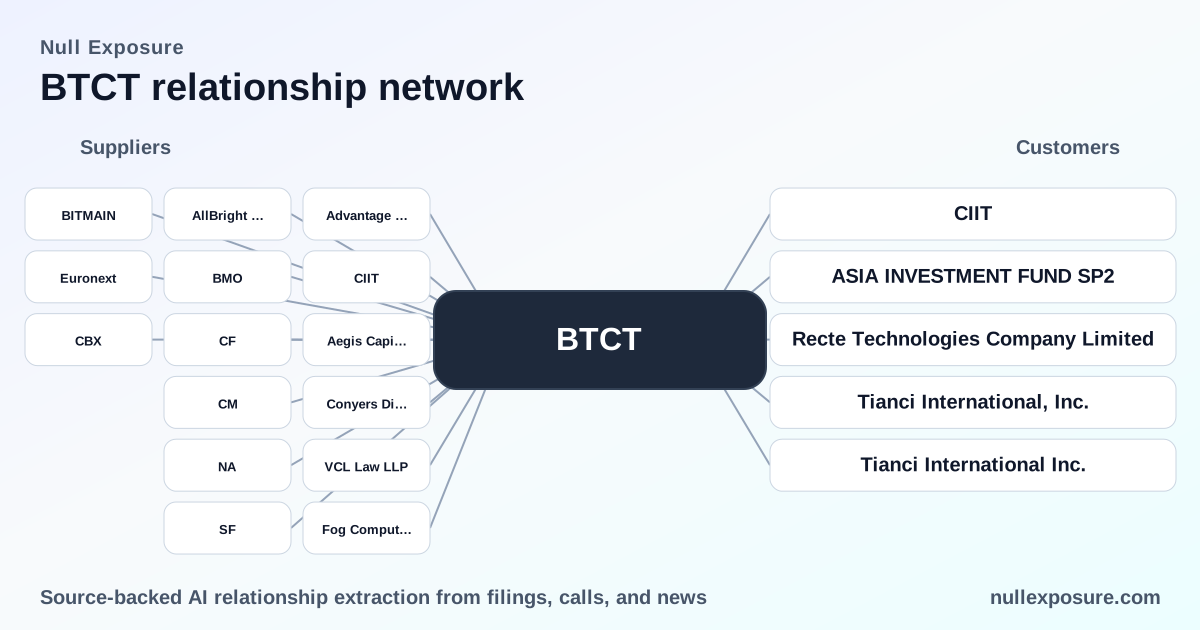
BTCT Customer Relationships: Hosting contracts and hardware sales that drive revenue
BTC Digital Ltd. operates a dual business model: it sells cryptocurrency mining hardware and provides hosting, operations and maintenance for deployed miners, generating revenue both from one‑off machine sales and usage‑based hosting fees tied to bitcoins mined. For investors, the current customer footprint shows a mix of equipment MOUs and active hosting agreements that increase recurring revenue potential while preserving exposure to bitcoin production economics. For more granular customer signals and to track relationship evolution, visit https://nullexposure.com/.
How BTC Digital monetizes and where customer value sits
BTC Digital’s public disclosures and media coverage outline a clear operating posture. The company resells mining machines when market shortages create favorable margins, and it rents out miners under contracts where payment is calculated based on the total bitcoins mined, establishing a usage‑based revenue stream. Historically the hardware segment has been material to top line, with machine sales representing significant shares of revenue in prior reporting periods; that mix creates both higher‑margin sales upside and cyclicality tied to miner supply and bitcoin economics.
Key operating signals:
- Contracting posture: predominantly usage‑based hosting plus direct sales and opportunistic resale; hosting contracts convert asset deployment into recurring cash flow linked to bitcoin yield.
- Concentration/criticality: hardware sales have been material to revenue; hosting customers that commit large fleets are operationally critical to utilization and margin.
- Maturity: a mix of active hosting agreements and MOUs for future equipment purchases—the pipeline includes executed MOUs that convert to deployments when equipment and customer acceptance align.
- Commercial role: BTC Digital functions as a both supplier/reseller of mining machines and as a managed‑service operator for hosted fleets.
Customer relationships: line‑by‑line coverage
Tianci International Inc. / CIIT — ~$5.0M MOU for equipment plus hosting (Mar–May 2026)
BTC Digital entered a memorandum of understanding with Tianci International (reported under CIIT) outlining Tianci’s intention to procure approximately US$5.0 million of mining equipment and engage BTC Digital to provide end‑to‑end hosting, operations and maintenance for the deployed miners, a deal announced across multiple press outlets in March 2026. (Sources: Futunn and MarketScreener press reports, March 2026; TipRanks and AccessNewswire coverage, May 2026.)
CIIT (as named ticker) — restatement of the Tianci MOU (Mar 2026)
Public filings and market notices repeated the CIIT designation when describing the same MOU: CIIT plans the ~$5.0M procurement and contracted hosting with BTC Digital, reinforcing that the transaction is positioned as equipment sale plus ongoing operational services. (Source: The Globe and Mail / CIIT press release, March 2026.)
ASIA INVESTMENT FUND SP2 — hosting agreement for a large fleet (Mar 2026)
BTC Digital announced new hosting arrangements that include management of miners for institutional Asian client ASIA INVESTMENT FUND SP2, reported alongside other client wins in early March 2026; this reflects the company’s role as a third‑party host for institutional fleets. (Source: StockTwits market coverage, March 9, 2026.)
Recte Technologies Company Limited — hosting agreement covering 1,100 machines (Mar 2026)
BTC Digital disclosed a hosting agreement to manage 1,100 Bitcoin mining machines for Recte Technologies, one of two Asian clients cited in the March 2026 hosting announcements, demonstrating the company’s capacity to deploy and operate large, multi‑customer racks. (Source: StockTwits market coverage, March 9, 2026.)
What these customer ties mean for BTCT’s financial profile
The combined relationship set reflects a deliberate commercial mix: material hardware sales when market conditions favor resale margins, and recurring, usage‑based hosting that translates installed capacity into operating revenue. The Tianci/CIIT MOU is an example of the sale‑plus‑host model that converts a one‑time equipment sale into an ongoing services relationship, while the Recte and ASIA INVESTMENT FUND SP2 hosting agreements illustrate BTC Digital’s capability to secure multi‑hundred to multi‑thousand‑rig management contracts.
Investor implications:
- Revenue durability: hosting contracts are usage‑based and therefore provide recurring inflows tied to bitcoin production rather than fixed rent alone; this aligns incentives but increases sensitivity to BTC price and miner yield.
- Margin profile: reselling machines during supply tightness can boost gross margins, while hosting commoditizes margin into service fees and operational cost management.
- Concentration risk: a small number of large hosting customers can materially influence utilization and reported revenue—company disclosures historically show hardware-related revenue as a substantial share of sales.
- Operational risk: hosting scale requires uptime, cooling and power arrangements; customer commitments for large fleets increase operational criticality and the need for robust O&M processes.
Constraints and company‑level commercial signals
BTC Digital’s public text and news summaries provide concrete constraints that shape the business model: the firm rents miners on a usage basis, resells machines opportunistically, and historically saw hardware account for a material share of revenue (evidence cited in company statements). These are company‑level characteristics—not relationship‑specific assertions—and they explain the revenue mix and volatility investors should expect. In short, BTCT’s commercial model is asset‑intensive, operationally driven, and partially indexed to bitcoin production economics.
Key takeaways for portfolio managers and operators
- BTCT converts hardware sales into recurring hosting revenue where possible; the March–May 2026 CIIT/Tianci MOU and the March 2026 hosting wins substantiate this strategic approach.
- Usage‑based contracts reduce fixed revenue predictability but align incentives with miners’ performance; investors price in bitcoin price and hash‑rate sensitivity.
- A few large hosting customers can move utilization and revenue materially; monitor renewal cadence, power contracts and deployment schedules.
- Operational execution is non‑trivial; successful delivery and O&M for fleets like the 1,100‑machine Recte program are differentiators.
For ongoing tracking of BTCT customer activity and to access structured relationship signals, visit https://nullexposure.com/ for deeper coverage and historical relationship timelines.