BTCW customer relationships: what investors need to know
BTCW operates as a U.S.-listed bitcoin trust that provides institutional and retail investors with market access to bitcoin via exchange-traded shares. The trust issues and redeems blocks of shares through a limited set of Authorized Participants (APs), uses a Cash Custodian to handle cash flows for creations and redemptions, and engages external service providers—most notably an external auditor—for governance and assurance. The trust’s monetization is driven by providing tradable bitcoin exposure through brokerage channels and the mechanics of creation/redemption activity described in the company’s public filings. For a concise data-driven view and primary filings, see https://nullexposure.com/.
Investor thesis in one line: BTCW is a custody-and-trust vehicle that commercializes bitcoin exposure through share issuance and AP-mediated liquidity, creating a fee and flow-dependent business whose operational and counterparty risk profile is concentrated and highly process-driven.
How the filings frame the business and counterparties
BTCW’s public filings describe a standard trust structure for asset-backed shares with a focused counterparty set and a precise operating playbook. The filings confirm that:
- Authorized Participants are U.S. registered broker‑dealers, which confines primary market activity to regulated domestic entities and narrows the counterparty universe (company filing, FY2024).
- Shares began trading on Cboe BZX Exchange on January 11, 2024, establishing the secondary market listing and attendant market-making dynamics (company filing, FY2024).
- Creation/redemption mechanics are rigid: the Trust issues shares only in blocks (Baskets) tied to the bitcoin attributable to each Basket, and APs deliver or receive cash through the Cash Custodian when they create or redeem shares (company filing, FY2024).
- APs can place creation orders on any business day, indicating an active, on‑demand issuance model rather than periodic or windowed offerings (company filing, FY2024).
These excerpts collectively signal a contracting posture that is concentrated (few authorized counterparties), operationally critical (creation/redemption is central to liquidity), and mature in process (daily operational windows and formal cash custodian flows).
Operational constraints and what they imply for investors
Understand these constraints as company-level signals about BTCW’s operating model rather than attributes of any single vendor.
- Concentration and counterparty risk: limiting primary issuance to U.S. registered broker-dealers reduces regulatory ambiguity but increases exposure to a concentrated AP set; large flow swings could stress a small group of counterparties.
- Process criticality: reliance on the Cash Custodian to settle creation/redemption cash flows means custody and cash settlement are central operational nodes—any disruption here materially affects liquidity transmission between the trust and markets.
- Market coupling: because share issuance is tied explicitly to bitcoin attributable per Basket, the trust’s economics align closely with spot bitcoin flows and exchange liquidity rather than being separable into multiple revenue streams.
- Maturity and transparency: the daily creation/redemption capability and public listing demonstrate a structured, repeatable operating rhythm suitable for institutional counterparties and market-makers.
Key takeaway: BTCW’s model is not a broad services marketplace but a tightly governed issuance and custody operation; investors should underwrite counterparty resilience and settlement robustness before taking exposure.
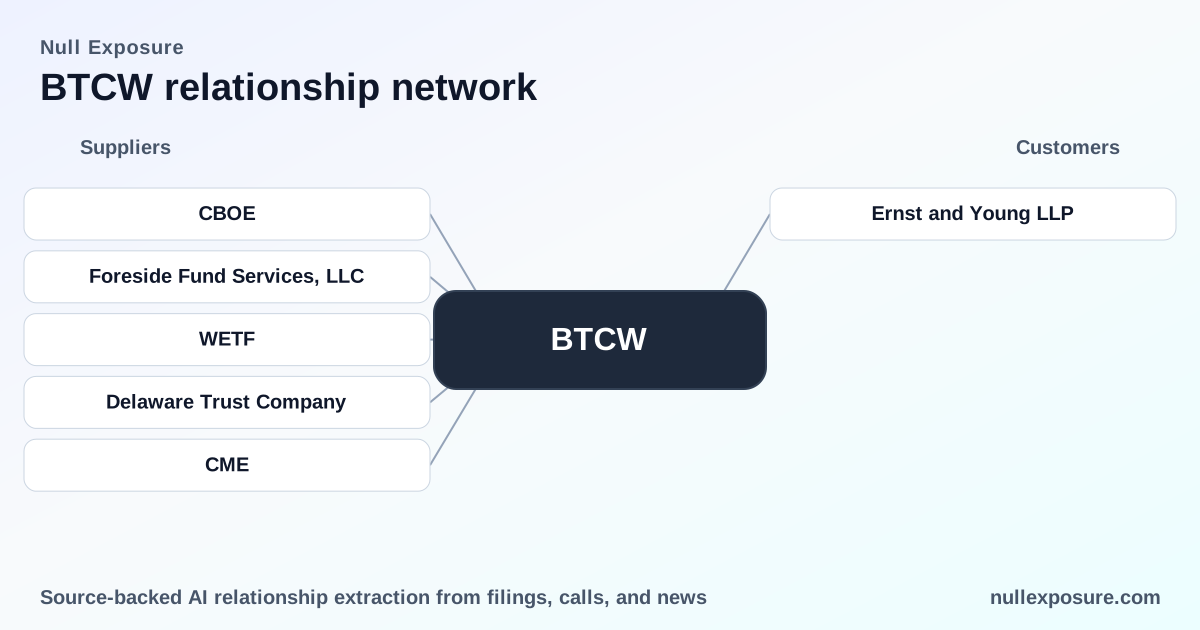
Audit and assurance: Ernst and Young LLP
Ernst and Young LLP provided services to BTCW for the year ended December 31, 2024, and the company discloses a summary table of fees for those services in its FY2024 Form 10‑K. This establishes EY as the trust’s principal external auditor and a core element of its financial reporting and governance framework (BTCW Form 10‑K, FY2024).
What the EY relationship signals for investors
An external auditor of EY’s profile indicates standard public‑company governance and financial assurance for BTCW; auditors of this standing are necessary for investor confidence in asset-backed instruments and reporting quality. The fees disclosed in the FY2024 filing quantify the economic relationship with the auditor and are part of the trust’s governance disclosures (BTCW Form 10‑K, FY2024).
Practical implications for counterparties and operators
- Liquidity providers and market-makers should price in the operational constraints of 5,000-share Baskets and the fact that creation/redemption is cash-settled through a custodian; this raises settlement and timing considerations for intraday hedges.
- Risk managers must stress-test scenarios where AP capacity is impaired; because APs are U.S. broker-dealers, a U.S.-centric systemic event could compress primary-market functioning.
- Operations teams need robust reconciliation processes with the Cash Custodian and clear escalation paths with the Transfer Agent, as APs may place daily orders that must be processed without delay.
Short, sharp risk checklist for investors
- Counterparty concentration: AP universe limited to U.S. registered broker-dealers increases single‑point risk.
- Settlement centrality: the Cash Custodian is an operational bottleneck; review custody agreements and failure remedies.
- Flow sensitivity: the trust’s economics and liquidity are directly correlated with bitcoin market dynamics and AP activity.
- Governance assurance: external audit by Ernst and Young LLP indicates compliance with standard reporting norms (BTCW Form 10‑K, FY2024).
For investors demanding primary source documentation and an index of counterparties, the trust’s Form 10‑K is the canonical reference and includes fee disclosures, AP mechanics, and the listing date on Cboe BZX (FY2024). Explore the filing details and related analyses at https://nullexposure.com/.
Bottom line: what to underwrite before taking exposure
Investors should underwrite AP resilience, custodian settlement robustness, and market liquidity rather than treat BTCW as a commodity ETF with broad counterparty diversification. The business model is straightforward and well-documented—issuance through a narrow AP channel, custody of underlying bitcoin, and a public secondary market listing—but its risk profile is concentrated and operationally interdependent. Conduct counterparty due diligence on APs and the Cash Custodian, and confirm audit and governance disclosures (FY2024 Form 10‑K) before committing capital.
If you want a concise, evidence-linked briefing tailored to an institutional diligence checklist, visit https://nullexposure.com/ for access to primary filing extracts and relationship mappings.