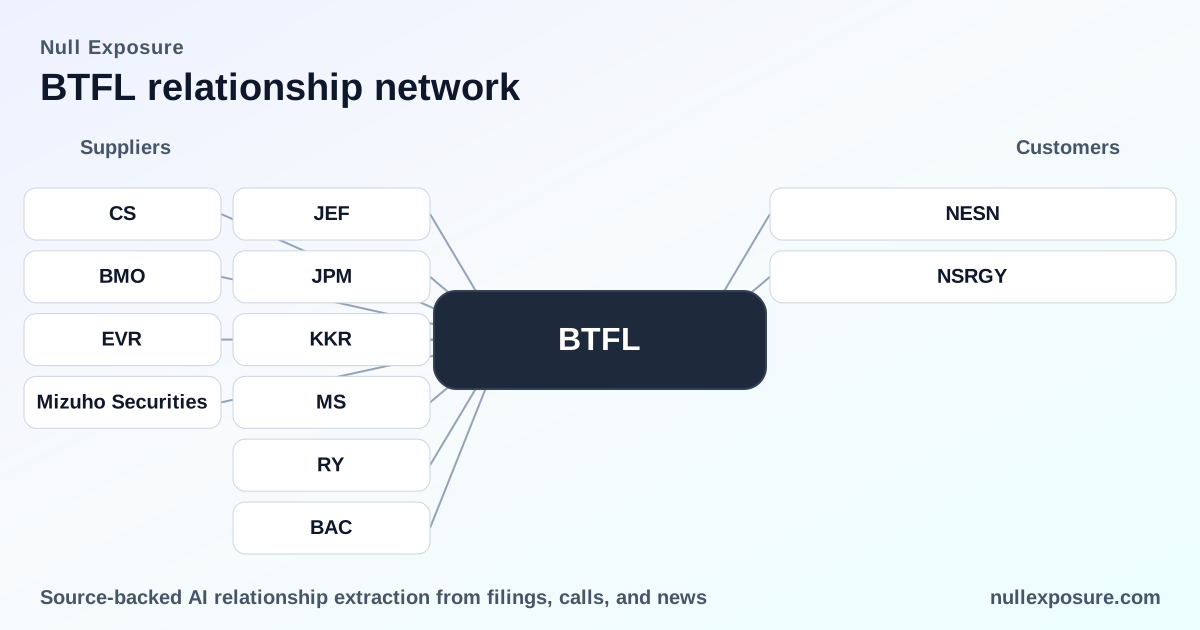
BTFL customer map: retail reach, one strategic buyer, and what investors should price in
Bountiful (BTFL) monetizes by selling branded and private‑label nutritional supplements through large national retailers and e-commerce channels, while its core brands have been the subject of strategic M&A that crystallized value. The company’s revenue model is straightforward retail CPG: product manufacture and margin capture via wholesale supply to chains and online marketplaces, plus private‑label and brand licensing; strategic buyers (notably Nestlé) have paid a premium that re‑rates the asset base. For investor due diligence, the critical questions are distribution concentration, channel durability, and the degree to which a strategic acquirer can extract synergies or change go‑to‑market economics. Learn more at https://nullexposure.com/.
Shelf presence drives cash flow — four national retail anchors and Amazon
Bountiful’s brands reach customers through large pharmacy chains and Amazon, giving the business scale in merchandising and promotions but also exposing it to category buying power.
CVS
Bountiful products are sold on‑shelf at select CVS locations as part of a wider retail rollout for Nature’s Bounty curated combinations. CVS represents a national pharmacy distribution channel that supports core branded revenue. (PR Newswire, FY2021)
Amazon.com
Bountiful’s brands are explicitly available online at Amazon.com, which is an essential direct‑to‑consumer and third‑party marketplace channel for supplements. Amazon supplements the brick‑and‑mortar footprint with broad e‑commerce reach and promotional velocity. (PR Newswire, FY2021)
Rite Aid
Rite Aid is listed among the retailers carrying curated Nature’s Bounty offerings, extending the chain coverage to another national pharmacy operator. Rite Aid adds distribution breadth in markets where other chains may be less dominant. (PR Newswire, FY2021)
Walgreens
Walgreens is a named retail partner for on‑shelf distribution of curated supplements, reinforcing the company’s penetration of the pharmacy channel. Walgreens helps secure category visibility and promotional placement across high‑traffic store formats. (PR Newswire, FY2021)
Strategic corporate buyer and brand consolidation: multiple references to Nestlé
A series of reports and filings documents a single strategic reality: Nestlé bought the core Bountiful brands, folding them into its global nutrition platform and changing the ownership and strategic trajectory of BTFL’s main assets.
Nestlé
Nestlé agreed to buy The Bountiful Co.’s core brands for $5.75 billion, a transaction that repositioned those brands inside a global packaged‑food and nutrition leader. The sale evidences the intrinsic brand value and strategic fit with a larger nutrition platform. (Axios, Apr 30, 2021; CNBC, Apr 30, 2021 — FY2021)
Nestle (alternate spellings reported)
Multiple trade outlets confirmed Nestlé’s acquisition of core Bountiful brands for roughly $5.75 billion, consistently reporting the transaction across industry press. Market coverage converges on a single valuation and strategic rationale: scale and portfolio expansion for Nestlé. (WholeFoodsMagazine; FoodBusinessNews; NutraIngredients — FY2021)
NESN
Swiss ticker references (NESN) appear in coverage tying Nestlé’s corporate identity to the acquisition of Bountiful’s brands. Public filings and press tied to Nestlé’s Swiss listing reflect the acquirer’s role in the deal. (NutraIngredients; other press — FY2021)
NSRGY
U.S. ADR ticker references (NSRGY) also appear in the reporting on the Nestlé transaction, reinforcing the cross‑listed market context for the buyer. U.S. investor channels reported the transaction under Nestlé’s ADR symbol, emphasizing the global investor audience for the deal. (CNBC; Whole WWD — FY2021)
Nestlé (encoded name in press)
Some sources use alternate encodings of Nestlé’s name while reporting the transaction; the substance remains the same: acquisition of core brands for $5.75 billion. Multiple editorial forms of Nestlé’s name do not change the strategic outcome. (WWD; trade press — FY2021)
Nestle SA
Additional coverage referenced Nestle SA explicitly as the buyer integrating Bountiful brands into Nestlé Health Science. This phrasing underscores the parent company’s role in folding the brands into its health‑nutrition business unit. (FoodBusinessNews — FY2021)
Nestlé Health Science
Industry reports indicate the acquired brands — Nature’s Bounty, Solgar, Osteo Bi‑Flex, Puritan’s Pride and the U.S. private‑label business — were to be integrated into Nestlé Health Science, aligning them with existing nutrition brands. Integration into Nestlé Health Science signals a shift toward a platform strategy focused on higher‑margin health‑nutrition products. (WholeFoodsMagazine — FY2021)
FTC enforcement reference (retroactive reputational issue)
Regulatory and reputational notes were raised in later enforcement coverage: the FTC cited instances tied to the supplement maker’s earlier operations, which surfaced in a 2023 enforcement matter related to hijacked Amazon reviews. Regulatory scrutiny around review practices can drive reputational and channel risk, especially in e‑commerce. (TechCrunch, Apr 10, 2023 — FY2023)
What the relationship map means for investors
- Channel concentration and buyer power are material. National pharmacy chains and Amazon are high‑volume customers that can negotiate price, placement, and promotions; that negotiating power compresses gross margins during promotional cycles.
- Strategic acquirers value brand equity and platform fit. The Nestlé transaction at $5.75 billion validates brand valuation and creates optionality for scale synergies, global distribution, and higher‑margin health science positioning.
- E‑commerce conduct and regulatory oversight are ongoing operating risks. The FTC action documented in 2023 signals that online marketplace conduct is an operational control that investors must monitor.
Operating model constraints and company‑level signals
While the dataset supplied no explicit contractual excerpts, investors should treat the following as firm‑level signals derived from the relationship map and transaction history:
- Contracting posture: retail‑wholesale relationships imply short to medium‑term purchase contracts and significant promotional levers exercised by retailers; there is limited long‑term contract protection for shelf space.
- Concentration: revenue concentration toward a handful of national chains and Amazon elevates counterparty risk — a single major customer’s delisting or promotional change can move quarterly revenue materially.
- Criticality: For retailers and Nestlé, Bountiful brands are important in category assortment but not uniquely critical; brands are valuable but substitutable, which strengthens buyer negotiating leverage.
- Maturity: The asset base is mature consumer brands with stable demand patterns; growth is incremental and brand‑marketing driven, not technology enabled.
Bottom line: price for durable brands and concentrated distribution risk
Investors should treat BTFL’s historical economics as a function of brand strength plus exposure to powerful retail buyers and e‑commerce dynamics. The Nestlé acquisition validates the intrinsic asset value, but the operating model retains material distribution concentration and margin sensitivity to retailer buying practices and online governance.
For a deeper cross‑check of customer exposure and M&A evidence, visit https://nullexposure.com/ for comprehensive relationship mapping and historical press references.