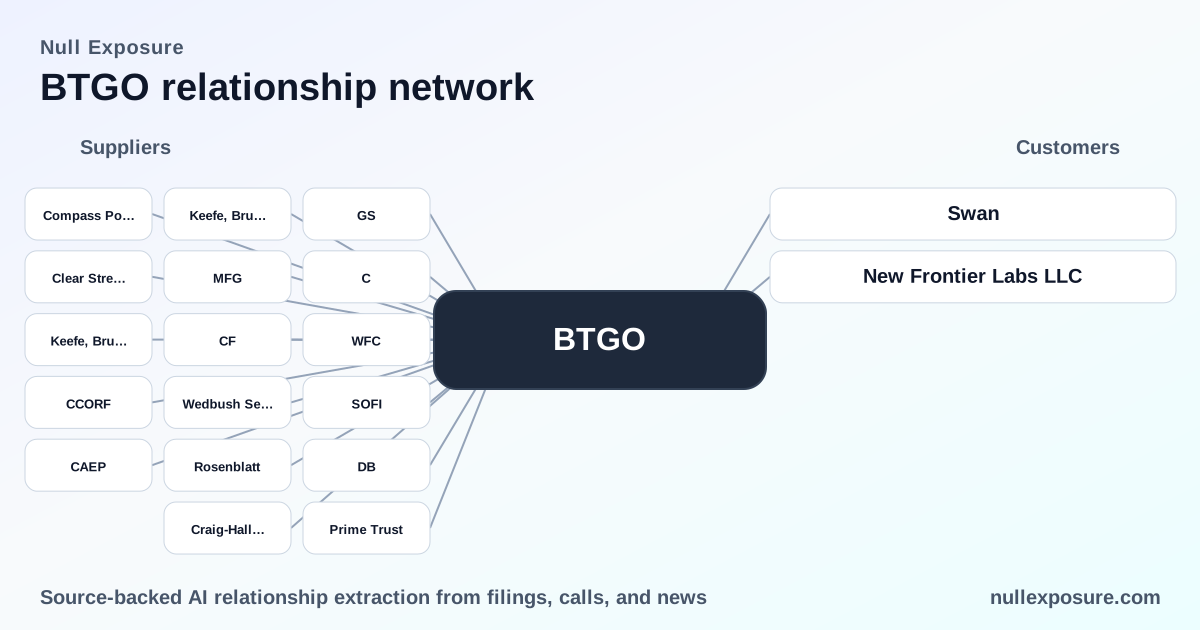
BitGo customer map: institutional custody, settlement and stablecoin issuance that monetize infrastructure
BitGo is an institutional digital-asset infrastructure company that monetizes through custody fees, settlement and OTC services, staking and crypto-as-a-service contracts, and by operating a federally chartered trust bank that enables regulated stablecoin issuance and custody. Its revenue mix is driven by recurring custody contracts, transaction and trading fees, and product-level services (staking, settlement, stablecoin issuance) sold to exchanges, treasury customers and fintechs. For a concise briefing on the broader coverage approach, visit Null Exposure.
What this relationship map tells an investor
BitGo’s customer roster in public reporting and press coverage shows a clear commercial posture: core custody and settlement as the product, regulated trust-bank rails as the differentiator, and stablecoin/issuance services as strategic expansion. The list below covers every reported customer relationship pulled from recent news items and filings; each entry is a short, plain-English take with the cited source.
Institutional and enterprise relationships — use cases and proof points
STSS — FY2026
STSS will use BitGo’s institutional-grade qualified custody through BitGo Bank & Trust, N.A., leveraging the OCC-regulated trust structure for treasury custody. Source: GlobeNewswire coverage via The Manila Times (March 2026).
OKX — FY2026
OKX plans to integrate into BitGo’s Go Network off-exchange settlement solution to support U.S. institutional flows, signaling adoption of BitGo’s settlement rails. Source: StockTwits news feed (May 2, 2026).
The Better Money Company — FY2026
The Better Money Company selected BitGo’s Crypto-as-a-Service to power a stablecoin clearinghouse, indicating BitGo’s role in stablecoin processing and clearing. Source: StockTwits news feed (May 2, 2026).
STSS (second mention) — FY2026
A parallel report notes STSS will use BitGo’s qualified custody plus Solana staking validator services to earn rewards and access OTC trading capabilities for SOL holdings. Source: Investing.com (May 4, 2026).
Swan — FY2023
Swan is reported to be moving custody to Fortress Trust and BitGo as part of a broader custody reshuffle, illustrating BitGo’s role as a receiving custodian for fintechs. Source: Bitcoin Magazine coverage (March 9, 2026).
New Frontier Labs LLC — FY2026
New Frontier Labs announced a strategic partnership naming BitGo Bank & Trust as the issuer and primary custodian of FYUSD, a U.S. dollar-backed stablecoin targeted at institutional adoption in Asia. Source: SahmCapital press release summary (March 2026).
AndX USA LLC — FY2026
AndX USA is leveraging BitGo’s platform built on BitGo Bank & Trust for digital asset services, a sign of BitGo’s bank-based platform being sold to U.S. trading businesses. Source: SahmCapital news (April 9, 2026).
Ubyx Inc. — FY2026
Ubyx appointed BitGo Bank & Trust, N.A. as a settlement agent within its network, demonstrating BitGo’s expansion into settlement and intermediation roles. Source: SahmCapital news (March 11, 2026).
LGHL (Lion Group Holding) — FY2025
Lion Group secured $600 million for a treasury initiative and uses BitGo to secure digital assets, indicating BitGo custody for large corporate treasuries. Source: Pintu.co.id reporting (March 2026).
LGHL (second mention) — FY2025
The Defiant reported that LGHL will have SOL and SUI stored and staked by BitGo through a new partnership, showing BitGo’s staking services for large treasury allocations. Source: The Defiant (March 2026).
SBLX (StableX) — FY2025
StableX selected BitGo as custodian to secure and facilitate acquisition of up to $100 million in cryptocurrency, a capstone example of BitGo supporting corporate crypto treasuries. Source: MarketScreener and Crypto.news press summaries (October 2025 / March 2026).
CNTN (Canton Strategic Holdings) — FY2026
BitGo was selected as the digital asset custodian for Canton Strategic Holdings MT, underscoring BitGo’s role in custody for public-company treasury management. Source: MarketScreener press release note (March 12, 2026).
AEHL (Antelope Enterprise Holdings) — FY2025
AEHL will open accounts and make Bitcoin purchases on the BitGo platform, storing acquired BTC on-chain using BitGo’s multi-signature key management. Source: QuiverQuant news (March 2026).
FLD (Fold Holdings) — FY2026
Fold expanded into nationwide availability through BitGo’s federally chartered trust framework and relies on the BitGo-provided $250 million insurance layer for bankruptcy-remote custody protections. Source: QuiverQuant and Investing.ca coverage (March–May 2026).
IPW (iPower) — FY2026
iPower funded a secured Digital Asset Treasury account and completed initial Bitcoin and Ethereum purchases through a subsidiary account maintained with BitGo. Source: QuiverQuant and Globe and Mail press releases (Dec 2025 / March 2026).
FGNX — FY2026
FGNX established third-party custodial and treasury partnerships that include BitGo, positioning BitGo among a set of custodial providers for its trading operations. Source: TradingView news (May 2026).
FIGR (Figure Technology Solutions) — FY2026
Figure signed BitGo for custody services and worked with BitGo to execute the first fully on-chain equity trades that were issued, traded and settled on blockchain rails. Source: Blockonomi and InsiderMonkey reporting (Feb–May 2026).
FLD (second mention) — FY2026
Additional reporting highlights Fold’s plan to enhance custody via a partnership with a federally regulated national bank and associated BitGo insurance protections. Source: Investing.ca (May 2026).
SBLX (second mention) — FY2025
StableX’s press release reiterates BitGo’s role as institutional-grade custodian and compliance oversight provider for StableX’s treasury. Source: Asianet News / regional press (Oct 2025).
SOFI — FY2026
BitGo was selected to provide custody and infrastructure services for SoFiUSD, supporting SoFi’s stablecoin infrastructure and distribution strategy. Source: Finviz and TIKR coverage citing SoFi announcements (early 2026).
SOFI (second and third mentions) — FY2026
Multiple outlets report BitGo’s selection for SoFiUSD infrastructure and distribution, reinforcing BitGo’s expanding role in bank-backed stablecoin ecosystems. Source: Finviz, TIKR (March 2026).
TRNR (Interactive Strength / TRNR) — FY2026
TRNR will use BitGo’s custody platform for trading and storing FET holdings as part of its crypto allocation strategy. Source: TradingView news (March 2026).
FSOL (Fidelity Solana Fund) — FY2025
Fidelity plans to stake up to 100% of SOL tokens through custodians that include BitGo, demonstrating BitGo’s validation/staking services for institutional funds. Source: TradingView coverage of Fidelity filings (May 2026).
BTOG (Bit Origin Ltd) — FY2025
Bit Origin selected BitGo for qualified custody and OTC trading services for its growing digital-asset treasury, including custody of DOGE holdings. Source: StockTitan press summaries (March 2026).
BTOG (second mention) — FY2026
Follow-up reporting reiterates the BitGo partnership to secure Bit Origin’s DOGE treasury with insured custody and OTC access. Source: StockTitan corporate release feed (March 2026).
AEHL (second mention) — FY2025
Additional company-level reporting reinforces AEHL’s cooperation agreement with BitGo to complete account opening and Bitcoin purchases on BitGo. Source: StockTitan news overview (March 2026).
IPW (second mention) — FY2025
Globe and Mail press releases document iPower’s December 2025 transactions executed through a BitGo-maintained subsidiary account as part of its DAT strategy. Source: The Globe and Mail press release (Dec 26, 2025; reported March 2026).
Aven (AVEPY) — FY2026
Aven built a Bitcoin-backed Visa card infrastructure using BitGo Inc. for custody and BitGo Bank & Trust as custodian, integrating custody into consumer credit products. Source: SahmCapital press release (April 27, 2026).
FIGR (second mention) — FY2026
Analyst notes emphasize Figure’s BitGo partnership for the on-chain equity trade experiment and custody coverage supporting its market structure innovations. Source: InsiderMonkey analyst discussion (May 2026).
Aven (second mention) — FY2026
Press reporting reiterates Aven’s launch of a Bitcoin-backed credit card built on BitGo infrastructure, underscoring product-level integration. Source: StockTwits news (May 2, 2026).
Contracting posture, concentration and operational constraints
No explicit contractual constraints or limitation excerpts were included in the collected relationship data; this absence is itself a company-level signal. The pattern of customers—exchanges, fintechs, public companies and stablecoin issuers—indicates diverse revenue channels but concentrated exposure to institutional treasury and stablecoin issuance business lines, where BitGo’s bank charter and insurance packaging are the primary competitive assets.
Risk and opportunity implications for investors
- Opportunity: BitGo’s role as an OCC-regulated trust bank and issuer/custodian for stablecoins (e.g., FYUSD, SoFiUSD) creates higher-margin, productized revenue streams and stronger stickiness with enterprise clients.
- Operational risk: Custody and settlement are mission-critical services; any service disruption, regulatory change, or insurance failure would have outsized commercial impact.
- Concentration risk: While customers are diversified across sectors, revenue concentration in custody/settlement still ties BitGo’s fate to institutional crypto market activity.
For ongoing coverage and deal-level parsing, see Null Exposure for our curated research and relationship maps.
Bottom line
BitGo is executing a classic infrastructure play: sell secure custody, expand into settlement and stablecoin rails through its OCC-regulated trust bank, and cross-sell staking, OTC and issuance services. The publicly reported customer list confirms broad institutional adoption across exchanges, fintechs, corporate treasuries and fund managers—a commercial mix that supports recurring revenue while concentrating exposure in custody and regulated stablecoin services. Investors should monitor customer wins, settlement adoption metrics, and regulatory developments around custodial banking and stablecoin issuance as primary value drivers.