Bitcoin Depot (BTM) — Customer Relationships and Commercial Risks
Bitcoin Depot operates and monetizes a retail-first cryptocurrency distribution network: it owns and operates a large fleet of Bitcoin ATMs (BTMs), places kiosks through lease or distribution agreements with retail partners, and generates revenue primarily from point-of-sale cryptocurrency sales and related software/services offerings. Revenue is principally driven by consumer transactions at kiosks and via BDCheckout and the mobile app, while strategic retail partnerships provide distribution scale and location density. For a concise baseline on partners and relationships, see https://nullexposure.com/ — the intelligence platform that surfaced the disclosures discussed below.
Distribution-led economics: how retail partnerships translate to cash flow
Bitcoin Depot’s business model is built on three commercial primitives: kiosk footprint, consumer transaction economics, and retail placement agreements. The company reported approximately 8,500 BTMs across the U.S., Canada and Puerto Rico and an additional BDCheckout acceptance footprint of roughly 7,600 retail locations as of December 31, 2024, which underpins recurring point-of-sale volumes. According to company filings and disclosures, revenue is realized at the point of sale when consumers buy (or sell) cryptocurrency, producing highly transactional, spot-based cash flows rather than long-duration contracts.
Key operating signals drawn from corporate filings and disclosures:
- Contracting posture is spot-oriented: customer transactions are governed by point-of-sale terms that do not extend beyond each transaction, which produces immediate revenue recognition and limited receivables duration.
- End counterparties are primarily retail consumers, not enterprise customers; the company sells cryptocurrency at kiosks and through online checkout to individuals.
- Geographic footprint is North America-first with nascent APAC expansion: the network is concentrated in North America (U.S., Canada, Puerto Rico) with disclosed plans and press announcements supporting first steps into Asia (Hong Kong).
- Product concentration is high: Bitcoin accounts for 99% of transaction volume, making the company effectively a single-asset crypto distributor.
- Customer-level concentration shows mixed signals: the company’s public narrative includes a claim that no customer approaches 10% of revenue, yet the FY2024 10‑K discloses that Circle K locations generated roughly 23% of total revenue for the year — an evident concentration in retail placement economics that investors should reconcile with other company statements.
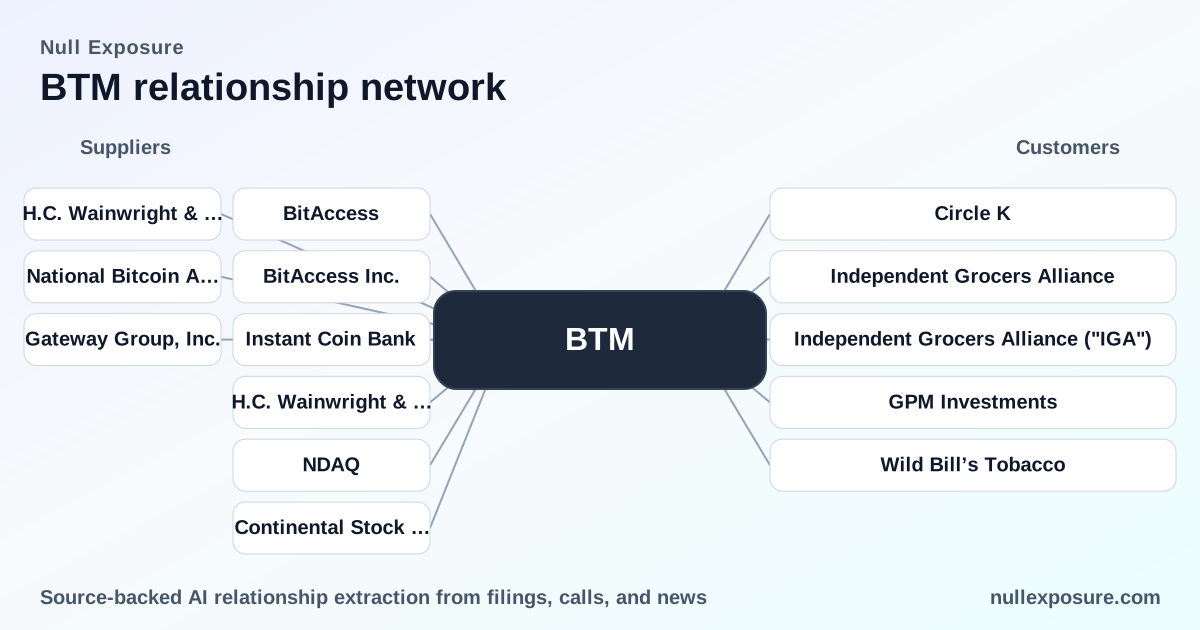
- Software and services are material to strategy: through the BitAccess acquisition, Bitcoin Depot supplies operating software to other BTM operators, creating a software/service channel that complements kiosk sales and introduces a different counterparty role (service provider).
These signals imply a revenue base that is transactional and footprint-dependent, with retail partners driving distribution but final demand coming from individual consumers. Investors should treat retail relationships as critical to distribution roll-out while recognizing the company’s core commercial exposure to Bitcoin price and retail footfall.
Operational constraints and company-level signals investors need to know
- Spot transaction model: transactions are governed by point-of-sale terms only, limiting receivable duration and credit exposure.
- Consumer-facing counterparties: the business sells to individuals through kiosks and web/mobile channels, limiting enterprise-style contract locks but increasing sensitivity to retail demand.
- Geographic concentration: primary operations are in North America with early expansion activities in Australia and a disclosed Hong Kong entry, signaling regional diversification but still heavy NA exposure.
- Single-asset dependency: Bitcoin represents 99% of transaction volume, concentrating product risk on one crypto.
- Retail partner concentration: corporate filings show material revenue from major retail partners (notably Circle K), which concentrates distribution risk despite company statements about customer immateriality.
- Software supplier role: via BitAccess, Bitcoin Depot provides software to third-party kiosk operators, creating both an incremental revenue stream and a potential competitive dynamic.
- Active consumer base: filings reference nearly 15,000 monthly active users, demonstrating an actively transacting customer base for kiosks and digital channels.
Each of these constraints is a company-level signal that shapes how investors should evaluate scalability, margin sustainability, and counterparty risk for Bitcoin Depot.
Partner-by-partner snapshot — what each relationship contributes
- Circle K: The company disclosed in its FY2024 10‑K that kiosks at Circle K locations accounted for approximately 23% of total revenue in 2024 (down from 27% in 2023), indicating a meaningful revenue concentration tied to a single large retail partner. According to the 10‑K (FY2024), these placements are under individual corporate and franchisee lease agreements.
- Independent Grocers Alliance (IGA): Bitcoin Depot announced a distribution partnership with IGA to expand kiosk access through neighborhood grocery stores; press pickups ran on March 9, 2026, describing IGA as a nationwide distribution channel for additional locations (news coverage March 2026).
- GPM Investments: Press releases and reporting reference a retail partnership with GPM Investments tied to kiosk installations and cited in a GlobeNewswire release (November 12, 2025) that also discussed the company’s first Asia expansion; subsequent press reports in 2026 reiterated GPM as a key retail distribution partner.
- Wild Bill’s Tobacco: Bitcoin Depot launched a pilot installation of 10 kiosks across Wild Bill’s Midwest stores starting November 19, 2025, with public commentary noting potential expansion into the retailer’s ~250-store footprint (news coverage Nov–Dec 2025 and citations in early 2026 press pickups).
Each relationship is distribution-centric: partners provide location density and foot traffic while Bitcoin Depot supplies kiosks, transactions, and in some cases adjacent software services.
What this means for valuation and risk
- Revenue scalability is tied to retail roll‑outs and per-kiosk throughput: expanding partner agreements and execution on pilot-to-rollout conversion will directly lift top-line and leverage fixed costs. The company reported TTM revenue of roughly $615 million and positive EBITDA of about $48.9 million, indicating operating leverage once kiosks achieve stable volume.
- Concentration risk requires monitoring: the Circle K disclosure is an explicit concentration flag — investors should watch contract terms, renewal cadence, and franchise-level exposures, especially given the company’s broader claim that no customer approaches 10% of revenue.
- Product concentration elevates macro sensitivity: with Bitcoin representing 99% of volume, the business is structurally sensitive to Bitcoin market cycles and regulatory developments specific to that crypto.
- Software services create margin diversification: BitAccess-driven software revenues and BDCheckout distribution provide higher-margin, lower-capex channels if management scales adoption.
For active diligence, review the FY2024 10‑K for contractual language on lease terms and the November 2025 and March 2026 press releases for partner rollouts and geographic expansion.
If you want a consolidated view of partner disclosures and constraint signals for modeling revenue concentration and rollout scenarios, see https://nullexposure.com/ — the platform where these relationship signals have been synthesized.
Bottom line for investors
Bitcoin Depot is a distribution-first operator that monetizes consumer crypto transactions through a leased and distributed kiosk network and ancillary software services. Its success hinges on converting pilot partnerships to large-scale retail deployments and sustaining per-kiosk transaction volumes, while product concentration in Bitcoin and notable retail dependency (Circle K) are primary risk factors. Monitor partner rollout cadence, renewal terms, and the pace of software adoption as the core inputs for any valuation or operational forecast.