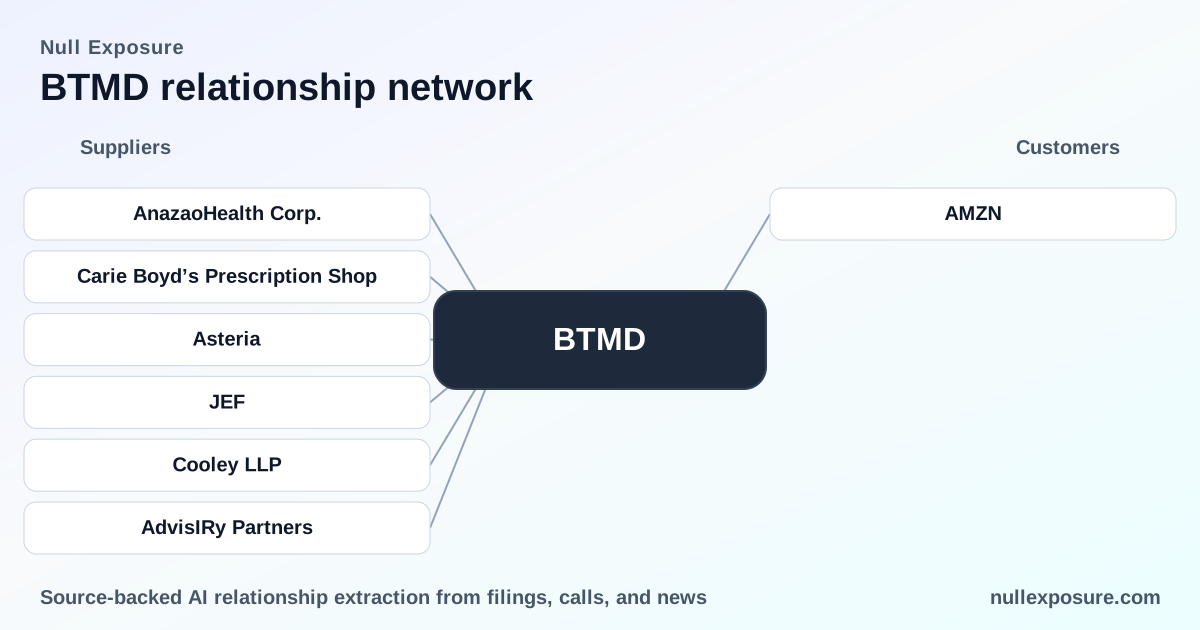
Biote Corp (BTMD) — Customer Map, Amazon Channel, and What Investors Should Know
Biote Corp operates a vertically integrated healthcare services and products model: it signs long-term master service agreements with clinics and certified practitioners, trains and licenses its Biote Method, and sells Biote‑branded dietary supplements both through partner clinics and retail channels such as Amazon. The company monetizes through recurring clinic fees tied to the Biote Method and direct product sales; in FY2025 Biote reported roughly $192.2 million in revenue and delivered meaningful EBITDA compared with its market capitalization, underlining a cash‑flow oriented operational profile. For a summary of relationship intelligence and how it affects revenue durability, see NullExposure for deeper customer analytics: https://nullexposure.com/
How Biote’s customer relationships drive the business
Biote’s operating model is built around a service‑first posture with product sales layered on top. Key company‑level operating signals drawn from filings and disclosures:
- Contracting posture: long‑term agreements. The company states it generates substantially all revenue from long‑term service agreements and supplement sales, indicating recurring revenue from clinic partners.
- Framework MSAs in place. Biote uses master services agreements with tiered pricing mechanics for management fees, suggesting predictable unit economics and the potential for volume discounts as partner scale increases.
- Geographic concentration: North America. Substantially all revenue originates in the United States, signaling exposure to U.S. healthcare regulation and payer/referral rules.
- Criticality and regulatory sensitivity. Management acknowledges dependence on Biote‑certified practitioners and partnered clinics, making clinical relationships operationally critical and subject to federal/state healthcare statutes.
- Multiple commercial roles. The company functions as licensor, service provider, reseller, and buyer — it trains practitioners, licenses IP, provides inventory management, and sells supplements to partner clinics which then resell to patients.
- Mature, active channel footprint. As of Dec 31, 2024, Biote contracted with over 8,600 practitioners and more than 4,700 partnered clinics, confirming a large installed base for cross‑sell and recurring fees.
- Service‑led revenue mix. The economics are driven by professional services and practice enablement, complemented by product margins from Biote‑branded supplements.
These characteristics create a business where contract durability and channel economics matter more than one‑off product launches, and where any changes in clinic behavior or regulation will have outsized revenue consequences.
Relationship intelligence: every mention in the record, explained
Below I cover each relationship result found in the provided signals. Each item is presented plainly with the original source cited.
-
An InsiderMonkey posting that runs the Q3 2025 earnings call transcript quotes management saying, “We continue to see strong performance in our Amazon channel in the Nutra s business.” This indicates that Amazon is a meaningful retail outlet for Biote’s nutritional/supplement line, supplementing clinic distribution (InsiderMonkey, Q3 2025 transcript). https://www.insidermonkey.com/blog/biote-corp-nasdaqbtmd-q3-2025-earnings-call-transcript-1641650/
-
A second entry from the same InsiderMonkey transcript was captured under the shorthand ticker AMZN; it repeats the same management language about Amazon channel strength, reinforcing that multiple monitoring services independently captured the same disclosure (InsiderMonkey, Q3 2025 transcript). https://www.insidermonkey.com/blog/biote-corp-nasdaqbtmd-q3-2025-earnings-call-transcript-1641650/
-
A Motley Fool earnings‑call transcript for Biote’s Q3 2025 includes the line, “We continue to see strong performance in our Amazon channel in the Nutris business,” showing management publicly acknowledges retail channel traction beyond clinic sales (The Motley Fool, Nov 6, 2025 earnings call transcript). https://www.fool.com/earnings/call-transcripts/2025/11/06/biote-btmd-q3-2025-earnings-call-transcript/
-
That same Motley Fool transcript appears again recorded under the compressed ticker AMZN in the signal feed; the duplicate capture underscores monitoring redundancy and the emphasis management placed on Amazon during the call (The Motley Fool, Nov 6, 2025 transcript). https://www.fool.com/earnings/call-transcripts/2025/11/06/biote-btmd-q3-2025-earnings-call-transcript/
-
A press release republished on The Globe and Mail that includes the Q3 2025 call transcript likewise quotes the Amazon channel line, providing a broad media distribution of management’s message that the Nutra/Nutris product vertical is performing well on Amazon (The Globe and Mail, press release republishing Q3 2025 transcript). https://www.theglobeandmail.com/investing/markets/stocks/BTMD/pressreleases/35958341/biote-btmd-q3-2025-earnings-call-transcript/
Taken together, these entries document consistent, repeated public messaging from Biote’s Q3 2025 earnings call about Amazon channel strength, captured by at least three distinct media outlets.
You can explore how these customer signals fit a broader coverage model at NullExposure: https://nullexposure.com/
What the Amazon channel disclosure means for investors
The repeated language across transcripts and press reposts establishes two practical points:
- Diversification of go‑to‑market. Amazon provides Biote a consumer storefront distinct from clinic distribution, expanding addressable reach and creating an alternate revenue stream that tracks retail demand rather than clinic appointment volumes.
- Visibility and scale signal. Management’s decision to call out Amazon performance on the earnings call and in distributed transcripts signals that the channel has reached a scale or trajectory meaningful enough to influence investor messaging.
These are positive operational developments, but they do not change the fact that the core revenue engine remains the long‑term MSAs and the network of certified practitioners and partnered clinics.
Investment implications and risk checklist
- Valuation context: Biote’s FY2025 revenues were ~$192.2M with EBITDA around $37.5M and market capitalization near $78.6M; multiples reported (EV/Revenue ~0.81, EV/EBITDA ~2.98, P/E ~2.93) reflect a low‑multiple profile relative to growth expectations. These figures imply an asset that generates cash today at a valuation that discounts growth.
- Durability vs. concentration tradeoff: Long‑term MSAs and an installed base of 8,600 practitioners underpin recurring revenue, but U.S. geographic concentration and regulatory exposure create binary operational risk vectors (licensing, referral rules, reimbursement).
- Channel‑mix upside with margin uncertainty: Amazon expands market access and could reduce seasonality, but channel economics (fulfillment costs, marketplace fees) are not disclosed granularly; investors should treat retail growth as a revenue diversifier, not an immediate margin arbitrage.
- Operational criticality: Given that Biote provides training, inventory management, practice software, and IP licenses, clinic relationships are critical to the business model; contract churn, regulatory enforcement, or partner consolidation would have amplified effects.
Bottom line
Biote’s customer base is structured for recurring, service‑led revenue with product sales layered in — long‑term contracts and a large practitioner network create stability, while the Amazon channel provides meaningful retail diversification that management has publicly highlighted. Investors should weigh the company’s strong operating cash profile and low multiples against concentrated geographic exposure and regulatory dependence. For deeper, transaction‑level customer mapping and continuous monitoring of these relationships, visit NullExposure for enterprise‑grade signals: https://nullexposure.com/