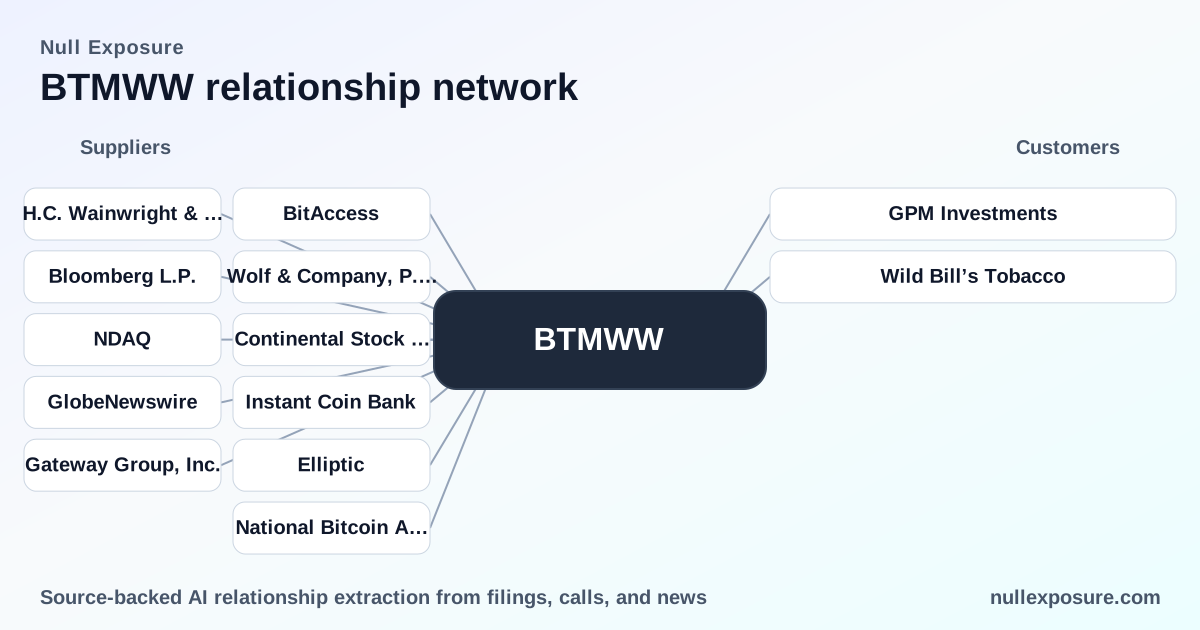
Bitcoin Depot (BTMWW): Retail partnerships as the growth lever for a kiosk-first crypto seller
Bitcoin Depot monetizes a physical payments footprint by operating thousands of Bitcoin teller machines (BTMs) in North America and selling Bitcoin at the point of purchase to individual consumers; primary revenue derives from one‑way cash-to-Bitcoin transactions executed at retailer locations, supported by software and services to other operators. The company grows through retail distribution agreements and pilot partnerships that expand kiosk placement and, secondarily, through software licensing and web-based services. For deeper relationship intelligence visit https://nullexposure.com/.
How Bitcoin Depot actually makes money and the implications for partners
Bitcoin Depot’s business is straightforward: it purchases cryptocurrency and resells it to retail customers at kiosks and retailer checkouts, recognizing revenue at the moment control of the cryptocurrency transfers to the customer. Company disclosures for the year ended December 31, 2024 describe the model as a point-in-time sale of Bitcoin at BTMs, which underpins both revenue recognition and counterparty exposure. The firm also records receipts of cryptocurrency as consideration for website and software services and offers a software solution to third‑party BTM operators.
This operating posture creates several practical constraints for partners and investors:
- Contracting posture: Transactions are spot, cash-to-Bitcoin sales executed at point-of-sale. That makes revenue predictable on a per-transaction basis but sensitive to transaction volumes and Bitcoin price volatility between purchase and sale.
- Counterparty profile: The business transacts primarily with individual consumers (average ~14,961 monthly active users in 2024), so retail footfall and consumer adoption drive throughput more than large counterparty agreements.
- Geographic concentration: Operations are concentrated in North America—U.S., Puerto Rico and Canada—with approximately 8,500 BTMs in retailer locations as of Dec 31, 2024; this regional footprint defines both growth runway and regulatory exposure.
- Role and inventory dynamics: Bitcoin Depot acts as both seller and buyer of cryptocurrency—purchasing crypto from exchanges and liquidity providers and selling to customers—so liquidity management and execution costs are material to margins.
- Product mix and maturity: The kiosk network is the core product; software and services are secondary but deliver a diversification pathway, offering upside if software licensing scales to other operators.
These characteristics imply low counterparty concentration but high operational concentration (real estate and retail partners), and a contracting model that favors transaction-level predictability over long-term contracted revenue streams.
Retail partner snapshots: what public reports show
Bitcoin Depot’s public coverage identifies a small set of named retail partners and pilot arrangements that illustrate its distribution strategy. Below are the partner relationships surfaced in recent reporting, each summarized with the source.
GPM Investments — a strategic retail distribution partner
Bitcoin Depot has announced collaborations with retailers such as GPM Investments, positioning GPM locations as placement points for kiosks and broader distribution channels for Bitcoin sales. According to a StockTitan company overview referencing FY2025 coverage, these retail collaborations are part of Bitcoin Depot’s effort to scale kiosk placement across national convenience chains. (Source: StockTitan corporate overview, FY2025, https://www.stocktitan.net/overview/BTMWW/)
Wild Bill’s Tobacco — a pilot and option for expansion
Bitcoin Depot executed a pilot of 10 kiosks with Wild Bill’s Tobacco with a stated option for broader expansion if the pilot succeeds; this arrangement illustrates the company’s go‑to‑market approach of small pilots that convert into larger deployments in retail chains. A StockTitan news item describing the Nov 19 retail partnership notes the 10‑kiosk pilot and the potential for wider roll-out. (Source: StockTitan news report, Nov 19, reported in FY2026 coverage, https://www.stocktitan.net/news/BTM/bitcoin-depot-announces-reverse-stock-mtdz7ocsy2we.html; see also the StockTitan company overview, FY2025, https://www.stocktitan.net/overview/BTMWW/)
What these relationships reveal about distribution strategy and risk
The partner list and company disclosures combine into a coherent commercial playbook:
- Rollout via national and regional retailers. Partnerships with chains like GPM Investments and pilot arrangements with specialty retailers such as Wild Bill’s Tobacco show Bitcoin Depot’s use of existing retail footprints to minimize site selection friction and accelerate kiosk density.
- Pilot-to-scale model. The Wild Bill’s pilot demonstrates a staged deployment model: trial installations to validate throughput and compliance before committing to larger rollouts—an approach that controls capex and operational risk but slows rapid scaling.
- Low counterparty dependence; high site concentration risk. Because the company transacts mainly with individuals and distributes across many retail partners, single-partner concentration risk is limited, but the overall network depends on the health of retail channels and foot traffic at kiosk sites.
- Revenue sensitivity to transaction volumes and execution costs. As a spot seller that also purchases crypto inventory, the company’s margins depend on procurement spreads, exchange execution, and consumer transaction frequency—factors that relate directly to retailer performance where kiosks sit.
For case-level detail and additional partner monitoring, NullExposure aggregates and tracks such retail relationships over time—visit https://nullexposure.com/ for ongoing coverage and relationship signal tracking.
Operational constraints that shape valuations and partner negotiating leverage
The company-level constraints derive directly from its model and influence how investors should think about partner economics:
- Spot contract economics reduce contractual protections but simplify recognition. Sales are instantaneous when cryptocurrency transfers to customers; there is no long-term binding revenue from retail partners to insulate throughput declines.
- Retail partnerships are primarily distribution arrangements, not revenue guarantees. Partners provide placement and customer access, but Bitcoin Depot retains primary commercial exposure to consumer demand.
- Software and services offer margin expansion potential. The company’s software solution to other BTM operators creates an adjacent, higher‑margin revenue stream that could improve predictability relative to purely transactional kiosk sales.
- Regional concentration focuses regulatory and macro risk. With operations concentrated in North America, regulatory shifts or localized reductions in retail traffic have an outsized impact on the installed base.
Investors should weight the upside from scaling kiosks through retailer partnerships against the operational execution risks of kiosk deployment, cash management for crypto inventory, and retail footfall dynamics.
Bottom line for investors
Bitcoin Depot’s model is a retail-first, spot-based crypto seller that monetizes physical distribution and incremental software services. Named partnerships—GPM Investments and a pilot with Wild Bill’s Tobacco—underscore the strategy of leveraging retailer networks to grow kiosk density while validating sites through pilots. Key value drivers are transaction throughput and procurement spreads; key risks are retail footfall, crypto liquidity costs, and North American regulatory trends. For actionable relationship monitoring and to see how these partnerships evolve, visit https://nullexposure.com/.