BTOG: Who’s Buying, Who’s Selling, and What It Means for Investors
Short thesis: Bit Origin Ltd (BTOG) operates as a niche public company with a speculative crypto/treasury narrative and almost no operating scale; the firm monetizes through whatever business lines its filings list while investor interest today is driven by headline moves and portfolio rebalancing by institutional trading desks. Given $39,500 in TTM revenue, a market cap of roughly $3.6 million, and acute swings in institutional positions, BTOG is governed more by headline-driven liquidity and short-term portfolio flows than by durable operating cash generation. For a quick corporate reference, see the company site and filings; for relationship signals read on. If you want a concise platform view of counterparty flows, visit https://nullexposure.com/.
Market context in one line: this is a micro-cap with headline-driven investor activity, not a revenue-growth story.
Why institutional movements matter for a penny-cap story
Institutional buys and sells matter differently at BTOG’s scale. When a trading desk or boutique manager adds or removes tens of thousands of shares, that can materially move the share price because the company has only ~1.6 million shares outstanding and a very small public float. Institutional position volatility is therefore a primary driver of market price discovery for BTOG, not underlying EBITDA or recurring revenue.
A mid-article note: if you track these flows systematically, our coverage platform consolidates the same signals for research teams — https://nullexposure.com/.
Line-by-line: every customer/relationship mention in the dataset
Below are the relationships called out in the QuiverQuant report (fiscal period FY2025; capture date March 9, 2026). Each entry is a one- to two-sentence plain-English take with the original QuiverQuant link for reference.
-
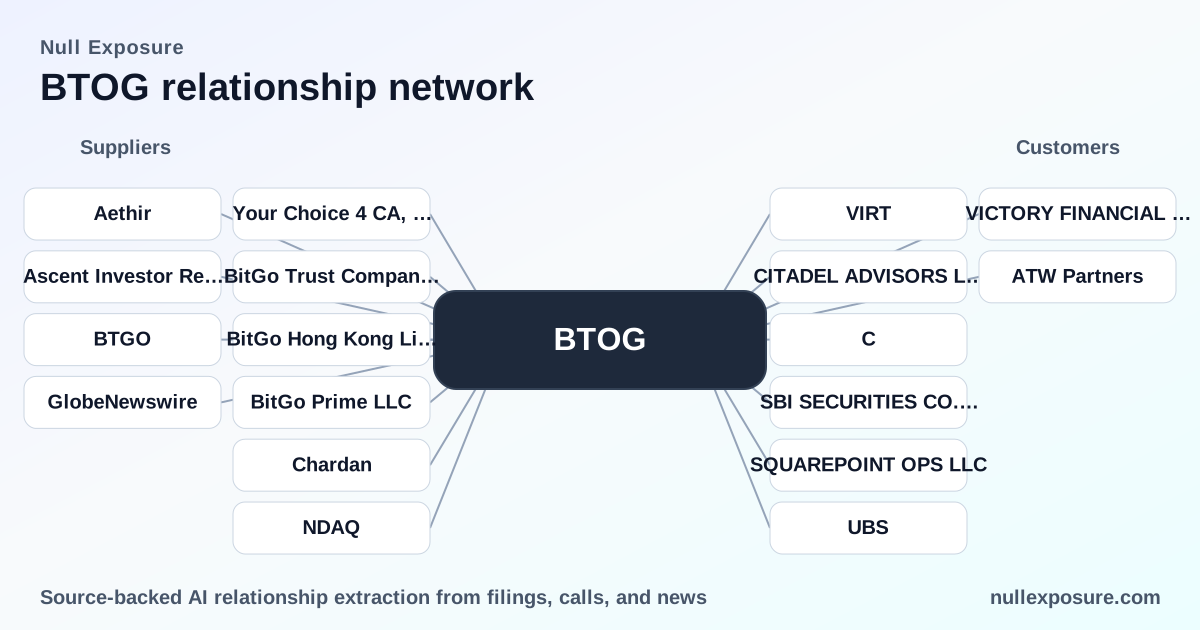
Virtu Financial LLC — Virtu added 218,114 shares to its Q1 2025 portfolio, an aggressive incremental position reported at an estimated $41,441. According to QuiverQuant (March 9, 2026): https://www.quiverquant.com/news/Bit+Origin+Ltd+Becomes+First+Publicly+Listed+Company+to+Establish+Dogecoin+Treasury+Strategy+on+Major+US+Exchange
-
Citigroup Inc. (C) — Citigroup is reported to have added 154 shares in Q1 2025 (a nominal stake estimated at $29), a token allocation consistent with trading-desk or client-oriented activity rather than an active strategic position. QuiverQuant (March 9, 2026): https://www.quiverquant.com/news/Bit+Origin+Ltd+Becomes+First+Publicly+Listed+Company+to+Establish+Dogecoin+Treasury+Strategy+on+Major+US+Exchange
-
Citadel Advisors LLC — Citadel removed 15,251 shares in Q1 2025 (reported as a complete removal, estimated $2,897), signaling tactical de-risking or rotation away from this micro-cap exposure. QuiverQuant (March 9, 2026): https://www.quiverquant.com/news/Bit+Origin+Ltd+Becomes+First+Publicly+Listed+Company+to+Establish+Dogecoin+Treasury+Strategy+on+Major+US+Exchange
-
SBI Securities Co., Ltd. — SBI added 4,121 shares in Q1 2025 (an increase of ~1,882% by the report’s calculation), a modest position estimated at $782 that reflects regional broker-dealer or wealth-management incremental buying. QuiverQuant (March 9, 2026): https://www.quiverquant.com/news/Bit+Origin+Ltd+Becomes+First+Publicly+Listed+Company+to+Establish+Dogecoin+Treasury+Strategy+on+Major+US+Exchange
-
Squarepoint Ops LLC — Squarepoint removed 19,936 shares in Q1 2025 (reported as a total removal, estimated $3,787), consistent with quantitative desk position rebalancing or stop-out activity. QuiverQuant (March 9, 2026): https://www.quiverquant.com/news/Bit+Origin+Ltd+Becomes+First+Publicly+Listed+Company+to+Establish+Dogecoin+Treasury+Strategy+on+Major+US+Exchange
-
UBS Group AG / UBS — UBS reportedly removed 120,038 shares in Q1 2025 (a nearly complete exit reported, estimated $22,807), a large directional change whose scale is meaningful relative to BTOG’s tiny market cap. QuiverQuant (March 9, 2026): https://www.quiverquant.com/news/Bit+Origin+Ltd+Becomes+First+Publicly+Listed+Company+to+Establish+Dogecoin+Treasury+Strategy+on+Major+US+Exchange
-
Victory Financial Group, LLC — Victory added 110,940 shares in Q1 2025 (reported as a material accumulation, estimated $21,078), indicating a sizeable speculative stake for a boutique manager. QuiverQuant (March 9, 2026): https://www.quiverquant.com/news/Bit+Origin+Ltd+Becomes+First+Publicly+Listed+Company+to+Establish+Dogecoin+Treasury+Strategy+on+Major+US+Exchange
-
ATW Partners — The report notes ATW Partners provided a funded facility to BTOG and that Chardan acted as the placement agent for that facility, indicating a financing/capital-provider relationship rather than a long-term strategic customer. QuiverQuant (March 9, 2026): https://www.quiverquant.com/news/Bit+Origin+Ltd+Becomes+First+Publicly+Listed+Company+to+Establish+Dogecoin+Treasury+Strategy+on+Major+US+Exchange
Each of the above items was extracted from the same QuiverQuant summary covering institutional flows and BTOG’s FY2025 activity (capture date March 9, 2026). The report aggregates portfolio changes across trading desks and asset managers; the magnitudes should be interpreted in the context of BTOG’s small float.
Operating-model signals and business-model constraints
The relationship data set contains no explicit contractual constraints between BTOG and counterparties; that absence is itself a company-level signal. Combine that with the corporate financials and you get a clear operating posture:
-
Low operating scale and negative profitability: BTOG reports $39,500 revenue TTM and negative EBITDA, which is consistent with a company in either early-stage commercialization or transitional/asset-repositioning status. The business does not generate meaningful operating cash flow to support large, contractually committed customer programs.
-
Concentration of influence and liquidity sensitivity: Institutional ownership is reported at ~80.7%, and the company has only ~1.6 million shares outstanding. Those metrics produce high concentration risk — single large portfolio moves can swing price materially, and counterparty importance is measured by trading impact rather than supplier integration.
-
Contracting posture is opportunistic, not lock-in: The relationship signals (large buys and complete removals by brokers and quant shops) indicate short-term trading and financing arrangements rather than long-term strategic contracts tied to revenue. The ATW-funded facility with Chardan as placement agent shows capital reliance instead of durable customer revenue streams.
-
Maturity is low; criticality is low to counterparties: Given the tiny revenue base, BTOG is non-critical to major financial institutions as a business partner; it is important only as a tradable instrument for desks and boutique managers.
These points should be read as structural characteristics of BTOG’s business model, not as claims about any individual counterparty unless explicitly noted.
Investment implications — what institutional flows signal for operators and allocators
-
Price sensitivity to flows: With the float and reported institutional moves, market price is primarily flow-driven. Allocators should expect outsized volatility from relatively small position changes by trading desks.
-
Event-driven liquidity windows: Financing events (the ATW facility) and crypto-treasure headlines (the QuiverQuant story itself) create discrete liquidity episodes that drive both buy-side accumulation and desk-level exits.
-
Counterparty risk is execution risk: For operators and market-makers, the primary operational consideration is execution risk and settlement mechanics, not counterparty revenue dependency.
Conclusion and next steps
For investor due diligence, prioritize monitoring institutional filings and desk-level movements over traditional revenue multiple analysis, because BTOG’s market behavior is dominated by portfolio rotation and headline trades rather than recurring cash flow. For a consolidated feed of these relationship signals tailored to investor workflows, visit https://nullexposure.com/.
Key takeaway: BTOG is a headline-driven micro-cap; institutional buys and sells create the valuation swings — treat capital events and desk flows as the primary risk and return drivers.