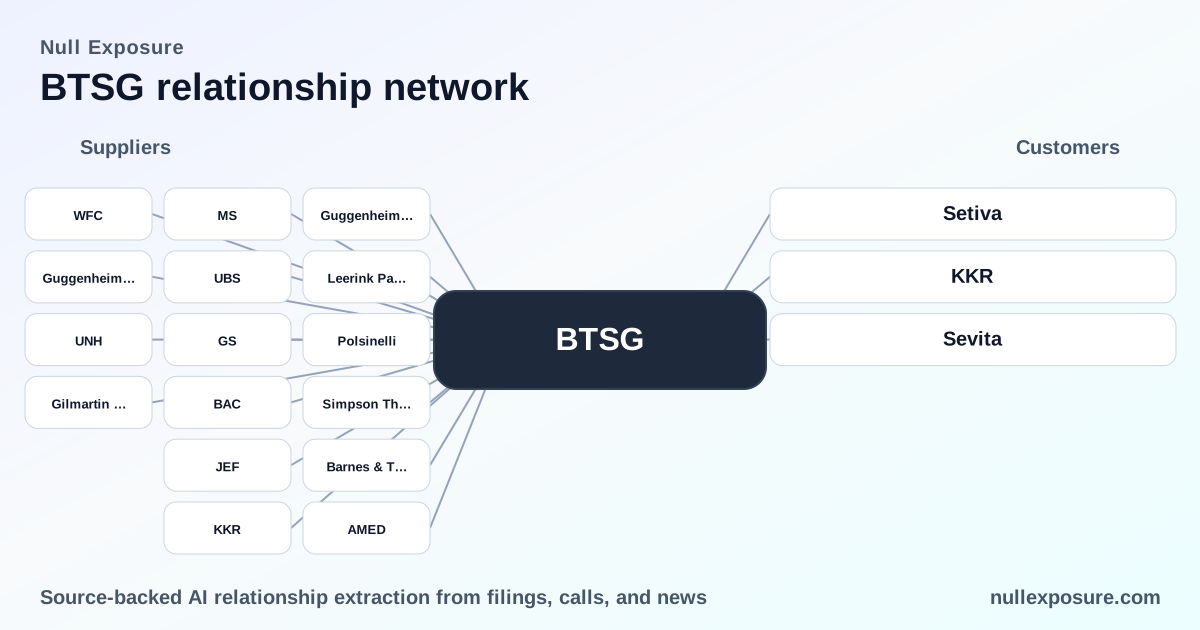
BrightSpring Health Services (BTSG) — Customer Relationships and Strategic Implications
BrightSpring operates as a vertically integrated home- and community-based healthcare platform that monetizes through two complementary streams: Pharmacy Solutions (drug distribution and specialty pharmacy services) and Provider Services (home health, hospice, long‑term specialty care and related managed services). The company sells services to a mix of government payors, managed care organizations and direct consumers, earns service fees from pharmaceutical manufacturers, and realized meaningful balance-sheet changes in 2025 after the divestiture of its Community Living business. For a deeper dataset-driven view of counterparty exposures and media-tracked transactions, visit the Null Exposure homepage: https://nullexposure.com/.
Quick take for investors: what matters now
- Divestiture reshapes revenue mix — the sale of the ResCare Community Living/IDD arm reduces exposure to congregate care and re‑orients BrightSpring toward pharmacy and home-health margins.
- Payor concentration is structural — substantial revenue continues to flow from Medicare/Medicaid and other government programs, which influences pricing power and collections timing.
- Contracting posture is mixed but defensive — many contracts are short‑term or terminable on short notice, while PBM arrangements include multi‑year elements; this creates revenue volatility but limited lock‑in upside.
- Scale and national footprint are durable advantages — operations in all 50 states and a large provider network underpin competitive reach and execution in value-based care.
Counterparty snapshots: who BTSG is transacting with
-
Setiva — Hospice News reported on January 27, 2025 that BrightSpring sold its community living business to Setiva for $835 million, marking a material carve‑out of its congregate/IDD operations. (Hospice News, Jan 27, 2025: https://hospicenews.com/2025/01/27/behind-brightsprings-835m-community-living-service-divestiture-to-setiva/)
-
Sevita — Multiple industry outlets confirmed that the ResCare Community Living business was sold to Sevita for $835 million, with regulatory approvals and closing conditions driving the transaction timetable into late 2025/early 2026. (Behavioral Health Business, Jan 21, 2025: https://bhbusiness.com/2025/01/21/brightspring-sells-idd-business-to-sevita-for-835m/; Home Health Care News, Aug 2025: https://homehealthcarenews.com/2025/08/brightsprings-home-health-segment-fuels-q2-gains-as-company-grows-into-the-space/)
-
KKR — Coverage of the company’s ownership history notes that private equity firm KKR acquired BrightSpring in 2019 for approximately $1.32 billion, a reference point for the company’s capital structure and strategic evolution. (Behavioral Health Business, Jan 21, 2025: https://bhbusiness.com/2025/01/21/brightspring-sells-idd-business-to-sevita-for-835m/)
Each of the above relationships is supported by public reporting and SEC disclosure activity tied to the divestiture and BrightSpring’s strategic disclosures (see related SEC 8‑K reporting summarized by market trackers).
Why the Sevita/Setiva sale is a structural event
The $835 million divestiture of the Community Living/IDD business is a clear strategic repositioning: it reduces exposure to congregate services and frees capital to invest in higher‑growth or higher‑margin parts of the platform — notably home health and pharmacy. Markets recognized the change: coverage noted the sale in the context of index reweighting and earnings expectations (MarketScreener and Finviz ran transaction headlines in May 2026). (MarketScreener, May 2, 2026: https://www.marketscreener.com/news/brightspring-health-services-set-to-join-s-p-smallcap-600-index-ce7d5adeda89ff2d; Finviz, May 2026: https://finviz.com/news/230853/ubs-ups-brightspring-target-to-42-reiterated-buy-after-beat-and-raise-q3)
KKR’s earlier ownership is a historical anchor for investors analyzing management incentives and capital allocation patterns; prior private equity control shaped the company’s acquisition and divestiture cadence and remains relevant to governance analysis. (Behavioral Health Business, Jan 21, 2025: https://bhbusiness.com/2025/01/21/brightspring-sells-idd-business-to-sevita-for-835m/)
How BrightSpring’s operating model shapes customer and counterparty risk
BrightSpring presents a mixture of short-term commercial risk and longer-term structural advantages:
-
Contracting posture — short-term tilt with some multi‑year PBM agreements. The public record indicates that managed care contracts commonly allow payors to terminate with roughly 30–60 days’ notice, while PBM contracts range from annual to multi‑year terms. This creates revenue sensitivity to payor behavior and pricing pressure, but PBM relationships provide pockets of term stability.
-
Counterparty profile — heavy government exposure and individual consumers. The company derives substantial revenue from Medicare and Medicaid programs and serves a large daily patient base through thousands of providers; this makes reimbursement policy and state program changes principal drivers of cash flow variability.
-
Geographic and scale advantages — nationwide footprint reduces single‑market concentration. Operating in all 50 states (and Puerto Rico/Canada in limited fashion) improves resilience to localized reimbursement shocks.
-
Materiality and role — services are material and core to the business model. Provider Services and Pharmacy Solutions are the operating backbone; distribution and service delivery are both revenue engines and execution risk points.
-
Maturity and stage — active service operations with ongoing commercialization & portfolio rebalancing. The company is actively reshaping its segment mix through disposals and reinvestment, signaling a mid‑cycle strategic posture rather than a static legacy business.
These characteristics mean investors should underwrite two principal exposures: payor contract churn/price pressure on near‑term revenue, and execution risk tied to workforce and reimbursement policy. At the same time, scale and integrated pharmacy-provider capabilities create durable competitive advantages in value‑based care.
Implications for investors and operators
For equity holders, the divestiture and the company's fundamental mix imply a tradeoff between near‑term margin optics and long‑term growth optionality. BrightSpring’s FY‑to‑date metrics show meaningful revenue scale (Revenue TTM ~$13.6B) with thin profit margins, so capital allocation decisions post‑sale will be a valuation driver. For operators and counterparty managers, the operational priorities are workforce stability, payor contracting discipline, and preserving access to specialty pharmaceutical services that generate manufacturer fees.
If you want a concise, transaction‑level map of BrightSpring’s counterparties and exposure signals, Null Exposure provides curated summaries and historical linkages — see the homepage here: https://nullexposure.com/.
Bottom line
BrightSpring has pivoted away from congregate community living toward a concentrated, integrated home‑health and pharmacy services model supported by nationwide scale and heavy government payor exposure. The Sevita/Setiva divestiture and the company’s contracting profile create distinct downside sensitivities to reimbursement shifts and contract churn, balanced by execution advantages in distribution and provider networks. Investors should focus on how management deploys divestiture proceeds and stabilizes payor relationships to convert scale into sustainable margin expansion.