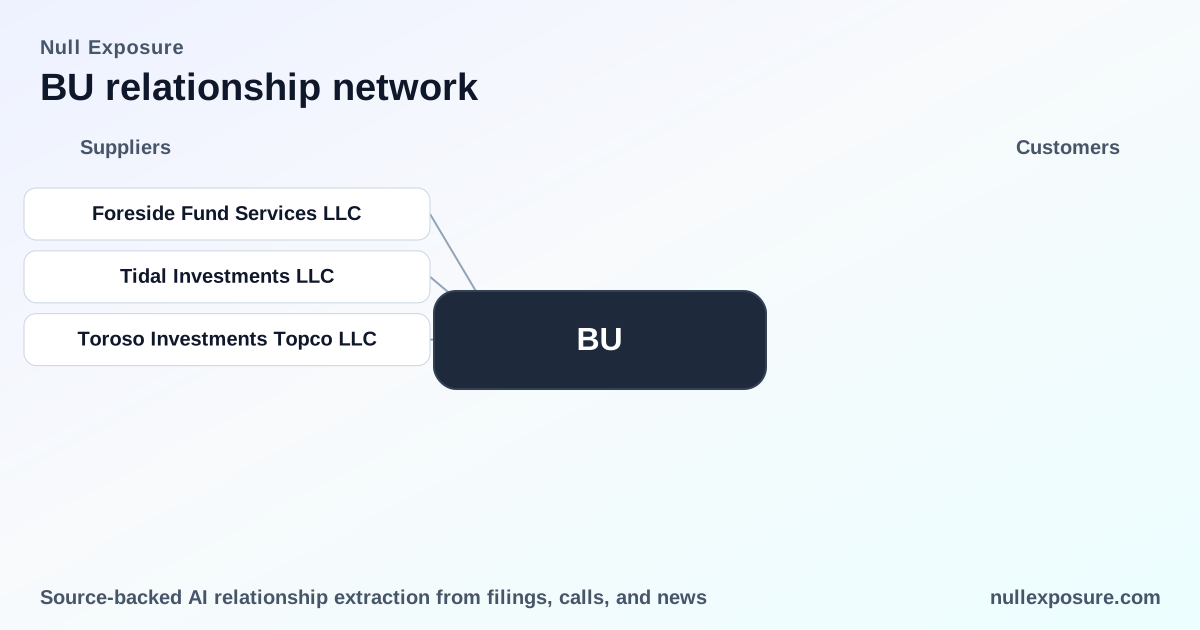
BU customer relationships: what investors need to know
BU operates as a business-to-business vendor that captures value by selling services and infrastructure to market participants — in this coverage set, notably leveraged ETF issuers and related trading channels. The company monetizes through recurring commercial arrangements and transaction-linked fees that attach to market-data, distribution, or trading technology used by institutional issuers. For investors, the key question is whether these customer links are strategic and concentrated (high revenue per customer) or shallow and transactional (low-stickiness, low-margin).
Explore more company-level signals at NullExposure.
High-level investor takeaways
- Limited public visibility of customers: The public feed shows two ETF-related references tied to leveraged ETF tickers; this suggests either a narrow set of high-profile relationships or low disclosure of a broader client base.
- Customer mix leans into ETF issuers and trading channels: Both identified relationships map to leveraged ETF products, pointing to a go-to-market focus on exchange-traded product participants.
- Concentration and criticality matter: If these relationships represent sizable contracts, BU’s revenue will be concentrated and dependent on a small number of issuer clients; conversely, if relationships are transactional, revenue is more diversified but lower margin.
How to read the relationship signals
The public signals in this set are news- and market-data mentions rather than formal customer contracts. Treat them as market-facing evidence that BU’s services are used by participants in the leveraged-ETF ecosystem. These items confirm presence in a specific vertical (ETF issuers/trackers) but do not disclose contract size, term, or exclusivity. Investors should use these signals to prioritize primary diligence: contract terms, billing model (subscription vs transaction), and customer concentration metrics.
Every customer relationship in the record
ONDL — Defiance $2x Long ONDS ETF
BU shows up in association with the Defiance $2x Long ONDS ETF (ONDL.US), which recorded a 20.10% intraday move with $36.47 million in trading volume in the cited report. The mention is a market-news reference tying BU’s customer footprint to leveraged ETF market activity. Source: Futunn news post, March 10, 2026 (https://news.futunn.com/en/post/69015864/us-equity-etf-tracker-amid-escalating-geopolitical-conflict-risks-the).
RKLZ — Defiance Daily Target 2x Short RKLB ETF
BU is also linked to the Defiance Daily Target 2x Short RKLB ETF (RKLZ) in a market-data/insiders listing that captures real-time price reference for the product. This citation indicates another leveraged ETF issuer in BU’s public relationship set. Source: Quiver Quant insiders page, March 10, 2026 (https://www.quiverquant.com/insiders/RKLZ).
Operating model and business-model constraints (company-level signals)
- Contracting posture: The available signals are public market mentions rather than contract disclosures, which is consistent with a vendor that operates behind the scenes and executes commercial agreements that are not routinely filed publicly. Investors should expect negotiated, bilateral contracts rather than one-size-fits-all public pricing.
- Concentration: With only two ETF-related relationships surfaced, revenue concentration is a salient risk unless further diligence reveals a broader, diversified client base. A small number of large issuer contracts would create volatility tied to client retention.
- Criticality: The relationships point to clients for whom market-data and distribution infrastructure are mission-critical. If BU supplies infrastructure that materially affects ETF issuance, customer switching costs and retention potential are high, which supports valuation multiple expansion conditional on contract terms.
- Maturity: The signal set is primarily short-form market mentions from FY2026; that pattern indicates public-facing maturity is limited — either the business is early stage in its issuer relationships or it reliably operates under non-disclosure commercial terms. This affects visibility into revenue predictability.
Risk and upside framing for investors
- Upside: If BU’s contracts with ETF issuers are long-term and fee-bearing (subscription plus per-ticket trading or distribution fees), then the company benefits from sticky, high-margin revenue tied to product flows and issuer growth. Exposure to leveraged ETF volumes amplifies upside when markets are volatile.
- Risk: If the relationships are transactional or purely data-listing arrangements, revenue will be sensitive to trading volumes and client churn. The present evidence does not disclose contract length or exclusivity, creating execution risk until primary diligence is completed.
Due diligence checklist for operators and investors
- Obtain contract copies or executive summaries that disclose pricing model (subscription vs. transaction), term, and termination clauses.
- Request client revenue split and concentration metrics to quantify single-customer exposure.
- Verify technical criticality: does BU provide a core infrastructure or an ancillary service that clients can replace without high cost?
- Validate growth path: are the identified ETF clients pilot customers leading to a broader issuer adoption?
Conclusion and action items
The disclosed customer links place BU squarely in the leveraged-ETF ecosystem, which is high-volume and high-sensitivity to market conditions. For investors, the next step is primary diligence on contract economics and concentration. For operators, validate whether current client relationships are strategic anchors or transactional engagements and adjust commercial terms accordingly.
For a concise company relationship view and deeper signals, visit NullExposure.