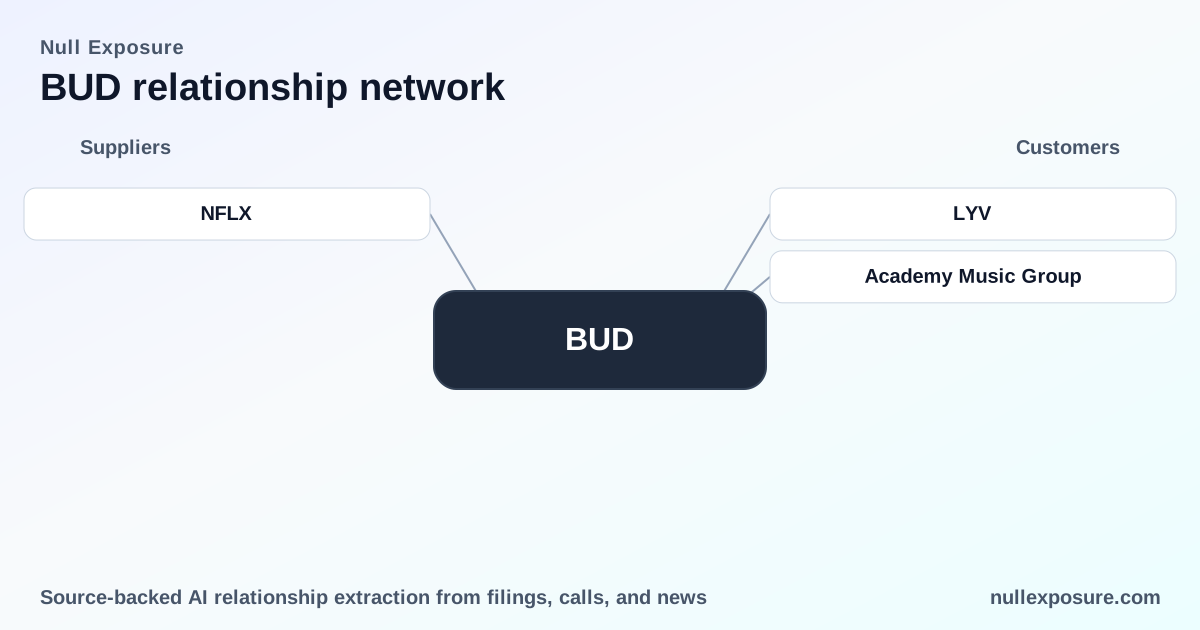
BUD Customer Map: Who Drives Revenue and Channel Reach for Anheuser‑Busch InBev
Anheuser‑Busch InBev (BUD) is a global brewer that monetizes through brand sales, route-to-market distribution agreements, event sponsorships, and selective licensing—generating roughly $59.3 billion in trailing revenue and EBITDA margins consistent with a consolidated consumer packaged‑goods leader. For investors, the key question is not whether AB InBev sells beer, but how its customer and channel relationships convert brand strength into durable cash flow. For a consolidated view of partner exposure and activation channels, visit NullExposure for ongoing relationship intelligence: https://nullexposure.com/.
Why the customer map matters to portfolio risk and return
AB InBev's business model is built on scale, brand mix, and an expansive distribution footprint. Customer relationships translate into three actionable investment signals: (1) activation and sponsorship contracts that boost seasonal and event-related volume, (2) distribution agreements that determine retail shelf access and wholesale margins, and (3) brand divestitures or licensing that reshape long‑term gross margin mix.
The source results here show a mix of contractual distribution renewals, exclusive event partnerships, and secondary-market activity around craft‑brand transfers—no explicit contractual constraints were flagged in the source material, which reads as a company-level signal that no single, material third‑party limitation is visible in these records. For investors this implies operational maturity and broad channel diversification, but also the usual exposure to concentrated trade partners and venue activations that can swing volumes around events and seasonality.
Customer relationships and what each partnership contributes
KKR (private equity historical deal link)
AB InBev’s past transactions with private equity are visible in the record: KKR previously sold and repurchased beer assets, with a noted sale back to AB InBev for $5.8 billion, underscoring AB InBev’s willingness to reabsorb brands when strategic consolidation is attractive. This deal history was reported by KED Global. (KED Global report; source: https://www.kedglobal.com/private-equity/newsView/ked202504100002)
Tilray Brands (TLRY) — craft portfolio and SKU rationalization
Tilray has become a meaningful player in the beer category by acquiring craft labels that once belonged to large brewers; Tilray’s strategy includes aggressive SKU rationalization of underperforming brands acquired from AB InBev to focus on higher‑margin craft and infused beverages, which reduces AB InBev’s craft footprint while transferring over retail placements. Coverage in FinancialContent and The Globe and Mail documents these moves as part of Tilray’s FY2026 expansion. (FinancialContent; https://markets.financialcontent.com/stocks/article/marketminute-2026-4-2-tilray-brands-surges-on-record-207-million-q3-revenue-margin-recovery-in-beverages-and-german-cannabis-growth-signal-turnaround; The Globe and Mail; https://www.theglobeandmail.com/investing/markets/stocks/TLRY/pressreleases/37323020/tlry-vs-cgc-which-cannabis-stock-is-the-better-investment-now/)
Tilray / BrewDog mentions (additional context)
Media coverage also highlights Tilray’s opportunistic craft acquisitions, including Bargain‑basement deals for parts of AB InBev’s portfolio, a structural signal that AB InBev will sell non-core craft assets rather than maintain low-margin SKUs. (VinePair; https://vinepair.com/booze-news/tilray-acquires-brewdog-for-44-million/)
Live Nation (LYV) — exclusive UK partnership and broader activation
AB InBev signed an exclusive beer and cider partnership in the United Kingdom with Live Nation, positioning its leading brands across festivals, venues, and outdoor shows and providing a direct activation channel to millions of legal‑age music fans—an important demand driver and brand‑building platform reported in investor coverage. (SimplyWallSt; https://simplywall.st/stocks/be/food-beverage-tobacco/ebr-abi/anheuser-busch-inbev-shares)
Live Nation UK (LYV) — headline exclusivity
StockTitan and other outlets specifically reported that AB InBev is now the exclusive beer and cider partner for Live Nation UK, which is material for U.K. event volume and sponsorship economics given the density of Live Nation’s festival calendar. (StockTitan; https://www.stocktitan.net/news/BUD/ab-in-bev-and-live-nation-strike-exclusive-uk-pi3xtguw3q7k.html)
Academy Music Group — venue activation in London
AB InBev will activate across Academy Music Group venues including O2 Academy Brixton and O2 Shepherd’s Bush Empire, extending the Live Nation exclusivity into specific, high‑profile London venues and reinforcing concert/channel activation as a repeatable volume lever. (StockTitan; https://www.stocktitan.net/news/BUD/ab-in-bev-and-live-nation-strike-exclusive-uk-pi3xtguw3q7k.html)
Ambev (ABEV) — BEES B2B commerce platform arrangement
Ambev entered a related‑party agreement with AB InBev to continue using and operating the BEES B2B digital commerce platform, signaling integrated digital trade capabilities across the group’s Latin American operations and potential margin and working‑capital benefits from platform consolidation. (Digital Commerce 360; https://www.digitalcommerce360.com/2025/12/23/ambev-deal-ab-inbev-bees-b2b-marketplace-platform/amp/)
Embotelladora Andina (AKO‑A / AKO‑B) — Chile distribution agreements
Local distribution arrangements in Chile were renewed and reinforced: Embotelladora Andina renewed AB InBev distribution agreements, aligning multi‑category beverage strategies in the region and demonstrating the company’s dependence on local bottlers and partners for shelf and route‑to‑market execution. (El Mostrador; https://www.elmostrador.cl/generacion-m/2020/08/17/luis-vives-por-acuerdo-coca-cola-embonor-s-a-y-ab-inbev-estamos-dando-un-gran-paso-en-la-estrategia-de-crecimiento-sostenible-organico-y-consistente-que-venimos-desarrollando-en-los-ultimo/; Pauta; https://www.pauta.cl/actualidad/2020/08/17/ab-inbev-firma-acuerdos-en-chile-con-embotelladoras-de-coca-cola.html; The Globe and Mail; https://www.theglobeandmail.com/investing/markets/stocks/AKO-A-N/pressreleases/37283973/embotelladora-andina-delivers-strong-4q-and-2025-results-expands-capacity-and-esg-commitments/)
Splash Beverage Group (SBEV) — distribution access through AB network
Splash Beverage’s acquisition included expanded distribution within the Anheuser‑Busch network and access to about 13,000 retail locations, illustrating AB InBev’s role as a distributor and activation partner for smaller beverage brands. (Newsfile; https://www.newsfilecorp.com/release/71454/Splash-Beverage-Group-Inc.-Acquires-Shark-Tank-Survivor-Copa-Di-Vino-Leading-Producer-of-Premium-Wine-by-the-Glass-Alongside-Potent-Growth-in-SingleServe-Beverage-Sector; TS2 Tech coverage; https://ts2.tech/en/will-sbev-pop-or-flop-splash-beverage-group-stock-surges-on-big-deals-analysts-weigh-in/)
Dine Brands (DIN) — trade placement and co‑promotion with casual dining
AB InBev’s brands show up in major casual dining channels—examples include product promotions such as Busch Light Apple at national chains, signaling the company’s importance to restaurant partners’ limited‑time offers and trade marketing programs. (Finviz news roundup; https://finviz.com/news/332663/dine-brands-el-pollo-loco-and-red-robin-shares-are-falling-what-you-need-to-know)
Investment implications: activation, concentration, and optionality
- Activation channels (Live Nation, Academy Music Group) are high‑leverage for brand momentum and seasonal upside; exclusivity deals support pricing and promotional control but create event‑dependent volume exposure.
- Distribution partners (Embotelladora Andina, Ambev, Splash) confirm that AB InBev relies on regional bottlers and commercial platforms to convert brand equity into shelf presence; this diversification reduces single‑counterparty concentration but underscores the importance of trade economics and digital commerce execution.
- Brand transfers (Tilray, historical private‑equity transactions) show AB InBev’s active portfolio management: the company will divest non‑core SKUs to improve portfolio profitability while retaining the major global brands that underpin margins.
Final read: what investors should watch next
Focus on quarterly disclosure of trade promotion intensity, renewals of major venue sponsorships in Europe and North America, and the pace of brand rationalization or portfolio divestitures. No direct contractual constraints surfaced in the reviewed results, which is a positive operational signal, but investors should track concentrated channel agreements and event dependency as drivers of near‑term volume volatility.
For a deeper, relationship‑level breakdown and live monitoring of partner activity, visit NullExposure to view structured customer intelligence for large corporates: https://nullexposure.com/.