Buda Juice (BUDA): Costco Placement Validates Wholesale Channel; Governance and Liquidity Drive Execution Risk
Buda Juice produces and distributes UltraFresh juices, lemonades, limeades, and wellness shots and monetizes through product sales to retailers and wholesale channels, supported by direct distribution agreements and retail rollouts. Revenue is generated at retail/wholesale unit margins, and recent third‑party placement signals channel expansion that can accelerate topline growth, while concentrated insider ownership and a small public float create execution and liquidity risk for investors.
For a concise, transaction‑level view of who buys Buda products and what it means for distribution risk, see https://nullexposure.com/.
Business model in plain language: unit economics, channels, and scale levers
Buda Juice sells finished beverage products into retail and wholesale accounts; the company’s P&L shows high gross margins and profitable unit economics for an emerging beverage brand. According to company‑level TTM figures (latest quarter 2025-12-31), Revenue TTM is $12.6M, Gross Profit TTM is $5.52M, and Profit Margin is 28%, demonstrating compact but profitable operations at current scale. Valuation metrics—Market Cap $121M, Trailing P/E 34.4, Price/Sales ~9.6—price the growth optionality into a relatively small revenue base.
Key operational characteristics:
- Channel dependence matters. Retail and big‑box placement are primary growth levers; each new national account materially lifts distribution reach and working capital needs.
- Liquidity and control are concentrated. Insiders hold ~74% of shares, with institutions at ~10% and a small public float (1.85M shares), constraining free‑float liquidity and making stock moves sensitive to insider actions.
- Small cap, high returns profile. With ROA ~49.5% and ROE ~102.5% (TTM), Buda shows strong returns on a small asset base, but scale risk and margin sustainability must be monitored as distribution expands.
What the data shows on customer relationships
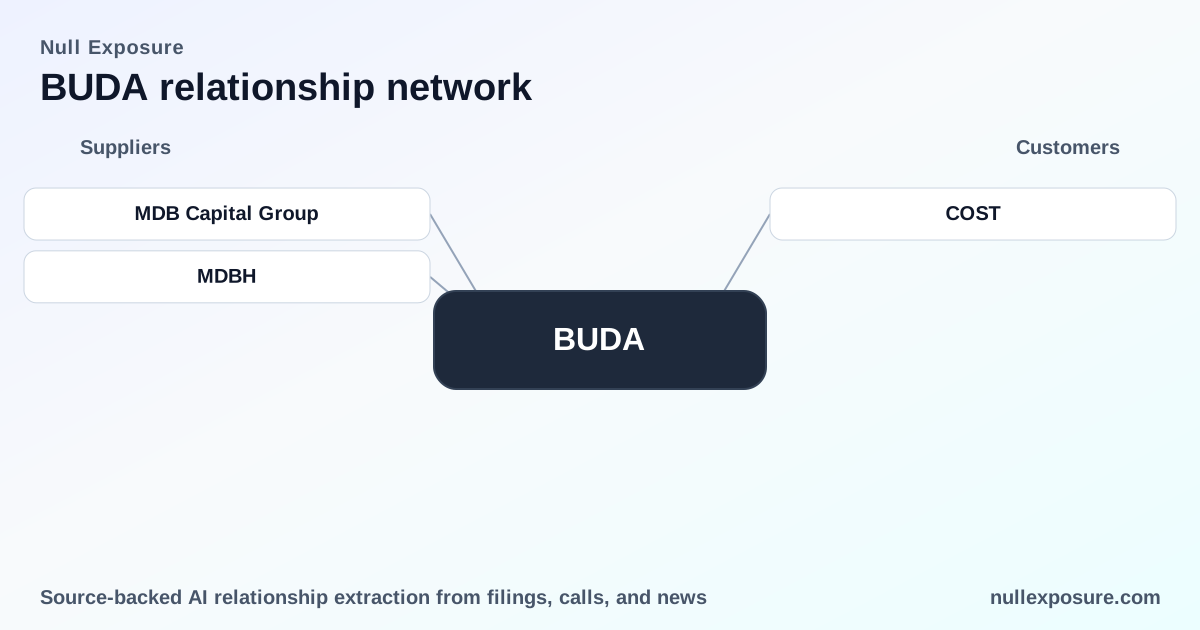
The dataset identifies Costco as a visible retail customer in media coverage; the captured items are news‑sentiment entries tied to the same media story. Below are the relationship items from the record, listed without omission.
COST (inferred symbol COST) — pop culture / social proof of retail placement
An Instagram post highlighted by a PopSugar write‑up reports that Costco is selling Buda Juice ginger and turmeric shots in bulk, indicating a wholesale placement and wider consumer visibility through a national big‑box channel. Source: PopSugar feature citing an Instagram user (first seen 2026-03-09).
Costco — confirmation of bulk placement in national club channel
The same PopSugar article notes Costco's bulk sale of Buda Juice ginger/turmeric shots, underscoring a distribution pathway into national club stores which typically moves large volume per SKU and raises production and supply requirements. Source: PopSugar article referencing Instagram evidence (published and detected 2026-03).
What the Costco placement implies for operations and contracting
The PopSugar coverage explicitly references bulk sales at Costco, which is an operationally meaningful signal: a Costco placement represents a wholesale contracting posture rather than a single, small‑format retail relationship. This has several implications:
- Fulfillment and scale: Bulk club placements require consistent volume, packaging and SKU management, and reliable fulfillment cadence; winning a Costco slot accelerates demand but increases supply chain complexity.
- Margin cadence: Club pricing and palletized SKUs can compress unit gross margin versus premium single‑serve retail, but volume can offset margin pressure through fixed‑cost absorption.
- Customer criticality: A recurring national club account becomes a high‑impact customer—loss or fluctuation in that channel would materially affect near‑term sales.
Because there are no explicit constraints reported in the dataset, the above contracting and criticality observations derive directly from the content of the Costco mention rather than from separate contractual disclosure.
Company‑level signals investors should weigh
In addition to the single identifiable retailer placement, company fundamentals and ownership structure are decisive for risk assessment:
- Concentrated insider ownership (74%) and tiny float (1.85M shares) mean governance and capital decisions are effectively controlled by insiders; public investors will see limited day‑to‑day influence and volatile tradeability.
- High profitability metrics at small scale (28% profit margin; ROA ~49.5%; ROE ~102.5%) indicate a lean cost base, but these figures will be sensitive to expanded distribution costs and promotional allowances required by national accounts.
- Valuation embeds growth. At a Market Cap of $121M and Price/Sales ~9.6, the market expects continued distribution expansion and margin preservation; any slowdown in new retail rollouts or SKU replenishment into large accounts will pressure multiples.
Investment takeaway and risk checklist
- Bull case: Costco placement is a concrete validation of Buda’s product fit for bulk club channels and provides a scalable revenue path; high margins at current scale allow cash flow reinvestment into growth.
- Key risks: Concentrated insider control and limited float reduce institutional arbitrage and can amplify volatility; operational scaling risk—logistics, packaging, and promotional funding required for big‑box rollouts—presents a meaningful execution hurdle.
- Catalysts to watch: recurring reorder patterns from Costco, expansion into additional national club or grocery banners, and quarterly updates on distribution and production capacity.
For practitioners building channel forecasts or stress tests, the Costco mention should be modeled as a wholesale account with lumpy volume, higher working capital draw, and lower per‑unit margin than boutique retail SKUs.
Discover more customer‑level intelligence and connect signals to financial models at https://nullexposure.com/.
Final read for operators and investors
Buda Juice is a profitable small cap with a demonstrable route into national retail through a Costco placement reported in social and lifestyle media; this converts brand momentum into tangible wholesale distribution but requires disciplined execution and careful liquidity management given ownership concentration. Track reorder cadence, promotional allowances, and any formal retailer announcements to convert this media signal into verifiable revenue trajectory.