Webull Corp (BULL): Capital Partners, Distribution Ties, and What Investors Should Price In
Webull operates as a digital retail brokerage platform that monetizes through trading-related revenue, interest and financing income, and platform services to both retail investors and corporate clients; the company reported $564.3 million in trailing twelve‑month revenue and a slim but positive profit margin of 4.39% as of the latest quarter. Its operating profile combines scalable transaction economics with visible capital-market activity—evidence of this includes a standby equity purchase facility that delivered $173.2 million of proceeds and strategic distribution arrangements to access overseas retail flows. For investors evaluating customer and partner risk, focus on capital flexibility, distribution concentration in select markets, and the commercial maturity of value-add services. Learn more about how we track counterparty exposure at https://nullexposure.com/.
How Webull’s partner set drives growth and capital options
Webull’s operating model blends three commercial levers: retail order flow and execution services, lending and interest on margin balances, and enterprise or corporate services that nurture issuer–shareholder engagement. That mix produces high revenue leverage to customer activity and makes distribution relationships—particularly in cross‑border markets—material to growth. The company’s move to terminate a standby equity purchase agreement (SEPA) after limited drawdown signals an active capital posture: it used the facility selectively (11.5 million shares for $173.2 million) and has since closed that avenue, which changes both dilution dynamics and available dry powder for M&A or marketing spend.
- Capital posture: The SEPA provided optional equity capital up to $1.0 billion but was used only modestly and subsequently terminated, indicating a preference for controlled, opportunistic financing rather than continuous shelf‑style dilution.
- Concentration and criticality: Distribution partners in Korea represent outsized access to non‑US retail flows; partners that route or sponsor customer access are commercially critical for international growth.
- Maturity: Positive operating margin and meaningful revenue growth year-over-year show a transition from scale investment toward operating profitability, but the company still relies on capital-market tools and institutional partners to accelerate international expansion.
Relationship map — each public customer mention, explained
YA II PN, Ltd.
- Webull used a SEPA with YA II PN, Ltd. under which it had the ability to issue up to $1.0 billion of Class A shares; the company ultimately sold 11.5 million Class A shares to Yorkville for $173.2 million and later terminated the facility. According to an FXNewsGroup report covering FY2026, the limited drawdown but material cash injection underscores an opportunistic financing posture. (FXNewsGroup, May 2026)
YA II PN, Ltd. (Morningstar press release)
- A Morningstar press release in April 2026 formally announced the termination of the standby equity purchase agreement with YA II PN, Ltd., reiterating that the SEPA permitted up to $1.0 billion in issuances but only $173.2 million was raised from the 11.5 million shares sold. (PR Newswire / Morningstar, Apr 7, 2026)
YA II PN, Ltd. (Yorkville) — news pick-up
- Coverage from The Globe and Mail / TipRanks confirmed that the Yorkville facility was ceased after those share sales, noting the program’s eventual discontinuation in September 2025, which crystallizes the timing of the company’s exit from that capital arrangement. (The Globe and Mail / TipRanks, May 2026)
Meritz Financial Group
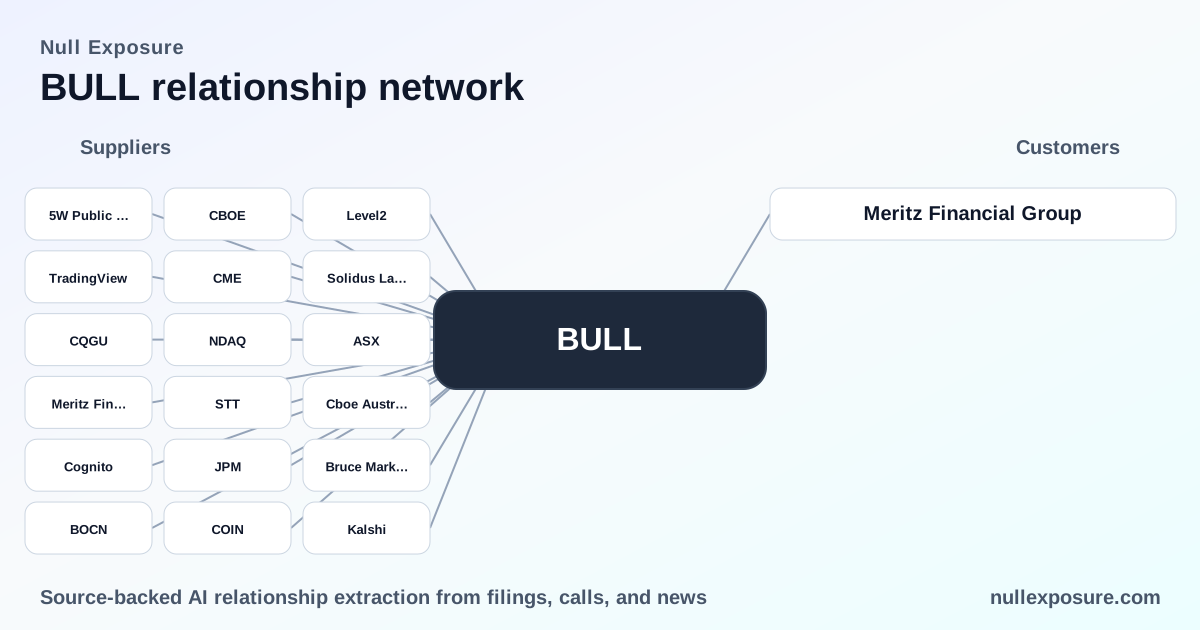
- Webull entered a distribution arrangement with Meritz Financial Group to bring U.S. equity market access to South Korean investors, a partnership described in FinanceMagnates’ reporting of FY2026 that positions Meritz as a key local conduit for retail order flow. (FinanceMagnates, Mar 2026)
Merits Financial Group
- Management reported trading in excess of $1 billion notional equity for Korean customers through its relationship with Merits, highlighting meaningful execution volume routed via a Korean partner and the commercial scale of Webull’s Korean distribution channels. This detail was captured during a Q4 2025 earnings call transcript reported by The Globe and Mail. (The Globe and Mail, Q4 2025 earnings call transcript)
FRRSF (Foremost Lithium / Corporate Connect Service)
- Foremost Lithium (FRRSF) joined Webull’s Corporate Connect Service to foster online dialogue with shareholders, indicating that Webull’s platform offers issuer‑facing products that monetize beyond pure retail trading and help corporates engage retail holders. The announcement came via GlobeNewswire in February 2024 and signals an incremental revenue stream from corporate services. (GlobeNewswire, Feb 20, 2024)
What these relationships imply for risk and upside
The Yorkville SEPA episode is the clearest signal on capital strategy: Webull exercised a limited portion of a much larger facility and then closed the program, which reduced immediate dilution while securing $173.2 million of liquidity—useful for product investment or to support market‑making needs. Distribution partners in Korea (Meritz/Merits) are both a growth vector and a concentration risk; the two separate media references to Korean flows indicate sustained, material routing of customer notional through local financial institutions. The Corporate Connect engagement with FRRSF highlights a diversification path into corporate services, which supports higher-margin, non‑transactional revenue.
Investment implications and watchlist
- Balance-sheet flexibility: The termination of the SEPA reduces potential future dilution but also removes a ready equity backstop; monitor cash and operating cash flow trends to assess runway for marketing and international expansion.
- Geographic concentration: Korean distribution relationships deliver scale quickly but increase regulatory and partner‑execution exposure; track partner contract terms and any disclosures on exclusivity or revenue share.
- Revenue mix evolution: Continued growth in fee and platform services (e.g., Corporate Connect) would improve margins and lower dependence on volatile trading activity; monitor disclosures and customer win announcements for repeatability.
For a structured view of counterparty and partner exposure across public filings, visit our research hub at https://nullexposure.com/ for methodology and ongoing updates.
Final takeaway
Webull’s public partner mentions present a coherent narrative: the company executes selective capital raises, relies on targeted distribution partners for international growth, and is layering corporate services to diversify revenue. Investors should value Webull for its scalable retail platform while pricing in the execution risk tied to partner concentration and the strategic consequences of retiring standby capital facilities.