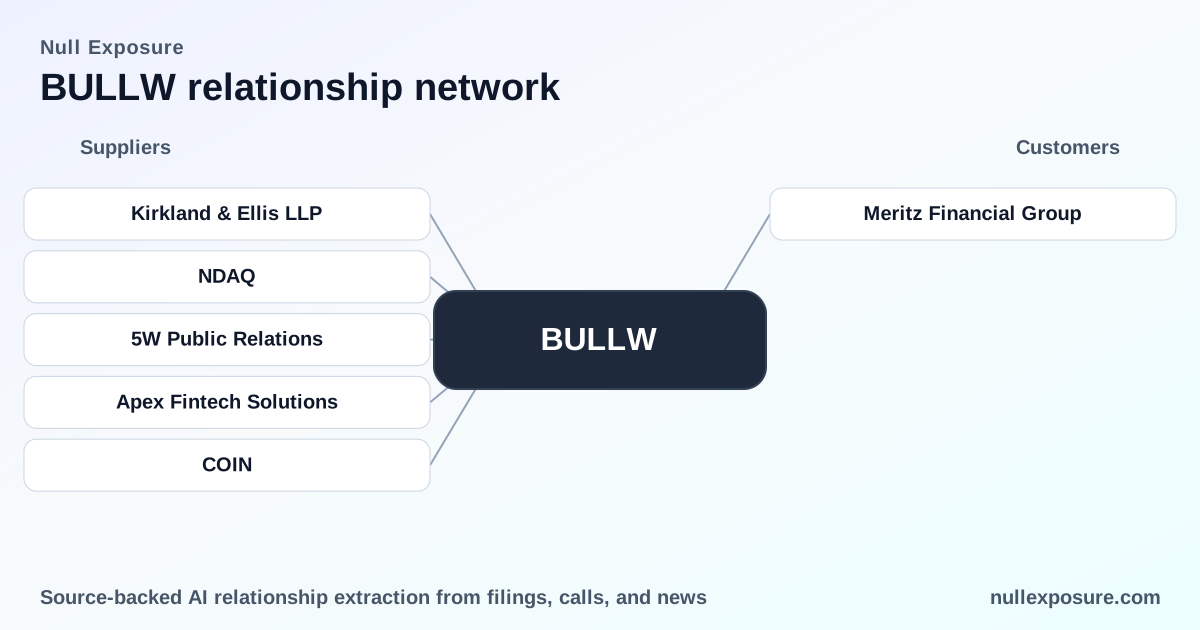
Webull (BULLW Warrants) — Customer relationships, what investors need to know
Webull is a digital investment platform that monetizes through platform-based trading and financial services: the firm reports meaningful top-line revenue from customer activity and product delivery and translates that into gross profit via platform economics. Webull reported Revenue (TTM) of $564.3M with Gross Profit (TTM) of $435.6M, signaling a high gross margin business built on trading volume, account-related services and financial product distribution. For investors evaluating BULLW, the most material customer signal in the public record is a strategic institutional partnership in South Korea that drives international distribution and access to U.S. equities.
If you want a concise feed of customer relationship signals for due diligence, visit https://nullexposure.com/ for a focused breakdown.
How Webull’s commercial model shows up in customer signals
Webull is a platform business: revenue scales with customer activity and the firm leverages partnerships to expand addressable markets. The company-level financials show substantial revenue relative to operating margins (RevenueTTM $564.3M; OperatingMarginTTM 2.42%), indicating a mature operating base with significant top-line throughput but still pressure on operating leverage. For investors and operators, that combination implies that distribution partnerships and customer acquisition channels are direct levers on profitability—acquiring higher-value accounts or opening new national markets will move both volume and margin.
The customer relationships on record
Webull’s customer-related public signals in our collection are narrow but consequential. The dataset returned two distinct disclosures pointing to the same strategic partner: Meritz Financial Group.
-
On Nov. 12, 2025 Webull announced a strategic partnership with Meritz Financial Group, one of South Korea’s established financial institutions, reflecting an institutional distribution arrangement to reach Korean investors. This coverage was reported in an article summarizing Webull’s Q3 2025 results (TS2.tech, article surfaced March 9, 2026).
Source: TS2.tech coverage of Webull Q3 2025 results (article referencing Nov. 12, 2025 partnership; published/collected March 9, 2026). -
A corporate press release filed with Webull’s fourth-quarter and full-year 2025 financial results reiterates the partnership: Webull entered into an arrangement with Meritz Financial Group to offer South Korean investors seamless access to U.S. equity markets. The company presented this as part of its FY2025–FY2026 go-to-market expansion (Newswire, May 2, 2026 press release).
Source: Webull press release on Q4 and FY2025 financial results (Newswire, May 2, 2026).
These two items are the complete set of customer-relationship signals surfaced for BULLW in the period covered by our search.
Why the Meritz relationship matters for investors
The Meritz tie is not a casual marketing agreement; both the timing (announced Nov 2025, restated with FY2025 results) and the language—“seamless access to U.S. equity markets”—point to an intentional distribution arrangement. For investors this implies direct customer acquisition into an attractive, underpenetrated offshore retail market, which can lift platform volumes and elevate revenue per account over time.
Key implications:
- Distribution lift: Partnerships with established local players reduce friction for market entry and accelerate customer inflows without Webull having to build local retail infrastructure from scratch.
- Revenue mix impact: Greater international retail adoption typically increases transactional revenue and related product sales; given Webull’s high gross-profit structure, incremental volumes can translate to rapid gross-dollar growth.
- Regulatory and execution considerations: Cross-border distribution introduces compliance and custody considerations; investors should track subsequent filings for details on custody arrangements, revenue-sharing, or exclusivity clauses.
Operating posture, concentration and maturity signals (company-level)
There are no explicit contractual constraint disclosures in the records we reviewed. That absence is itself a company-level signal: public filings and press reports contained no detailed vendor concentration or long-term exclusivity commitments that would indicate a dependency on a single supplier or customer in the disclosed materials.
From an operator’s perspective, this yields the following characteristics of Webull’s business model:
- Contracting posture: Partnership-led expansion—Webull uses institutional partners to extend reach rather than relying exclusively on internal country builds.
- Concentration: Publicly documented customer relationships are limited in number, so disclosed concentration is low in the sample; however, the presence of a large institutional partner like Meritz introduces a single, visible channel for a specific international market.
- Criticality: Partnerships that enable market access are functionally critical to international growth and distribution, even if they are not described as exclusive or long-term in the available materials.
- Maturity: The Meritz relationship is early-stage in public disclosure, announced in late 2025 and reiterated in 2026, which positions it as an initial expansion step rather than a long-standing channel.
Risks and what to watch next
- Customer concentration in disclosures: Only Meritz shows up in the public relationship signals we reviewed; investors should watch for additional partner announcements or customer filings to understand whether Webull will continue to rely on one-off institutional distribution deals or scale a diversified set of local partners.
- Execution and economics: The commercial terms—revenue share, custody arrangements, customer onboarding costs—are not disclosed in the press materials; those economics will determine whether the partnership moves the margin needle or primarily boosts volume at low margin.
- Regulatory exposure: Cross-border access to U.S. markets involves regulatory complexity; future filings or disclosures will reveal how Webull structures compliance and who bears regulatory costs.
Bottom line: actionable takeaways for investors and operators
- Meritz Financial Group is the single material customer relationship disclosed in our search window, positioned to broaden Webull’s South Korea distribution (TS2.tech coverage, Nov. 12, 2025; Webull press release on Q4 and FY2025 results, May 2, 2026).
- Webull’s platform economics (RevenueTTM $564.3M; GrossProfitTTM $435.6M) make distribution partnerships high-leverage levers for growth—effective partner execution will have outsized impact on revenue and gross profit trends.
- No explicit contractual constraints were disclosed in the sample, which signals that public documents do not yet reflect long-term exclusives or concentration risks; confirmatory diligence is required to assess commercial terms and regulatory responsibilities.
For a consolidated view of customer and commercial signals across tickers, visit https://nullexposure.com/ — the site provides targeted relationship intelligence for investor diligence and operator benchmarking.