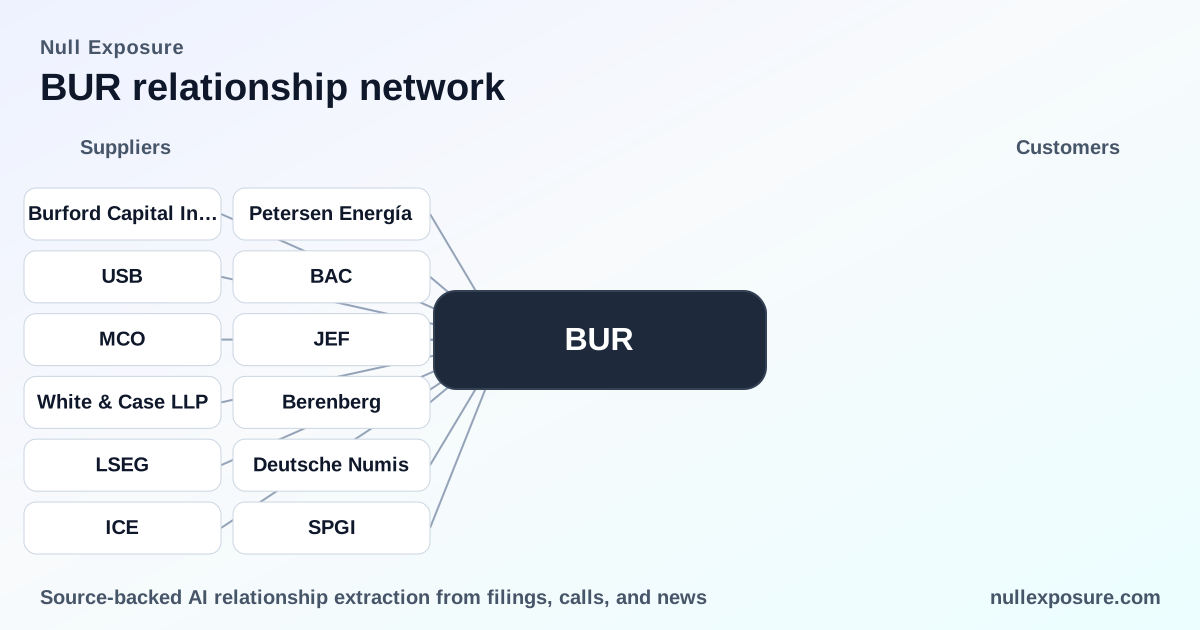
Burford Capital (BUR): Customer relationships that drive legal-finance returns
Burford Capital provides capital, asset management and risk solutions to the legal sector and monetizes through capital provision income on its balance sheet and asset management fees and performance fees on third‑party funds. Investors should value Burford as a hybrid asset manager and principal investor: revenues combine recurring management fees and long‑term contracts with lumpy, case‑driven performance receipts tied to litigation outcomes. For a quick company summary and additional context, see NullExposure’s profile: https://nullexposure.com/.
Business model in plain language: recurring fees plus outcome‑dependent upside
Burford operates in two complementary channels. Its Principal Finance arm commits capital from the balance sheet into litigation and arbitration cases, generating capital provision income that is sensitive to recoveries and case timing. Its Asset Management and Other Services segment manages funds for third parties and earns management fees (generally low single‑digit rates on AUM) and performance fees when cases settle favorably. The contracts that underpin these revenue streams are predominantly long‑term and service‑oriented, where fees are recognized over time as cases progress and outcomes crystalize.
Key operating constraints and characteristics that shape execution:
- Contracting posture: revenues include subscription‑style management fees and longer‑duration service contracts recognized over time.
- Concentration: a meaningful portion of AUM is concentrated in a small number of single‑investor private funds (company disclosure identifies BOF‑C and a sidecar as representing a large share of AUM).
- Counterparty profile: counterparties are a mix of very large law firms, corporate litigants and sovereign investors—counterparty financial strength materially affects recoveries.
- Geographic footprint and maturity: Burford is a global operator with established offices in New York, London and Chicago, and a business model that balances recurring fee stability with event‑driven principal results.
Relationships that matter to the FY2026 story
Below I cover every customer relationship surfaced in the available reporting and media references, with concise takeaways and original sources.
Advantage Fund — performance fees supported FY2026 results
Burford recognized stronger performance fees from the Advantage Fund in FY2026, which partially offset weakness elsewhere in the business. This contribution highlights the asymmetric payout profile of managed funds where realized case outcomes can rapidly lift revenues. (InsiderMonkey coverage of Burford’s FY2026 results, May 2026: https://www.insidermonkey.com/blog/burford-capital-bur-fq4-2025-earnings-heres-what-you-should-know-1712594/?amp=1)
BOF‑C fund — large single‑investor exposure and reduced profit‑share dragged results
The BOF‑C fund was explicitly cited as a source of reduced profit‑sharing in the FY2026 commentary, and company disclosures identify BOF‑C (together with a sidecar) as single‑investor funds—one of which is a sovereign wealth investor—representing roughly 30%+ of AUM. That concentration creates material dependency on a small set of counterparties for a sizeable portion of fee and performance income. (InsiderMonkey on FY2026 decline attribution, May 2026; Burford filing excerpts noting BOF‑C single‑investor status, FY2024/2023 disclosures)
Eton Park — financed claim reversal increases recovery uncertainty
A US Court of Appeals decision reversed a prior judgment that had favored Petersen and Eton Park, both of which Burford financed in relation to claims over Argentina’s YPF nationalization. The reversal reduces the near‑term certainty of recoveries on those financed claims and is a negative read‑through to Burford’s exposure where it has capital at risk. (Sharecast report summarizing broker reaction and the Second Circuit reversal, May 2026: https://www.sharecast.com/news/broker-recommendations/berenberg-slashes-burford-capital-target-price-following-us-court-reversal--22209835.html)
Petersen — co‑financier whose favourable judgment was overturned
Petersen, a co‑claimant in the YPF financing, was similarly affected by the appellate reversal; the outcome decreases expected proceeds from those claims and therefore compresses the value of any capital Burford deployed on similar matters. The market reaction reflected the direct legal‑outcome sensitivity of Burford’s principal finance positions. (Sharecast coverage on the same Second Circuit decision, May 2026: https://www.sharecast.com/news/broker-recommendations/berenberg-slashes-burford-capital-target-price-following-us-court-reversal--22209835.html)
What the relationship map signals about risk and optionality
Taken together, these relationships demonstrate the core tradeoff in Burford’s model: stable, subscription‑style revenue from management fees against idiosyncratic, high‑payoff principal investments that are binary and timing‑uncertain. Company disclosures and reporting highlight several firm‑level signals:
- Concentration risk is elevated. The BOF‑C and sidecar single‑investor exposures account for a material share of AUM; when one or two investors dominate AUM, fee revenue and fundraising flexibility become sensitive to those counterparties’ preferences and renewal decisions.
- Counterparty mix is high‑quality but outcome‑dependent. Clients include very large law firms and sovereign investors; their financial strength supports counterparty performance, but litigation outcomes drive ultimate cash flow.
- Contracts skew long‑term and service‑oriented. Management fees are recurring while performance fees and principal recoveries are realized over the life of cases—this creates a layered revenue profile with different volatility characteristics.
- Operational maturity and global reach reduce execution risk but do not eliminate legal or sovereign litigation volatility, as the Eton Park/Petersen reversal illustrates.
If you want a concise monitoring framework for these dynamics, visit NullExposure’s investor hub for Burford: https://nullexposure.com/.
What investors should watch next
- Appeal activity and finality on the YPF‑related decisions and any settlement negotiations.
- BOF‑C and related single‑investor fund renewal or migration signals from the sovereign investor.
- Timing and recognition of performance fees from Advantage and other funds, which create quarter‑to‑quarter revenue swings.
- Fundraising and capital allocation: how much capital Burford retains on its balance sheet versus third‑party AUM growth, which determines the blend of recurring vs outcome‑dependent revenue.
Bottom line: asymmetric payoff with concentrated exposures
Burford’s economics combine predictable management fee streams and highly asymmetric principal returns. The relationships cited in FY2026 reporting confirm both the upside—performance fees from funds like Advantage—and the downside: concentrated AUM (BOF‑C) and legal reversals (Eton Park/Petersen) that meaningfully affect near‑term realized value. For investors, the key decision is whether the current price fully compensates for concentration and legal‑outcome risk while pricing in the optional upside of future performance fees and successful principal recoveries.