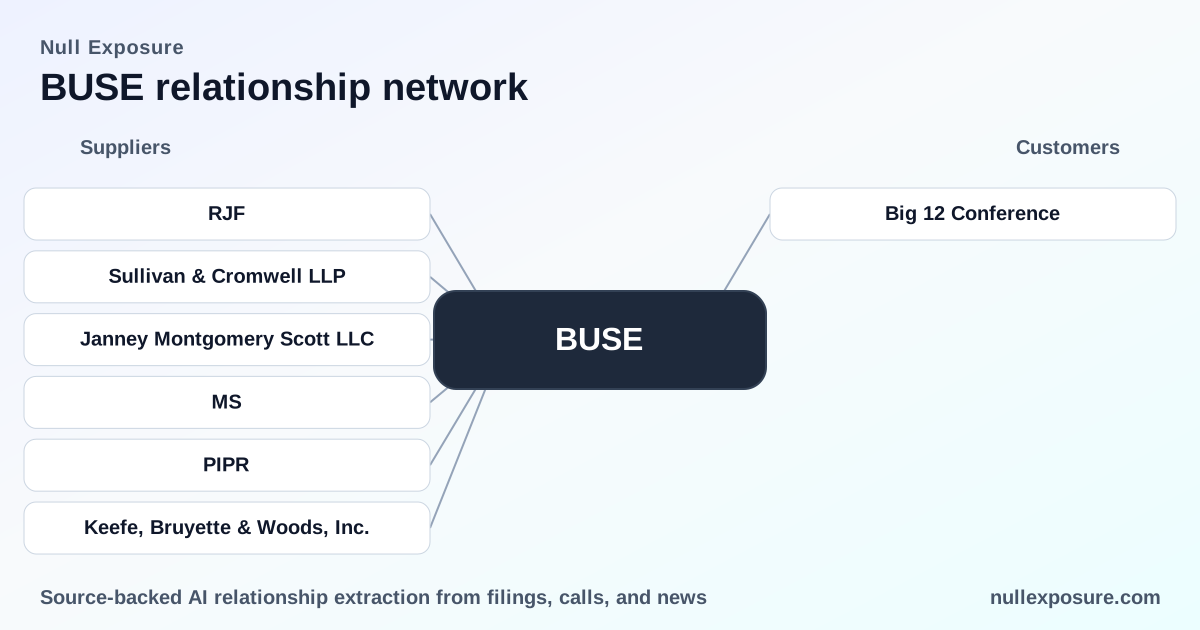
First Busey (BUSE) — Customer relationships and what the Big 12 partnership signals for investors
First Busey Corporation operates as a regional banking holding company that monetizes through three principal noninterest service streams—wealth management fees, payment-technology services via its FirsTech unit, and traditional banking deposit/loan spreads—supplemented by retail and commercial lending. The company leverages a multi-state branch footprint and a commerce-oriented payments business to sell services to individuals, businesses, and institutions, converting local brand presence into fee revenue and transactional income. For investors, the critical lens is how customer contracts and strategic partnerships drive noninterest income growth, deposit capture, and distribution for Busey’s service offerings.
Visit Null Exposure for the data behind these relationship assessments: https://nullexposure.com/
A single line item that matters: the Big 12 sponsorship is tangible customer-facing distribution
On January 5, 2026, the Big 12 Conference named Busey Bank the Official Bank of the Big 12, marking the league’s first official banking partner. This multi‑year agreement is both a marketing and commercial channel play: it increases Busey’s brand visibility across a widespread, affinity-driven audience while creating sponsorship platforms that can be activated to win new deposit customers and card/payment relationships. (Source: Big 12 press release, January 5, 2026 — https://big12sports.com/news/2026/1/5/busey-bank-named-official-bank-of-the-big-12-conference.aspx)
Relationship inventory — the complete list (one entry)
- Big 12 Conference — Busey Bank was designated the Official Bank of the Big 12 in a multi‑year partnership announced January 2026; the agreement positions Busey to expand brand reach and capture consumer and small-business banking relationships tied to conference audiences. (Source: Big 12 press release, January 5, 2026 — https://big12sports.com/news/2026/1/5/busey-bank-named-official-bank-of-the-big-12-conference.aspx)
What the relationship roster implies about Busey’s operating model
The available relationship evidence and First Busey’s public disclosures point to several company-level operating characteristics investors should treat as structural realities:
-
Contracting posture: seller + service provider. First Busey sells wealth management, payment processing (FirsTech), and banking services directly and also provides services on behalf of third parties where revenue is shared. The firm recognizes service revenue as operations complete (ASC 606 language is explicit in the filings), indicating a recurring, performance-based revenue profile rather than one-off product sales. (Source: First Busey consolidated financial statement disclosures / ASC 606 discussion.)
-
Counterparty mix and concentration: broad retail base with enterprise pockets. Disclosures emphasize individual consumers and small-to-medium businesses as core customers, while also noting the presence of Fortune 1000 clients in some Illinois markets—creating a mix that is retail-dominated but not void of large-enterprise exposure. This profile reduces single-counterparty concentration risk but creates sensitivity to regional economic cycles. (Source: First Busey management discussion and segment disclosures.)
-
Geographic scale: regional but diversified across U.S. time zones. Busey’s footprint spans the Midwest, Southwest, and Florida with full-service locations across ten states and roughly $20 billion in combined assets for the larger franchise context. That footprint supports cross-sell opportunities from sponsorships like the Big 12 deal, but also exposes the company to disparate regional competitive dynamics. (Source: company operating segment disclosures; press materials highlighting state coverage.)
-
Revenue criticality and maturity: services are a strategic growth lever. Wealth fees and FirsTech processing are explicitly called out as noninterest revenue drivers whose timing aligns with service delivery. These lines are strategic for margin expansion and are more mature in terms of operating cadence than early-stage fintech experiments—FirsTech is a subsidiary with established multi-channel payment capabilities. (Source: segment descriptions in First Busey disclosures.)
How the Big 12 partnership fits into the strategic playbook
The Big 12 deal is not a fintech integration contract; it is a marketing-led distribution relationship that creates direct consumer and business engagement opportunities. For a regional bank whose noninterest income growth is anchored to wealth and payments, the partnership delivers three concrete advantages:
-
Scale and reach for customer acquisition. Sponsorship exposure across college athletics provides low-friction access to younger demographics and alumni networks—useful for deposit growth and fee product cross-sell.
-
Brand differentiation in crowded regional markets. In markets dominated by national banks and digital competitors, an athletics partnership amplifies local affinity and improves standing with community and business leaders.
-
Commercial activation for payment products. The Big 12 platform can be used to promote FirsTech merchant solutions and Busey business banking services to conference partners, venues, and vendors—driving fee-bearing payment relationships rather than only brand impressions.
(Primary source: Big 12 press release and First Busey segment disclosures describing payments and wealth services.)
Risks and operational constraints investors should price in
-
Concentration of business model in services: While spread income remains foundational, First Busey’s disclosed focus on wealth fees and payment technology increases reliance on fee stability and transaction volumes; a downturn in activity levels or competitive fee compression would pressure noninterest income. (Source: ASC 606/noninterest income disclosures.)
-
Regional macro sensitivity: With primary markets concentrated in Illinois, Missouri, Indiana, and Florida, regional economic weakness or a localized deposit flight would have disproportionate effects compared to more nationally diversified peers. (Source: market footprint statements.)
-
Competitive displacement in payments: FirsTech competes in a crowded payments landscape; success depends on distribution breadth and pricing discipline. The Big 12 sponsorship helps distribution, but monetization still requires conversion of impressions into contracted merchant relationships. (Source: FirsTech operating segment description.)
The investment takeaway — clear and actionable
First Busey’s customer relationships are a mix of retail depth and targeted enterprise exposure, with service lines—wealth management and payments—positioned as growth engines. The Big 12 partnership is a low-complexity, high-visibility channel that supports deposit and payment-product acquisition without changing the company’s core underwriting or credit risk profile. Investors should value Busey as a regional banking franchise with meaningful optionality from fee businesses, while monitoring service revenue conversion metrics and regional deposit trajectories as the primary indicators of operational health. For original-source relationship data and structured signal interpretation, review the coverage at Null Exposure: https://nullexposure.com/
If you want a deeper breakdown of Busey’s customer contracts, revenue recognition practices, or to track new customer relationships as they are announced, visit our platform at https://nullexposure.com/ for the underlying relationship signals and source links.