BrightView Holdings (BV): Customer Relationships, Revenue Quality, and Contract Dynamics
BrightView Holdings operates the largest commercial landscaping platform in the United States, monetizing through a dual model of recurring maintenance contracts and project-based landscape development, supplemented by seasonal services such as snow removal and specialized turf management for venues. Revenue mixes into stable, repeatable maintenance streams and higher-margin development projects, with contract structures that produce both near-term cancellable cash flow and multi-year remaining performance obligations that underwrite visibility. For an investor evaluating customer relationships and revenue durability, BrightView’s position as a national service provider and its roster of high-profile clients deserve attention.
Learn more at https://nullexposure.com/.
How BrightView wins business and what that implies for revenue predictability
BrightView’s commercial model is straightforward: it sells ongoing maintenance packages (lawn care, mowing, irrigation, tree care), bespoke landscape development projects, and event- or season-driven work such as snow removal. The company combines recurring annual contracts—typically 1–3 years and cancellable with 30–90 days’ notice—with a pipeline of longer-duration obligations tied to development projects. BrightView’s FY2025 disclosures report remaining performance obligations for contracts with an original expected duration greater than one year of approximately 463.4, reflecting meaningful forward revenue tied to multi-year engagements.
- Contracting posture: Maintenance contracts are primarily short-term recurring agreements with modest cancellation notice, while development work generates larger, less frequent commitments; snow removal is sold on fixed-fee or per-occurrence terms.
- Concentration and criticality: Top ten customers represented roughly 17% of fiscal 2025 revenues with no single customer >4%, signaling low counterparty concentration and reduced single-account tail risk.
- Geographic footprint and scale: BrightView is the largest U.S. commercial landscaping provider, with revenue concentration in North America and a customer mix that includes Fortune 500 campuses, municipalities, airports, healthcare and education institutions, and golf courses.
- Spend scale: Development projects span from $100,000 to over $10 million, with an average project size of approximately $1.5 million—implying project-level economics that can materially swing margins when development is elevated.
These structural characteristics create a hybrid revenue profile: predictable baseline cash flow from maintenance plus episodic upside from development and specialty venue contracts.
Major customer relationships: direct summaries and sources
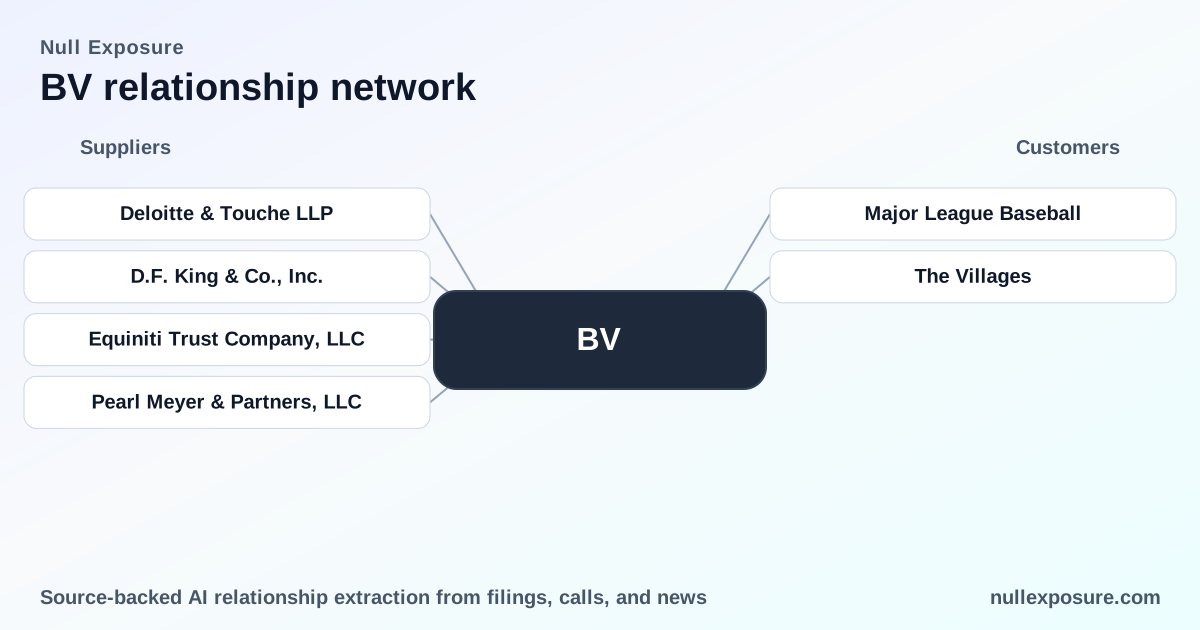
Major League Baseball
BrightView acts as the Official Field Consultant to Major League Baseball, a role that underscores the company’s turf-management expertise and provides high-profile proof points for stadium, entertainment, and sports venue work. This relationship reinforces BrightView’s national brand and technical capabilities in high-performance turf environments. (Source: regional reporting and press coverage, MyChesco, March 2026 — https://www.mychesco.com/a/news/regional/brightviews-preferred-dividend-streak-signals-cash-strength-without-dilution/)
The Villages
BrightView expanded its golf course management partnership with The Villages, a large master-planned community in Florida, deepening its footprint in golf and amenity services where recurring, community-scale maintenance and recreation-area development are material. This win signals growth in higher-margin, amenity-driven contracts that align with the company’s development and golf-course maintenance capabilities. (Source: company and market reporting, Simply Wall St / StockTitan coverage, March–May 2026 — https://simplywall.st/stocks/us/commercial-services/nyse-bv/brightview-holdings/news/brightview-deepens-the-villages-ties-with-larger-golf-role-a)
Both relationships are active, publicly disclosed commercial arrangements that highlight BrightView’s strategy of pairing marquee venue work with broad-based commercial maintenance.
Constraints and company-level operating signals investors should price in
BrightView’s filings and public disclosures provide several concrete operating signals that shape investor expectations for revenue quality and margin durability:
- Mix of contract tenors: The company reports remaining performance obligations for contracts longer than one year at approximately 463.4, indicating a non-trivial backlog of multi-year revenue (company FY2025 disclosure). Concurrently, maintenance services are largely sold under annual, cancelable contracts (1–3 years; cancellable on 30–90 days’ notice), which introduces some churn risk but preserves recurring revenue.
- Spot and seasonal work: Snow removal and similar services are routinely sold on fixed-fee or per-occurrence bases, creating a volatility vector tied to seasonality and weather.
- Customer base and concentration: Top ten customers contributed ~17% of FY2025 revenues; no single customer accounted for more than 4%—a diversified customer book that reduces account-specific concentration risk.
- Counterparty types and criticality: The client roster spans large enterprises and government-related entities (municipalities, airports, hospitals, educational institutions), indicating a mix of credit profiles and procurement processes that require scalable operations and compliance capabilities.
- Segment economics: The business is split into Maintenance Services and Development Services; development projects vary widely in size, with many projects meaningfully above $1 million—a source of lumpy revenue and margin expansion when activity is high.
- Materiality of losses: The company reports anticipated losses on contracts are immaterial to current and historical operations, signalling operating controls around project estimating.
These constraints collectively indicate a scalable, capital-light service model with predictable baseline cash flow but susceptibility to cyclical development activity and seasonal weather impacts.
What investors should watch next
- Monitor quarterly changes in remaining performance obligations and the composition between maintenance and development revenue to assess forward revenue visibility.
- Track any movement in the percentage of revenue from the top ten customers to detect concentration drift.
- Watch weather-sensitive service volumes and pricing for snow removal and turf maintenance, which can create short-term margin swings.
- Evaluate any expansion of marquee partnerships (stadium, resort, or master-planned communities) that lift average contract size and cross-sell opportunities.
For a concise data-driven monitoring framework and ongoing relationship tracking, visit https://nullexposure.com/.
Bottom line
BrightView’s customer relationships—anchored by marquee field consultancy for Major League Baseball and an expanded golf-management deal with The Villages—validate both the company’s technical credentials and its strategy of pairing high-visibility, specialized contracts with a diversified recurring maintenance base. Investors should value BrightView for its stable recurring cash flows, low customer concentration, and the upside optionality from development projects, while factoring in the operational sensitivity to seasonality and cancellable short-term contracts.