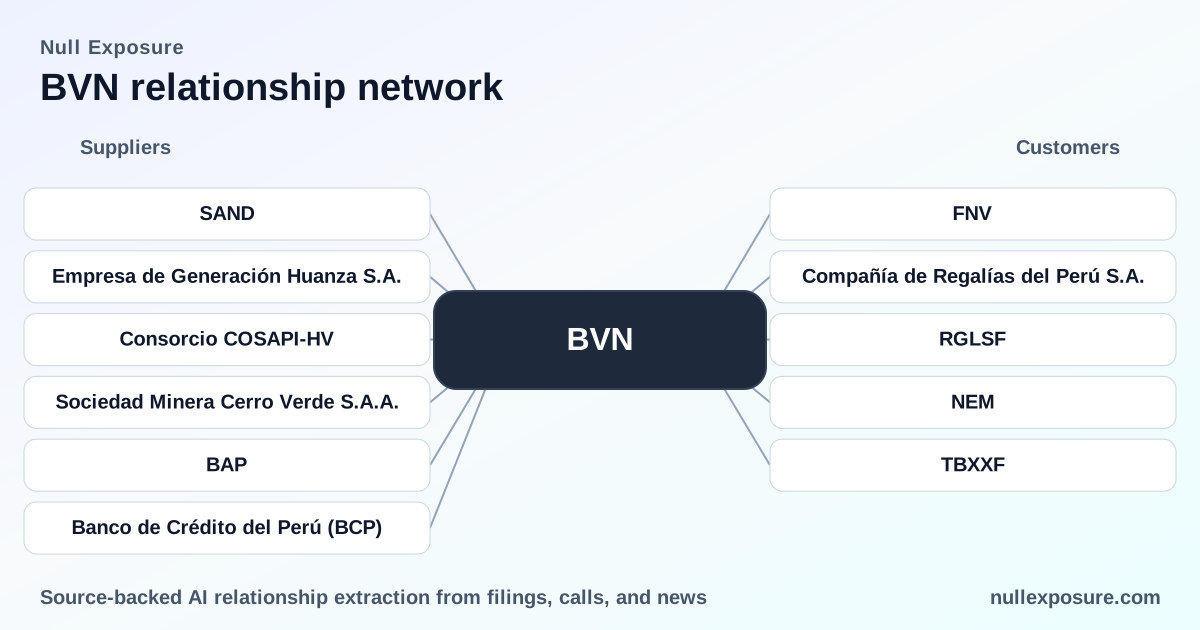
BVN: Asset monetizations and customer counterparties shaping cash generation
Buenaventura operates as a Peruvian precious-metals miner and developer that monetizes through direct mineral production, strategic asset sales, and royalty structures. The company converts mineral rights and minority project stakes into cash or recurring income by selling subsidiaries and partnering with royalty and junior miners, while maintaining core production assets; this mix supports a strong FY2026 operating margin and steady dividend profile. For a deeper look at counterparties and how those relationships affect liquidity and strategic optionality, visit https://nullexposure.com/.
How Buenaventura earns and what that implies for investors
Compania de Minas Buenaventura combines operating cash flow from producing mines with opportunistic disposals and royalty transactions to optimize capital allocation. Financials through the latest quarter show high margins (operating margin ~52.5%, profit margin ~47.7%), EBITDA of about $1.01B and market capitalization near $8.0B, which position the company to monetize non-core projects without imperiling core mine economics. The company’s operating model exhibits three practical characteristics:
- Contracting posture: Buenaventura executes bilateral, asset-level sales and royalty transfers to specialized counterparties rather than wide syndicated financings; these are discrete, transactional disposals that deliver near-term cash.
- Concentration and criticality: Counterparties span global royalty houses, major miners and juniors — relationships with royalty firms and majors are strategically material because royalties link future cash flows from large assets (e.g., Yanacocha) to third parties.
- Maturity profile: Transactions reported are a mix of life-of-mine royalties on established operations and transfers of exploration-stage or development-stage project stakes, indicating the company actively trades optionality between near-term cash and long-term resource exposure.
Recent counterparties and the reported transactions
Below are concise, plain-English summaries for every relationship reported in the dataset, with source references for verification.
1) FNV — Franco‑Nevada Corporation (news_sentiment entry 1)
Buenaventura sold the 100% ownership of its subsidiary Chaupiloma Dos de Cajamarca to Franco‑Nevada Corporation, realizing an asset monetization valued in reported coverage at approximately US$210 million. According to MineriaEnergia (March 9, 2026), the sale transferred full control of the Chaupiloma asset to Franco‑Nevada (https://mineriaenergia.com/buenaventura-cierra-venta-de-chaupiloma-por-us-210-millones-a-empresa-canadiense/).
2) Franco‑Nevada Corporation — same transaction (news_sentiment entry 2)
Franco‑Nevada’s acquisition is the counterparty headline: it acquired Chaupiloma Dos de Cajamarca from Buenaventura, reflecting royalty/stream companies’ appetite for cash-flow-linked mineral assets. Reported by MineriaEnergia on March 9, 2026 (https://mineriaenergia.com/buenaventura-cierra-venta-de-chaupiloma-por-us-210-millones-a-empresa-canadiense/).
3) Compañía de Regalías del Perú S.A. (news_sentiment entry 3)
The legal purchaser of Chaupiloma shares is Compañía de Regalías del Perú S.A., a Franco‑Nevada subsidiary that now holds the transfer; the filing to Peru’s SMV confirms the transfer of the subsidiary’s shares to this royalty vehicle. The SMV notice cited in MineriaEnergia (March 9, 2026) details the transfer (https://mineriaenergia.com/buenaventura-cierra-venta-de-chaupiloma-por-us-210-millones-a-empresa-canadiense/).
4) Regulus Resources / RGLSF — Colquirrumi partial sale (news_sentiment entry 4)
Regulus Resources executed an agreement with Buenaventura to acquire the remaining 30% stake in Colquirrumi (Cajamarca), consolidating ownership of that concession under Regulus. Gestion reported the agreement on March 9, 2026, noting the junior miner’s consolidation of the project (https://gestion.pe/economia/empresas/canadiense-regulus-sube-su-participacion-al-100-en-concesiones-de-colquirrumi-empresas-mineria-cajamarca-buenaventura-noticia/).
5) RGLSF — duplicate Regulus mention (news_sentiment entry 5)
The duplicate entry reiterates that Regulus (ticker RGLSF) subscribed to the purchase, taking the residual 30% interest in Colquirrumi from Buenaventura, consistent with Gestion’s coverage on March 9, 2026 (https://gestion.pe/economia/empresas/canadiense-regulus-sube-su-participacion-al-100-en-concesiones-de-colquirrumi-empresas-mineria-cajamarca-buenaventura-noticia/).
6) Newmont Corporation / NEM — royalty linkage to Yanacocha (news_sentiment entry 6)
The Chaupiloma transaction included transfer of an entity that holds a 1.8% net return royalty over minerals covering Newmont’s Yanacocha mine, thereby linking future commodity cash flows from one of Peru’s largest operations to the new royalty owner. MineriaEnergia’s SMV-based report on March 9, 2026, describes the royalty assignment (https://mineriaenergia.com/buenaventura-cierra-venta-de-chaupiloma-por-us-210-millones-a-empresa-canadiense/).
7) NEM — duplicate Newmont mention (news_sentiment entry 7)
A second entry repeats that the Chaupiloma vehicle is the titleholder of the 1.8% Yanacocha royalty, reinforcing the strategic significance of the asset sale to a major royalty purchaser; reported via MineriaEnergia on March 9, 2026 (https://mineriaenergia.com/buenaventura-cierra-venta-de-chaupiloma-por-us-210-millones-a-empresa-canadiense/).
8) TBXXF / Turmalina — Colquemayo sale (news_sentiment entry 8)
Buenaventura agreed to sell the Colquemayo polymetallic project to Turmalina, a transaction reported as part of the company’s asset rationalization and conversion of development-stage projects into cash or partner-operated assets. Gestion covered the agreement on March 9, 2026 (https://gestion.pe/economia/empresas/buenaventura-eleva-ebitda-en-156-y-muestra-resultados-mixtos-de-produccion-mineria-empresas-plata-oro-cobre-noticia/).
9) Turmalina — duplicate Turmalina mention (news_sentiment entry 9)
The duplicate entry reiterates Turmalina’s purchase of Colquemayo from Buenaventura, confirming the transfer of that polymetallic project as reported by Gestion on March 9, 2026 (https://gestion.pe/economia/empresas/buenaventura-eleva-ebitda-en-156-y-muestra-resultados-mixtos-de-produccion-mineria-empresas-plata-oro-cobre-noticia/).
For investors, these transactions illustrate a coherent corporate playbook: sell non-core or early-stage assets to generate cash and transfer development risk to juniors or monetize royalties with specialized buyers. Learn more about how counterparties influence miner balance-sheet outcomes at https://nullexposure.com/.
What these relationships mean for BVN’s risk and return profile
The transactions collectively shift Buenaventura’s risk-return profile in measurable ways:
- Near-term liquidity boost: The reported Chaupiloma sale to Franco‑Nevada has a cash component (~US$210M reported) that reduces funding needs for core operations and supports dividends and capex without diluting equity.
- Recurring vs. one-off revenue: Transfers to royalty vehicles convert project value into recurring royalty income when royalties are retained, but full equity transfers convert value into one-off cash — Buenaventura used both mechanisms across the reported set.
- Counterparty quality matters: Selling to Franco‑Nevada and transferring royalties tied to Newmont’s Yanacocha links Buenaventura’s proceeds to counterparties with strong balance sheets and established cash flows, reducing counterparty execution risk.
- Concentration of monetization strategy: Multiple disposals in a short interval signal active portfolio pruning and suggest that management is prioritizing cash conversion of optionality over holding minority exploration stakes.
Constraints and company-level signals
The dataset contains no explicit constraints entries. That absence is itself a signal: there are no reported regulatory holds, financing covenants, or public lien disclosures tied to the listed transactions in these sources, which indicates transactions were completed through standard corporate and SMV notice channels. Investors should treat this as a neutral-to-positive operational indicator while remaining attentive to future SMV filings for any post-closing encumbrances.
Bottom line for investors
Buenaventura is executing a deliberate model of production plus selective asset monetization that leverages high-margin operations to fund value-extracting disposals. The March 2026 wave of sales and transfers to Franco‑Nevada, Regulus and Turmalina—and the royalty link to Newmont’s Yanacocha—strengthen liquidity and reallocate exploration risk away from Buenaventura, while preserving exposure to large-asset cash flows via third-party royalty structures. Key takeaway: these counterparties reduce execution risk on non-core assets and convert optionality into tangible balance-sheet strength, supporting dividend capacity and near-term capital allocation flexibility.
If you want a deeper mapping of counterparties and the cash impact per transaction, visit https://nullexposure.com/ for detailed monitoring and historical transaction context.