Bioventus (BVS) — Customer Relationships, Concentration and Commercial Posture
Bioventus monetizes through the sale of musculoskeletal and regenerative medical products—primarily direct-to-provider medical device sales and reimbursed therapeutic systems—supplemented by distributor channels and international shipments. Revenue is driven by U.S. clinical sales (roughly 88% of net sales in 2024), a direct sales force that services hospitals and physicians, and reimbursement-dependent products such as EXOGEN where payments come from Medicare, Medicaid and private payers. Investors should value the company on a mix of product growth, reimbursement stability and the concentration risk embedded in a small number of large customers. For additional diligence on BVS customer exposures visit https://nullexposure.com/.
How Bioventus goes to market and where value is captured
Bioventus operates a two‑segment commercial model: U.S. (the dominant market) and International (a smaller but strategic share). The company sells through a combination of its own direct sales team (which manages provider relationships), independent distributors in selected markets, and through purchase channels that eventually reach individual patients and specialty pharmacies. This hybrid model captures value by combining clinical training and physician-level selling with distribution scale in markets where direct coverage is not efficient.
- Direct sales and clinical relationships drive adoption among surgeons, physiotherapists and other healthcare professionals; product sales and procedural use are the core revenue engine.
- Reimbursement dependency is material for certain product lines: Bioventus submits and receives claims directly from Medicare/Medicaid and private payers for the EXOGEN system, creating both revenue support and billing complexity.
- Distributor channels are used selectively, particularly for Surgical Solutions and in certain international markets, meaning the company’s commercial footprint is a mix of owned and third‑party relationships.
Key commercial constraints and what they imply for investors
The company disclosures reveal several structural signals that shape risk and opportunity:
- Geographic concentration: Bioventus reported that the U.S. accounted for 88% of net sales in 2024, with International at 12%, which implies that near‑term revenue growth and regulatory/reimbursement risk are heavily U.S.‑centric (company filings, FY2024).
- Payer mix and billing complexity: The company states, “In connection with our EXOGEN system, we submit claims directly to, and receive payments directly from, the Medicare and Medicaid programs and private payers.” This creates a dependency on public reimbursement pathways and exposes revenue to changes in coding, coverage or payment rates (company disclosure).
- Customer concentration: One single customer accounted for 10.4% of total net sales in the year ended December 31, 2024, with product sales to that customer totaling $59,742 according to the filing—an explicit materiality signal that requires monitoring for contract renewal, pricing pressure and collection risk (company filing, FY2024).
- Mixed role of counterparties: The company sells to healthcare institutions, physicians, patients, distributors and dealers, reflecting a diversified set of counterparty types including government payers and individuals (company filing).
- Channel role signals: Distributors are material in certain product lines and geographies—Surgical Solutions products are sold through independent distributors to hospitals in selected markets, which introduces third‑party execution risk and margin pass‑through (company filing).
Together these signals describe a company that is commercially mature in the U.S., reimbursement‑sensitive for some product lines, and operationally hybrid—own sales teams where clinical relationships matter and distributors where scale or regulation favors intermediaries.
What each reported customer relationship says (complete coverage)
Below is every customer/partner entry returned in our review and what it means for BVS investor due diligence.
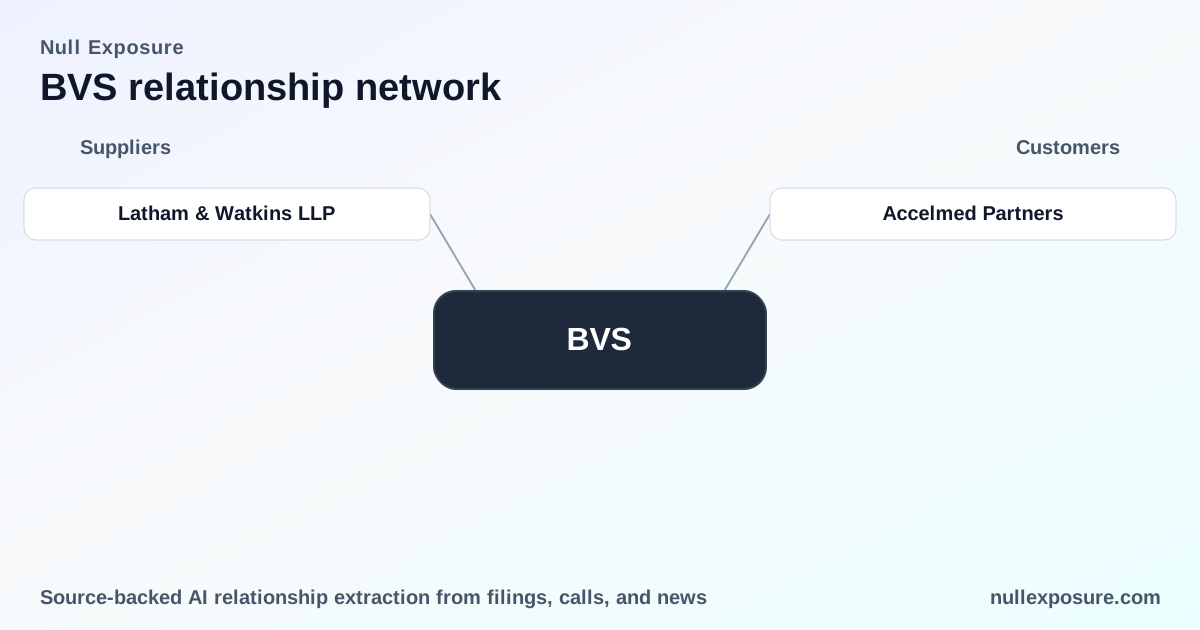
Accelmed Partners — acquirer of Advanced Rehabilitation business
Bioventus completed the divestiture of its Advanced Rehabilitation business to Accelmed Partners, a transaction announced in a GlobeNewswire release on January 24, 2024 and carried on public market news pages. The deal removes a non‑core revenue stream and refocuses Bioventus on its core device and biologics portfolio, while creating a counterparty relationship in the form of an acquirer for that business unit (GlobeNewswire press release, Jan 24, 2024, reported on CNN Markets).
Commercial and counterparty risk mapped to operating model
Translate the constraints into observable investor implications:
- Contracting posture: The mix of direct sales and distributor agreements means Bioventus negotiates both supplier‑style wholesale terms and provider‑level contracts; clinical training and service matter as much as price for core surgical customers.
- Concentration and counterparty criticality: A single customer represented 10.4% of revenue in the latest reported year, making revenue somewhat concentrated and elevating the importance of retention clauses and payment routines in major contracts (company filing, FY2024).
- Payer exposure and cash flow: Direct billing to Medicare/Medicaid for EXOGEN ties cash flow to public reimbursement cycles and administrative processes; this supports revenue but creates a risk vector if coverage rules change.
- Maturity and scalability: The company’s U.S. dominance (88% of sales) points to a mature domestic market where incremental growth likely requires share gains, new product introductions or deeper penetration of reimbursed therapies; international operations are secondary but available for expansion.
Investment takeaways and monitoring checklist
- Revenue is U.S.‑centric and reimbursement‑sensitive. Watch for CMS guidance, coding changes, or payer denials that affect EXOGEN flows.
- Concentration is non‑trivial. Monitor contract renewal timelines and payment performance of the customer representing ~10% of sales.
- Divestitures simplify focus. The sale of the Advanced Rehabilitation business to Accelmed Partners reduces product-line complexity but shifts growth expectations back to core segments.
- Channel complexity exists. Distributor dependence in Surgical Solutions and international markets demands ongoing oversight of partner execution and margin structure.
If you want a concise, investor‑grade summary of how customer exposures translate to balance‑sheet and cash‑flow risk for BVS, see our expanded coverage at https://nullexposure.com/.
Final view
Bioventus operates with a clear commercial framework: direct, clinician‑facing sales in the U.S., selective distributor partnerships internationally, and reimbursement‑anchored products that generate predictable but policy‑sensitive cash flows. For investors, the core questions are execution (sales penetration and clinical adoption), reimbursement durability for EXOGEN, and the management of customer concentration. All three determine whether current valuation metrics—relative EBITDA multiples and forward growth expectations—are justified.