BrainsWay (BWAY): payer wins are reshaping the revenue runway
BrainsWay develops and commercializes non‑invasive Deep TMS™ neuromodulation systems and then monetizes through equipment sales, recurring disposables and service, and protocol-driven clinical procedures reimbursed by third‑party payers and providers. Recent payer policy expansions and clinical partnerships materially increase addressable demand for Deep TMS across adolescents and adults, reducing friction for patient access and accelerating recurring service revenue. For deeper coverage mapping, visit https://nullexposure.com/.
Why payer policy is the commercial fulcrum for BrainsWay
BrainsWay’s revenue model is bifurcated: device and consumable sales plus recurring clinic‑level procedure volumes. As a result, coverage decisions by major insurers and government payers are first‑order drivers of utilization and revenue growth, not marginal clinical data alone. Over the past six months BrainsWay reported a string of coverage policy changes—final and draft—that broaden both eligible patient age bands and provider types who can administer TMS, reducing administrative hurdles and unlocking more referral sources.
- Coverage breadth is moving from pilot to mainstream: large national payers and several Blue plans have updated policies, which directly supports revenue predictability for clinic partners and device placement.
- Administrative friction is falling: moves like elimination of prior authorization by certain payers accelerate treatment initiation and shorten sales cycles for clinics.
- Provider base expands: allowing psychiatric nurse practitioners to order and administer TMS in states with full practice authority expands the available provider network.
If you want the raw relationship mapping and citations that institutional research teams need, see the full list below or consult additional analysis at https://nullexposure.com/.
Full list of payer and partner relationships (with source notes)
-
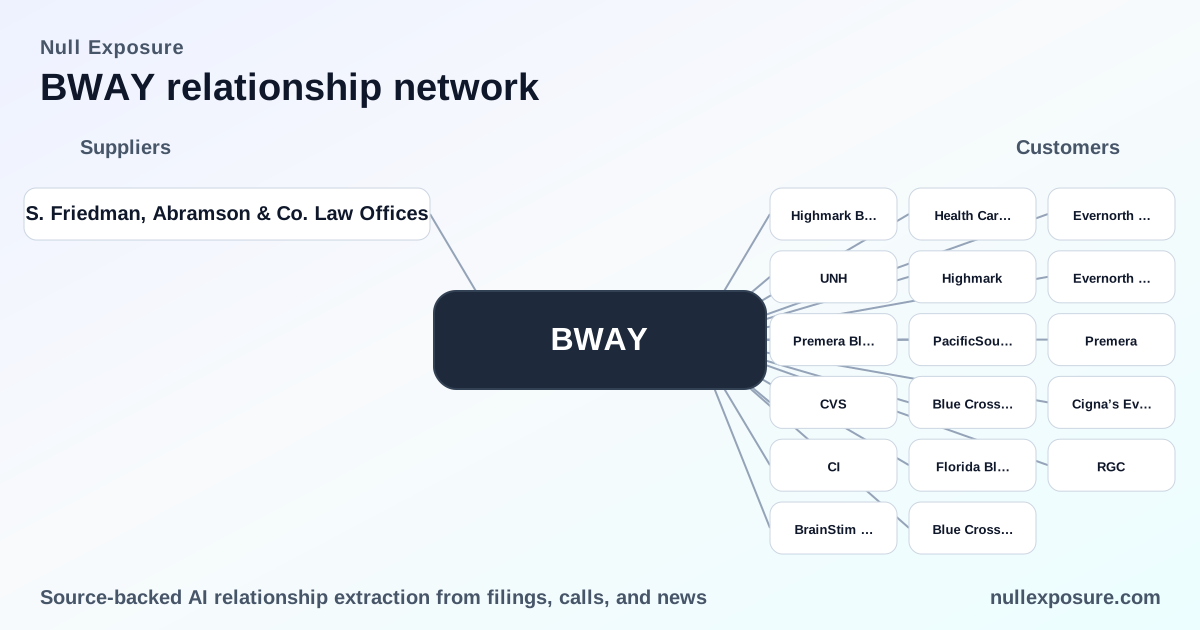
UNH (UnitedHealth Group / Optum) — Optum Behavioral Health expanded its medical policy to cover Deep TMS™ for adolescents aged 15+ with confirmed major depressive disorder. This policy change broadens access across Optum’s large membership base. Source: BrainsWay press coverage and trading reports referencing Optum/UnitedHealth (GlobeNewswire Dec 22, 2025; TradingView / Zacks and StockTitan first seen Mar 9, 2026).
-
Optum Behavioral Health — BrainsWay announced that Optum’s behavioral arm explicitly expanded coverage to adolescents 15 and older for Deep TMS, aligning clinical policy with other national payers. Source: GlobeNewswire press release (Dec 22, 2025) and related market reporting (Mar 9, 2026).
-
Optum/United Behavioral Health — Company commentary also emphasizes that Optum updated TMS clinical policy to allow PMHNPs to order and administer TMS in states granting full practice authority, widening the treating clinician pool. Source: BrainsWay press release highlighting U.S. payer policy shifts (GlobeNewswire Apr 15, 2026).
-
Premera Blue Cross Blue Shield — Premera adopted a final medical policy expanding coverage for BrainsWay’s accelerated SWIFT™ Deep TMS protocol for patients 15 and older with moderate‑to‑severe MDD, which supports penetration in Washington and Alaska markets. Source: BrainsWay press release (GlobeNewswire Jan 7, 2026; StockTitan reporting Mar 9, 2026).
-
Highmark Blue Cross Blue Shield / Highmark — Highmark released a draft policy expanding coverage for BrainsWay’s accelerated protocol to adolescents and adults with MDD, signaling potential uptake across its ~7M covered lives. Source: BrainsWay press release (GlobeNewswire Jan 21, 2026; StockTitan Mar 9, 2026).
-
Evernorth Health Services / Evernorth Behavioral Health / Cigna’s Evernorth Behavioral Health — Evernorth removed prior authorization requirements for Deep TMS, streamlining access and accelerating initiation of care in that large managed‑care channel. Source: BrainsWay filings and press summaries (StockTitan and company releases Feb–Mar 2026).
-
CVS / CVS/Aetna — Listed among major payers already covering adolescent Deep TMS in BrainsWay’s summary of coverage expansion, indicating CVS/Aetna alignment with national payer policy trends. Source: BrainsWay press release and market write‑ups (GlobeNewswire Dec 22, 2025; Yahoo Finance/TradingView Mar 9, 2026).
-
Medi‑Cal — Included by BrainsWay as an existing payer covering adolescent Deep TMS, a positive for access in California’s large Medicaid program. Source: BrainsWay release summarizing payer landscape (GlobeNewswire Dec 22, 2025).
-
PacificSource Health Plans — Named among regional plans covering Deep TMS for adolescents, supporting expansion in West Coast and select regional markets. Source: BrainsWay press coverage (GlobeNewswire Dec 22, 2025).
-
TRICARE / TRICARE West — BrainsWay lists TRICARE among payers that cover Deep TMS for adolescent MDD, indicating federal military health program acceptance in some regions. Source: BrainsWay press material (GlobeNewswire Dec 22, 2025; Apr 15, 2026).
-
Health Care Service Corporation (HCSC) — HCSC included in the list of Blue plans covering adolescent Deep TMS; notable for its scale across multiple Midwestern states. Source: BrainsWay release (GlobeNewswire Dec 22, 2025).
-
Blue Cross Blue Shield of Michigan — Called out as supporting adolescent coverage, which helps Midwestern clinic networks. Source: BrainsWay press release (GlobeNewswire Dec 22, 2025).
-
Blue Cross Blue Shield of North Carolina — Named in the coverage list, supporting southeastern regional access. Source: BrainsWay release and market reports (GlobeNewswire Dec 22, 2025; Mar 9, 2026).
-
Florida Blue — Identified among Blue plans covering adolescent Deep TMS; relevant for Florida market penetration. Source: BrainsWay press material (GlobeNewswire Dec 22, 2025).
-
Regence — Included in the list of insurers covering adolescent Deep TMS; supports presence in Pacific Northwest member populations. Source: BrainsWay announcement (GlobeNewswire Dec 22, 2025; TradingView Mar 9, 2026).
-
BrainStim Health Inc. — BrainsWay announced a minority‑stake investment and strategic partnership in Canadian provider BrainStim to accelerate clinical deployment and grow the provider network. Source: BrainsWay press release (GlobeNewswire Feb 19, 2026; StockTitan Mar 9, 2026).
-
First Coast — Identified among Medicare Administrative Contractors (MACs) adopting expanded scope for nurse practitioners administering TMS in applicable jurisdictions. Source: BrainsWay policy summary (GlobeNewswire Apr 15, 2026).
-
National Government Services — Listed as a MAC that updated coverage approaches increasing the role of nurse practitioners for TMS care. Source: BrainsWay release (GlobeNewswire Apr 15, 2026).
-
Novitas — Named with other MACs that have aligned on expanded practitioner scopes for TMS delivery. Source: BrainsWay communications (GlobeNewswire Apr 15, 2026).
-
U.S. Department of Veterans Affairs — Included in BrainsWay’s summary of payers adopting similar coverage approaches for broader clinician roles in TMS care. Source: BrainsWay press release (Apr 15, 2026).
-
U.S. Department of Veterans Affairs (duplicate mention in policy summary) — Further cited in BrainsWay commentary on federal payer alignment and practitioner scope expansion. Source: GlobeNewswire Apr 15, 2026.
What this network of relationships signals for investors
BrainsWay is transitioning from niche device vendor to platform for reimbursed clinical services. Payer acceptance across national carriers (Optum/UNH, CVS/Aetna, Cigna/Evernorth), major Blues, regional plans, MACs and federal payers materially lowers commercial execution risk for recurring procedure revenue. Concentration risk declines as coverage becomes distributed across many payers; criticality for clinics increases because device placements and recurring consumable sales depend on predictable reimbursement. Policy maturity is improving from isolated pilots to mainstream coverage, supporting longer‑term revenue visibility.
Key takeaway and next step
BrainsWay’s recent sequence of payer policy wins is the most consequential commercial development since device approvals — it unlocks recurring procedure volumes and shortens sales cycles for clinics. For institutional investors and operators assessing revenue durability, these relationships materially improve BrainsWay’s addressable market and de‑risk utilization forecasts. Learn more about how payer dynamics translate to revenue models at https://nullexposure.com/.