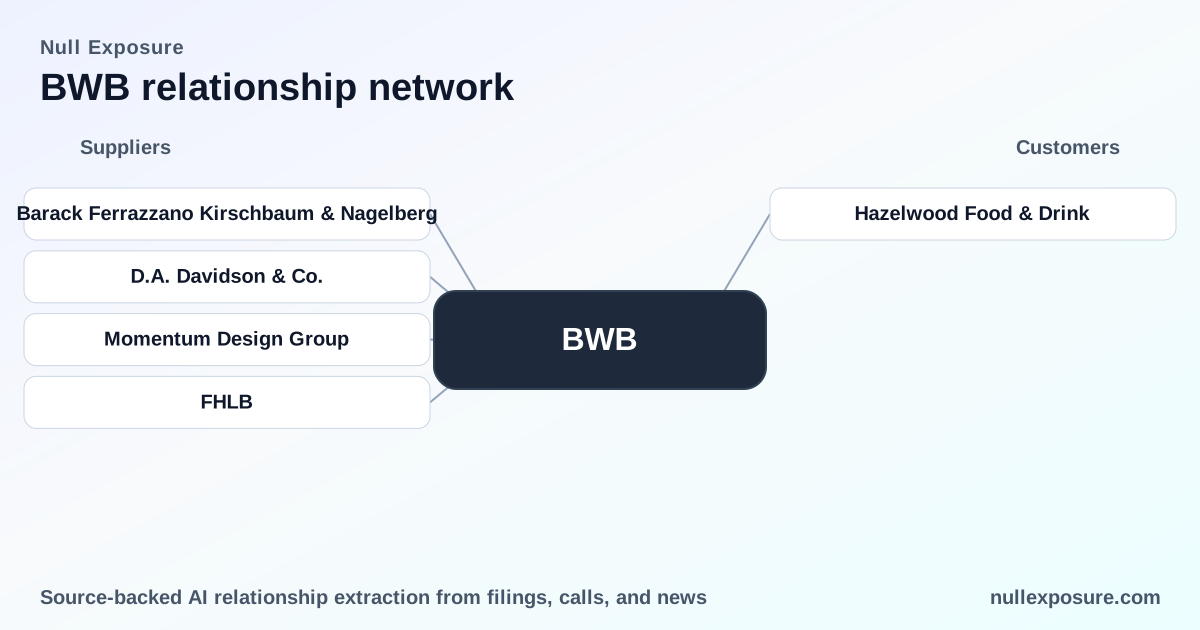
Bridgewater Bancshares (BWB): A localized bank with predictable fee and interest economics
Bridgewater Bancshares operates as the banking holding company for Bridgewater Bank, monetizing primarily through net interest income on commercial and consumer loans and recurring service fees on deposit accounts. The company focuses on commercial real estate investors, small and mid-sized businesses, and high‑net‑worth individuals within the Minneapolis–St. Paul metropolitan area, deriving stable funding from a large base of core deposits and recurring product relationships. For investors and operators assessing BWB customer dynamics, the critical signals are concentration in a defined geography, a borrower mix centered on small and mid‑market enterprises, and a business model weighted toward short‑term commitments and fee income. Learn more at https://nullexposure.com/.
How Bridgewater makes money — simple, service-driven banking
Bridgewater’s income mix is straightforward: interest and fees on loans, interest and dividends from securities, plus service charges and transaction fees. The public financial snapshot shows a compact franchise: revenue TTM of $151.5M, trailing P/E of 10.4, and a price-to-book near 1.1, which aligns with a regional bank capturing predictable spreads and deposit margins. According to company disclosures through Q1 2026, core deposits totaled roughly $3.11 billion and represented 76.0% of total deposits, underscoring a funding profile anchored in retail relationships rather than wholesale funding.
Bridgewater’s revenue recognition follows standard banking practice—monthly or transaction-based recognition for deposit services—and the bank positions service fees as a recurring adjunct to its lending business. This dual revenue stream gives the franchise stable cash flows with measurable sensitivity to local economic cycles.
Operating characteristics that matter to investors
Investors should weigh several operational constraints that shape customer relationships and risk:
- Contracting posture — short-term orientation. A material portion of the bank’s commitments (standby letters of credit and similar commitments) are structured to mature within two years, indicating an emphasis on shorter tenor exposures rather than long-term locked-in contracts. Company filings reference that “most of these commitments mature within two years and the standby letters of credit are expected to expire without being drawn upon.”
- Counterparty mix — retail and small/mid-market commercial customers. The bank explicitly lends to small and midsized businesses while also offering retail deposit products through branches, online and mobile channels, highlighting a customer base composed of individuals, small businesses, and mid-market firms rather than large corporates.
- Geographic concentration — Twin Cities focus. Bridgewater concentrates lending and deposit services within the Minneapolis–St. Paul–Bloomington MSA, operating predominantly in the Twin Cities market. The firm states this market is among the largest MSAs by deposit base in the U.S., which supports local scale despite regional concentration.
- Materiality of deposits — stable, core funding base. Core deposits are a significant funding source, representing a material share of liabilities and reducing reliance on volatile market funding. The company reports core deposits of approximately $3.11 billion as of December 31, 2024.
- Relationship roles and maturity — seller and service provider with mature accounts. Bridgewater acts as a seller of financial services (loans and deposit accounts) and as a service provider for deposit-related fees, with many customer relationships characterized as mature and tied to other products that promote stickiness.
Those characteristics create a business that is operationally simple, locally concentrated, and reliant on relationship retention and fee capture.
Risks and concentration — what to watch
- Local economic cycles. Heavy concentration in the Twin Cities amplifies exposure to regional CRE cycles and small-business performance.
- Short-term commitments. While short-term posture limits duration risk, it increases rollover risk should local credit conditions deteriorate.
- Customer credit profile. Lending to small and mid-market borrowers increases sensitivity to economic downturns and borrower-specific volatility.
Each of these is not an existential issue for a well-managed regional bank, but together they define where operational discipline and credit oversight must be strongest.
What the customer relationships tell us — a complete list
Below are the explicit customer relationships surfaced in the coverage set and their practical implications.
Hazelwood Food & Drink — a street-level tenant and local customer
Local hospitality operator Hazelwood Food & Drink opened a full-service restaurant at street level, referenced in coverage of Bridgewater’s office and retail properties; the mention links Hazelwood to the bank’s local footprint and tenant activity. (Source: tcbmag.com, “Office Envy — Bridgewater Bank,” March 9, 2026.)
Interpretation: This citation indicates Bridgewater’s involvement in local commercial real estate leasing and community-facing tenant relationships, consistent with its focus on serving small businesses and CRE investors.
(That concludes the full set of customer relationships identified in the available results.)
Putting constraints into business-model context
The constraints flagged in corporate disclosures are instructive for revenue durability and counterparty risk:
- Short-term contract posture produces predictable near-term cash flows but requires active portfolio management to control rollover and liquidity risk. Evidence in recent filings notes short maturities for many commitments and limited reliance on long-dated obligations.
- Counterparty profile dominated by individuals and small/mid-market firms drives revenue concentration toward deposit fees and loan interest from locally oriented business owners; Bridgewater’s product mix (retail deposits, commercial loans, service charges) reflects this orientation.
- Geographic concentration in the Twin Cities provides depth and market knowledge advantages but reduces geographic diversification benefits. Company materials emphasize the bank’s strategic focus on the Minneapolis–St. Paul MSA.
- Mature customer relationships and material core deposits enhance funding stability and cross-sell opportunities; the firm reports core deposits representing three-quarters of total deposits as of year‑end 2024.
Together these characteristics define Bridgewater as a relationship-driven regional bank, where operating discipline, deposit retention and local credit underwriting determine performance.
Investment implications and next steps
Bridgewater presents as a compact regional lender with solid profitability metrics (profit margin ~35.5% and ROE ~10.8% TTM) and attractive valuation relative to book value and forward earnings. The stock’s institutional ownership (~68%) and insider stake (~20.6%) further suggest alignment between management and holders. Key monitoring items for investors are local CRE trends, small‑business credit quality, and deposit stickiness through rate cycles.
For operational partners and research teams, the bank’s short-term exposure profile and concentrated geography indicate opportunities for targeted product partnerships that enhance deposit stickiness or diversify tenor risk.
Explore additional relationship-level insights and sector context at https://nullexposure.com/.
Bold takeaway: Bridgewater’s value proposition is local scale and fee-stable banking built on a large core deposit base; performance depends on disciplined underwriting and retention of retail and small-business customers.