Broadwind Energy (BWEN): Customer Relationships and What They Mean for Investors
Broadwind Energy is a U.S.-focused precision manufacturer that monetizes by selling wind towers, gear systems and heavy fabrications to industrial and cleantech customers under a mix of multi-quarter supply agreements and single purchase orders. Revenue comes from engineered manufacturing contracts sold primarily to large wind-turbine OEMs and industrial buyers; the company’s cash flow profile is therefore driven by the cadence of tower supply agreements, episodic spot orders in non-tower segments, and the retention or disposition of fabrication assets. For a concise, data-driven view of third‑party relationships and competitive exposure, see https://nullexposure.com/.
How Broadwind’s customer model drives investable outcomes
Broadwind operates as a contract manufacturer with a hybrid contracting posture that combines framework supply agreements for towers with spot purchase‑order business in its Gearing and Industrial Solutions lines. This structure gives a mix of revenue visibility and order volatility: supply agreements create predictable follow‑through over successive quarters, while PO‑based work introduces earnings lumpyness when industrial projects slow.
- Concentration is high. The company discloses that sales from its top five customers made up 73% of total sales in 2024, with one customer alone contributing more than 10% of revenue. That level of concentration amplifies counterparty risk and bargaining power dynamics.
- Geographic focus is North America. Broadwind’s customer base operates primarily in the United States, anchoring demand to regional OEM cycles and domestic policy drivers for clean energy.
- Material contract scale exists. The firm has used framework supply agreements to lock in future tower deliveries (a supply agreement announced in January 2023 was reported at roughly $175 million in contracted tower purchases), creating multi‑year revenue buckets while still shifting delivery timing when needed.
These company‑level signals imply elevated revenue sensitivity to a small number of large counterparties, balanced by some predictability where framework contracts are in force. If you evaluate BWEN, place emphasis on counterparty continuity and the cadence of tower PO issuance.
Explore a practical relationship map and source detail at https://nullexposure.com/.
Where Broadwind’s customers sit today — the relationship roll call
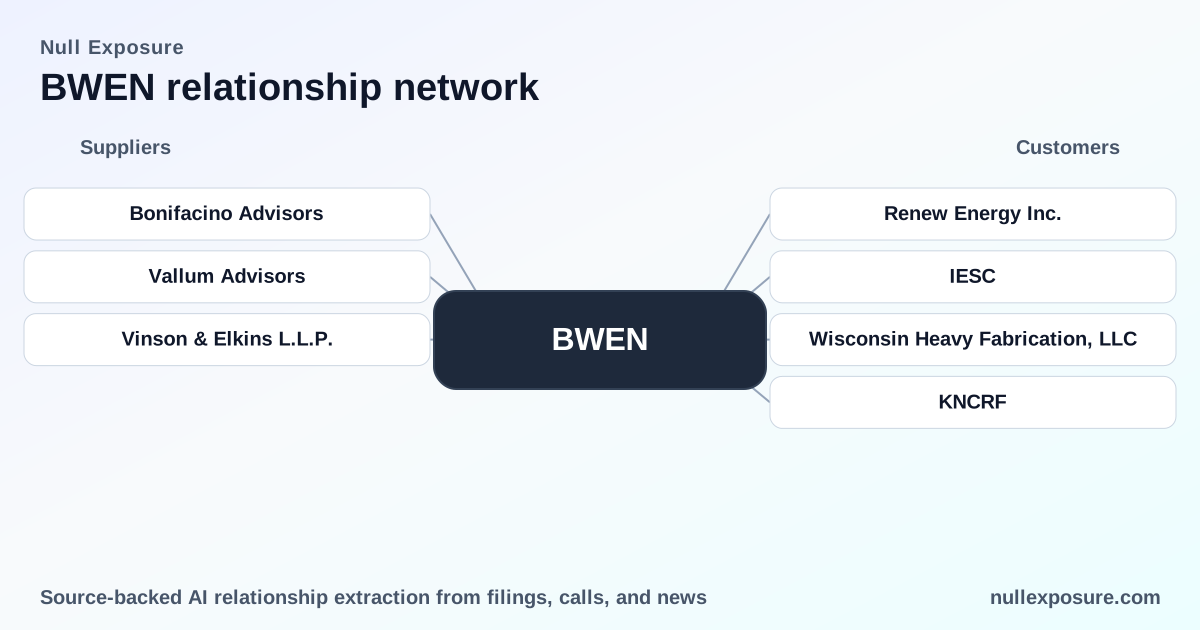
Below are every customer/partner referenced in publicly available coverage and filings in our results, each with a concise, plain‑English takeaway and an attributable source.
-
IES Holdings, Inc. (ticker reference IESC) — Broadwind completed the sale of its Manitowoc, WI industrial fabrication operations to Wisconsin Heavy Fabrication, LLC, a subsidiary of IES Holdings, for $13.5 million in cash consideration; the transaction shifts on‑book fabrication exposure away from Broadwind and monetizes that facility. (StockTitan news report, March 9, 2026: https://www.stocktitan.net/news/BWEN/broadwind-completes-sale-of-industrial-fabrication-operations-in-mzhwklqfm8yl.html)
-
Wisconsin Heavy Fabrication, LLC — Acting as the IES Holdings subsidiary buyer, Wisconsin Heavy Fabrication acquired the Manitowoc fabrication operations from Broadwind for $13.5 million, signaling Broadwind’s exit from that physical fabrication footprint and a reduction in direct fabrication customer obligations. (StockTitan news report, March 9, 2026: https://www.stocktitan.net/news/BWEN/broadwind-completes-sale-of-industrial-fabrication-operations-in-mzhwklqfm8yl.html)
-
Renew Energy Inc. — In a historical divestiture, Renew Energy acquired the majority of the assets of Broadwind’s wind turbine services division, representing an earlier step in Broadwind’s strategic reshaping away from certain service activities. (Argus Leader coverage, December 17, 2015: https://www.argusleader.com/story/news/business-journal/2015/12/17/sioux-falls-energy-company-makes-big-acquisition/77440622/)
-
Manitowoc (MTW) — Reporting on segment activity notes that Heavy Fabrications saw renewed wind tower orders and completed a limited Manitowoc tower run while other industrial fabrication volumes declined, indicating intermittent factory throughput tied to tower demand cycles. (TradingView summary of Broadwind filings, May 2, 2026: https://www.tradingview.com/news/tradingview:eac92502aa312:0-broadwind-10-k-revenue-158-1m-eps-0-23/)
-
Konecranes (listed as KNCRF in some reports) — Broadwind acknowledged Konecranes as a partner customer on a Wisconsin‑based fabrication project that earned local recognition; this reference underscores Broadwind’s work with established heavy‑equipment customers and regional suppliers. (Fox11 Online local coverage, fiscal period noted FY2021: https://fox11online.com/news/local/gallery/crane-from-manitowoc-wins-coolest-thing-made-in-wisconsin-contest)
Each relationship above is drawn directly from public reports and local press coverage; where Broadwind has completed asset sales, those transactions materially change its customer and operational footprint.
What the relationship map implies for risk and upside
-
Revenue concentration is the dominant risk. With 73% of 2024 sales coming from the top five customers and a single customer over 10% of revenue, Broadwind’s earnings are sensitive to order changes by a small set of large counterparties. That concentration reduces revenue diversification but also concentrates visibility when framework agreements are active.
-
Framework agreements improve near‑term visibility but can be re‑timed. The company’s practice of converting forecasts into periodic POs under supply agreements creates committed volume windows; however, Broadwind disclosed negotiated shifts of contracted tower deliveries across fiscal years, showing that timing flex remains a lever for counterparties.
-
Geographic concentration narrows macro exposure. Being primarily U.S.‑facing means performance will be tied to domestic wind OEM cycles, infrastructure budgets, and supply‑chain conditions rather than broader international demand.
-
Asset sales change the structural profile. The sale of the Manitowoc fabrication operations to an IES subsidiary for $13.5 million reduces Broadwind’s fixed‑asset exposure and repositions it toward higher‑margin manufacturing where capital intensity is lower.
How to position exposure as a portfolio manager
- Prioritize counterparty disclosure and cadence: monitor tower supply‑agreement rollouts and any amendments that shift delivery timing; those are the most immediate drivers of revenue realization.
- Stress‑test scenarios for the top five customers: losing or materially downgrading one of these relationships would compress revenue and margins quickly given the concentration.
- Treat asset dispositions (like Manitowoc) as balance‑sheet and margin events: proceeds improve liquidity and reduce capital commitment, but reduce on‑site throughput capability for future fabrication wins.
Bottom line: clear signals you can trade on
Broadwind is a small‑cap, manufacturing‑centric play with meaningful customer concentration and a mixed contracting profile—framework supply agreements deliver chunks of visibility, while spot PO business injects lumpy variability. The company’s recent asset sale materially reshapes its fabrication exposure and is a net credit to liquidity and focus.
For a focused, relationship‑level briefing and monitoring workflow designed for investment and operational due diligence, visit https://nullexposure.com/ — the site hosts the underlying coverage and source links used in this note.