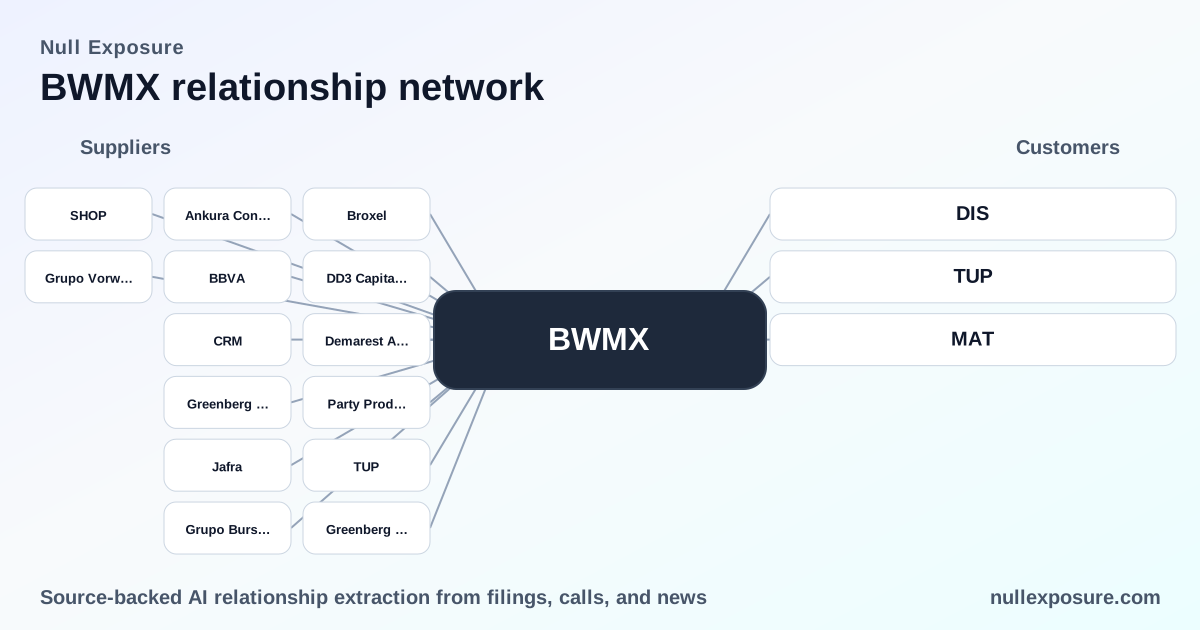
Betterware de México (BWMX): customer relationships that shape near‑term growth
Betterware de México is a direct‑to‑consumer specialty retailer that monetizes through a combination of branded product sales, licensed goods, and third‑party distribution partnerships. The company drives revenue via a high‑margin mix of proprietary merchandise and licensed lines, with an expanding emphasis on co‑brands and category extensions that leverage partner IP to accelerate product introductions and top‑line momentum. For a concise view of Betterware’s platform and data services visit https://nullexposure.com/.
Quick investor thesis: how the model works and why customers matter
Betterware converts catalog and direct sales capability into predictable revenue by pairing its distribution network with external licenses and strategic partners. Licensed relationships (Disney, Mattel) and distribution agreements (Jafra, Tupperware transaction) are central to product innovation cadence and revenue volatility, because new licensed assortments both raise margins and drive customer acquisition faster than organic SKUs alone.
What the customer list tells you about execution
Betterware’s public commentary and recent news indicate a deliberate mix of licensing and M&A/distribution moves. The company is executing on license rollouts to capture category expansion (skin and hair care) while simultaneously pursuing a transaction involving Tupperware that would change its product and channel footprint in Mexico. These relationships are operational levers—they influence assortment, margin profile, and near‑term revenue visibility.
Every relationship disclosed in public results
TUP (earnings call, 2025 Q4)
Betterware is pursuing a transaction with Tupperware and is awaiting Mexican antitrust approval, expected in the second quarter of 2026. This deal is positioned as strategic for distribution and product breadth. According to the Q4 2025 earnings call (March 7, 2026), management outlined the pending approval timeline and near‑term expectations.
Disney (earnings call, 2025 Q4)
Management indicated a push to expand Disney‑branded product lines as part of an innovation focus and planned category launches, including new skin‑care offerings and a move into hair care in the second half of 2026. This was discussed on the Q4 2025 earnings call (March 7, 2026), where Disney licenses were cited as a growth vector.
DIS (earnings call, 2025 Q4)
The company reiterated plans to refocus on expanding Disney licenses and launching adjacent personal‑care categories, signaling a sustained commitment to leveraging marquee intellectual property for product introductions. This was stated in the same Q4 2025 earnings call (March 7, 2026).
Tupperware (earnings call, 2025 Q4)
Betterware’s commentary on Tupperware repeats the central point: a transaction is underway and awaits regulatory clearance in Mexico in Q2 2026, which would immediately affect Betterware’s distribution capabilities and category access. Management discussed this in the Q4 2025 earnings call (March 7, 2026).
Mattel (earnings call, 2025 Q4)
Mattel was named alongside Disney as a license partner that Betterware will expand in the coming periods, supporting product innovation and assortments that target family and household categories. This licensing strategy was described on the Q4 2025 earnings call (March 7, 2026).
Jafra US (IndexBox news sentiment, FY2026)
An IndexBox report covering Q1/FY2026 noted that improving trends at Jafra US contributed to Betterware’s top‑line growth during the period, highlighting the commercial importance of the Jafra partnership in the U.S. channel mix. See the IndexBox post (May 2026) for summary commentary on Jafra’s contribution.
Jafra Mexico (IndexBox news sentiment, FY2026)
The same IndexBox coverage observed that sales softness at Jafra Mexico partially offset gains elsewhere, underlining regional execution differences within the Jafra relationship and the sensitivity of consolidated results to geographic mix. IndexBox reported this in May 2026.
How these relationships translate into operating signals
- Contracting posture: Betterware demonstrates an opportunistic contracting approach—shoring up licensed IP deals and pursuing strategic transactions rather than relying solely on organic SKU expansion. Licensing contracts give the company short‑cycle product refreshes, which increases revenue responsiveness to marketing pushes.
- Concentration: The firm’s use of a handful of high‑profile licensors and partner brands creates concentration risk: a small set of relationships (Disney, Mattel, Jafra, and the Tupperware transaction) drive a disproportionate share of innovation and seasonal lifts.
- Criticality: These partners are operationally critical because they underpin new category entries (skin and hair care) and geographic sales mixes. The pending Tupperware approval, in particular, is a single‑event inflection that would change distribution scale in Mexico.
- Maturity: Licensing and distribution relationships are at differing maturity stages—Jafra accounts show mixed regional performance, while new licensed product plans (Disney, Mattel) are in early expansion phases slated for the rest of 2026.
No formal constraint excerpts were provided in the source material; the operating signals above reflect company‑level characteristics evident from public commentary and recent news.
Investment implications and risk checklist
- Catalyst: Approval of the Tupperware transaction is a discrete near‑term catalyst tied to regulatory timing (Q2 2026), with immediate implications for Mexican market share and assortment depth.
- Growth engine: Expansion of Disney and Mattel licenses plus entry into personal‑care categories is the primary organic growth thesis; successful rollouts will support margin expansion if product mixes skew toward higher‑margin licensed SKUs.
- Execution risk: Mixed performance across Jafra’s U.S. and Mexico operations shows geographic sensitivity to execution, making regional management and channel oversight a key operational focus.
- Concentration risk: Reliance on a small number of licensors and partners concentrates downside if any single relationship underperforms or is disrupted.
If you want a structured investor brief or a model-ready summary of how each partner affects revenue and margins, explore more at https://nullexposure.com/.
Bottom line
Betterware’s near‑term outlook is driven by a combination of a pending strategic transaction (Tupperware) and an active licensing playbook (Disney, Mattel) that will determine whether revenue growth is durable or episodic. For investors, the regulatory timeline for Tupperware and the execution of new licensed categories are the two most important watchpoints over the next two quarters.