Blackstone (BX): How customer relationships drive fee engines and risk exposure
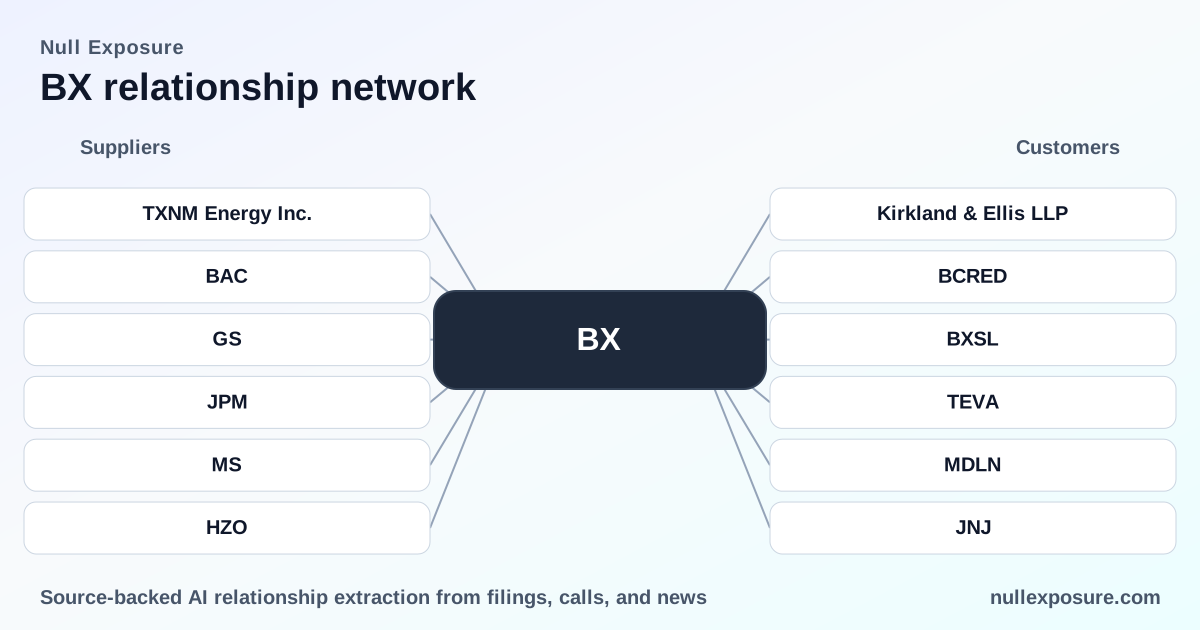
Blackstone is a fee-first alternative asset manager that monetizes through recurring management fees, performance carry and advisory and capital markets services to funds, institutional investors and permanent-capital vehicles. The firm's customer relationships span externally managed public vehicles, credit sponsors, strategic corporate financings and insurance partnerships — each relationship reinforcing Blackstone’s role as both seller of investment services and buyer of financing exposure. For a consolidated view of counterparties and relationship context visit https://nullexposure.com/.
Why the relationship map matters to investors
Blackstone’s commercial posture is contract-driven and service-centric: the firm earns fixed base management fees and performance fees from funds and perpetual capital vehicles, and it also acts as an external manager for listed REITs and credit vehicles. Company-level signals from filings show a broad counterparty mix — individual and institutional investors, public pension funds and government accounts — and geographic breadth centered in North America but with material EMEA and APAC activity. The fee base from perpetual capital vehicles is identified as a material and growing revenue source, which increases earnings predictability but concentrates exposure to asset-liability mismatches in open-ended credit or non-traded funds.
Key operating model characteristics:
- Contracting posture: fee and advisory agreements dominate; capital commitments are callable under subscription structures in carry funds.
- Concentration: a meaningful share of revenue is tied to perpetual vehicles and marquee credit and real estate mandates.
- Criticality & maturity: relationships with sponsored public vehicles and externally managed REITs are operationally critical and typically long-tenored; many fund-management arrangements are mature and recurring.
- Segment orientation: the customer base is tilted toward services — investment management, credit solutions and capital markets — rather than one-off product sales.
Relationship catalog: concise takeaways for each counterparty
Kirkland & Ellis LLP
Blackstone engages Kirkland & Ellis LLP as outside legal counsel in the ordinary course of business, consistent with large-scale alternative managers retaining top law firms for transactions and fund matters, as disclosed in Blackstone’s FY2024 10‑K filing.
Blackstone Private Credit Fund (BCRED)
BCRED is a non‑traded private credit vehicle managed by Blackstone that has attracted media attention for recent redemption dynamics, signaling liquidity and investor-behavior risk in certain private-credit wrappers (NationalToday, March 2026).
Blackstone Secured Lending Fund (BXSL)
BXSL is a closed‑end management investment company sponsored by Blackstone Credit that provides middle‑market financing; the vehicle has priced public bonds and been the subject of analyst coverage and investor option activity, underlining its role as a capital-markets conduit for Blackstone’s credit franchise (MarketBeat; PE‑Insights; Bloomberg references, 2025–2026).
BXMT (Blackstone Mortgage Trust)
Blackstone Mortgage Trust is a publicly traded commercial mortgage REIT that is externally managed by a Blackstone subsidiary, creating a direct fee and advisory relationship and an internal pipeline for real‑estate debt origination (company releases and market coverage, 2025–2026).
Royalty Pharma (RPRX)
Funds managed by Blackstone Life Sciences sold a royalty interest in Alnylam’s AMVUTTRA to Royalty Pharma for $310 million, illustrating Blackstone’s life‑sciences capital deployment and secondary monetizations (QuiverQuant, March 2026).
Dropbox (DBX)
Blackstone Credit & Insurance served as lead arranger and substantial lender on amended Dropbox secured credit facilities (up to $700M–$2B reported), demonstrating Blackstone’s role as a direct corporate lender and structuring agent (WSGR / Latham press coverage, 2024–2025).
F&G / FG (FG, FGN, FGSN)
F&G Annuities & Life and its affiliates have an established multi‑year relationship with Blackstone: Blackstone manages a substantial portion of F&G’s investment portfolio and backed a reinsurance sidecar with roughly $1 billion in commitments, reflecting both asset management and sponsored reinsurance solutions (PR Newswire; Artemis; earnings call transcripts, 2025–2026).
Ellington Residential Mortgage REIT (EARN)
Blackstone-affiliated capital markets teams acted as co-managers on an EARN offering, indicating Blackstone’s participation in capital-markets execution and distribution for mortgage-related issuers (FinancialContent press release, 2021).
BioCryst Pharmaceuticals (BCRX)
BioCryst drew roughly $396.6 million from a financing facility provided by funds managed by Blackstone to finance its acquisition and related costs, showing Blackstone’s use of corporate credit to support strategic transactions (GlobeNewswire / SimplyWall, January–March 2026).
Teva Pharmaceutical Industries (TEVA)
Blackstone Life Sciences committed up to $400 million over multiple years to fund Teva’s duvakitug clinical program, demonstrating external growth capital deployment via life‑sciences mandates (ContractPharma; industry reports, 2026).
Corebridge (CRBD)
Blackstone has a mandate to manage some Corebridge assets and retains an equity stake of roughly 12% following Corebridge’s spinout, creating overlap between ownership and manager roles and producing potential alignment and conflict considerations (AdvisorHub, 2026).
Hamilton Insurance (HG)
Blackstone-affiliated funds sold a block of Hamilton Insurance shares to the company group at a notable discount to VWAP, reflecting portfolio rotation and secondary placement activity in the insurance space (Royal Gazette, May 2024).
Genedx / WGS (WGS)
A $100 million term loan from Blackstone was provided to support Genedx operations in early 2026, showing Blackstone’s targeted financing into genomics and diagnostics companies (SahmCapital, February–March 2026).
Medline Inc. (MDLN)
Blackstone-affiliated selling stockholders and Blackstone Capital Markets acted as co‑managers in Medline’s secondary offering of Class A shares, indicating distribution-led exits for private‑equity‑backed holdings (GlobeNewswire / StockTitan, March 2026).
Boxwood Merger Corp. / ATCX
GSO Capital Partners, Blackstone’s credit arm, provided up to $155 million in financing for Boxwood Merger Corp.’s transaction, illustrating sponsor support for SPAC-related deal financing (SPACInsider, 2020 disclosure).
Finance of America (FOA)
Public disclosures around strategic transactions referenced expectations about repurchasing Blackstone’s equity stake and the associated financial impacts, highlighting Blackstone’s legacy minority holdings and related capital‑structure negotiations (company filings and market commentary, 2025).
SL Green preferred series (SLG‑P‑I)
SL Green purchased Park Avenue Tower from Blackstone’s Perform Properties for $730 million, evidence of Blackstone’s portfolio dispositions and commercial real‑estate transmission to REIT buyers (ConnectCRE, 2026).
Rexford Industrial (REXR)
Rexford Industrial acquired Blackstone real‑estate assets adding roughly 3 million square feet, demonstrating Blackstone’s asset recycling via sales to specialized REITs (LA Business Journal, 2024–2025).
VNET (VNET)
VNET entered an amended agreement with Blackstone Tactical Opportunities-managed investment vehicles to extend note maturities, showing opportunistic credit extensions to technology infrastructure firms (Bitget news, 2026).
Johnson & Johnson (JNJ)
Funds managed by Blackstone Life Sciences jointly financed clinical trials with Johnson & Johnson for bleximenib in AML, indicating co‑investment structures with major pharma partners (Finviz market note quoting Barclays, 2026).
Investment implications and final takeaways
Blackstone’s customer map underscores a diversified franchise that monetizes through long-term management contracts, sponsored public vehicles and bespoke credit solutions. The firm’s revenue base benefits from predictable management fees tied to perpetual and closed‑end vehicles, but investors must monitor liquidity dynamics in non‑traded funds and credit vehicles (BXSL, BCRED) and the operational dependence on external management mandates (BXMT, MDLN). Active commercial relationships with insurers, life‑sciences sponsors and corporate borrowers broaden fee pools while concentrating underwriting and reputational risk in credit and insurance-linked structures.
For a structured dashboard of counterparties and relationship signals, visit https://nullexposure.com/ — the single-stop page for mapping Blackstone’s client and sponsored-vehicle exposures.
Bold attention to material relationships — BXSL, BXMT, F&G, and core life‑sciences financings — is warranted for position sizing and scenario analysis.