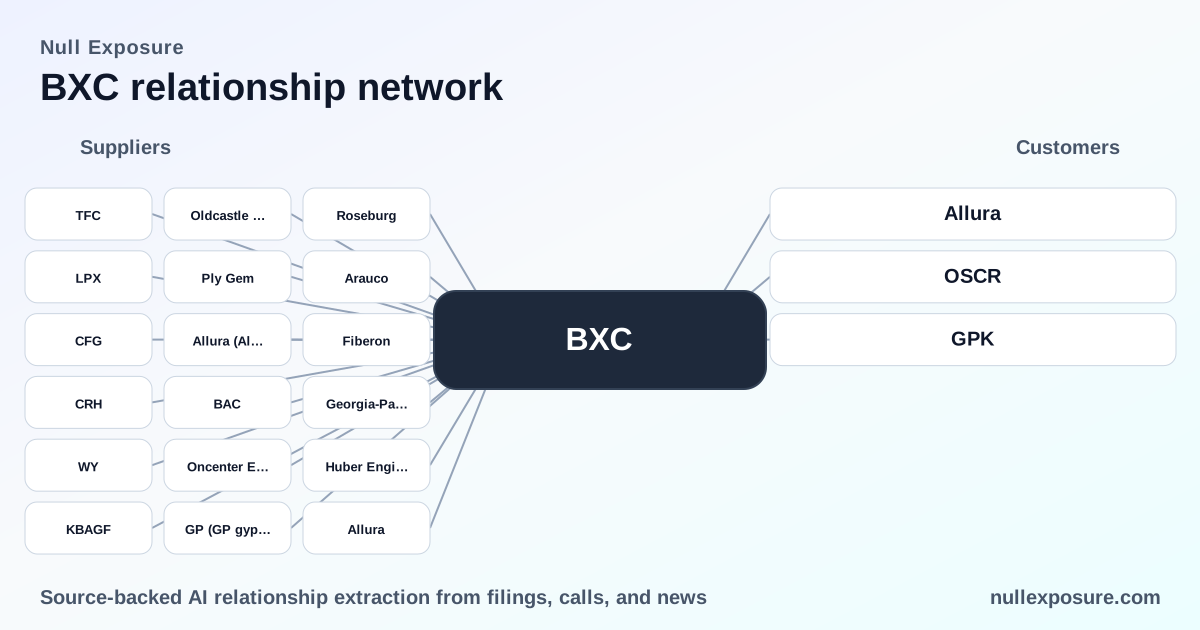
BlueLinx (BXC) — customer relationships that move product and margin
BlueLinx is a national, “two‑step” wholesale distributor of residential and commercial building products that monetizes scale and logistics: it purchases from manufacturers, sells into local dealer channels, and captures margin and service fees while providing inventory, logistics and value‑added services. With roughly $2.95 billion in trailing revenue and a national footprint across all 50 states, BlueLinx’s economics depend on execution in distribution, supplier brand conversions, and stable dealer demand. For a concise, machine‑readable view of these customer relationships, visit https://nullexposure.com/.
How BlueLinx actually makes money — the distribution thesis
BlueLinx operates as a classic wholesale intermediary: it buys from manufacturers (brands), warehouses and transports inventory, and resells into dealer and contractor channels, adding revenue through product markup and ancillary services. The company also markets and converts dealer customers to preferred manufacturer brands — an activity management called out on the 2025 Q4 earnings call — which reinforces vendor relationships and improves mix and margin. BlueLinx reported roughly $2.95 billion of revenue (TTM) and $70.5 million of EBITDA, highlighting a low margin, high‑throughput business where incremental improvements in mix and logistics directly lift profits.
What management named on the 2025 Q4 call — the customer relationships
Management explicitly referenced a handful of brand‑level relationships on the 2025 Q4 earnings call, framing them as pathways for converting dealers and end customers to key product lines. Below are every relationship cited in the call, with concise plain‑English takeaways and source attribution.
Allura
BlueLinx pointed to Allura fiber cement siding as a brand into which it is successfully converting customers, showing active go‑to‑market efforts to shift dealer demand toward that product category. According to the 2025 Q4 earnings call (March 2026), Allura was cited as an example of effective brand conversion.
Oncenter EWP
Oncenter EWP was named as a target brand for customer conversions, signaling BlueLinx’s role in promoting engineered wood products within its dealer network. Management discussed Oncenter EWP on the 2025 Q4 earnings call (March 2026) as part of its conversion strategy.
OSCR
OSCR appears in the call transcript alongside Oncenter EWP (the inferred symbol reported for that mention), suggesting the same manufacturer/brand relationship is tracked under a market identifier. The 2025 Q4 earnings call (March 2026) associates OSCR with the company’s brand conversion efforts.
GP
BlueLinx highlighted GP gypsum products as another brand where it is funneling customer demand, indicating a push to shift more interior building‑product volumes to preferred gypsum suppliers. This point was made on the 2025 Q4 earnings call (March 2026).
GPK
GPK is recorded separately in the call results — reflecting the same GP gypsum product relationship under the GPK ticker inference — and reinforces that gypsum lines are a focused channel for BlueLinx’s sales and conversion work. The reference comes directly from the 2025 Q4 earnings call (March 2026).
What the relationships imply about operating posture and risk
The call’s emphasis on brand conversion is not simply marketing language — it signals a deliberate go‑to‑market strategy that intersects with core operating constraints and investor considerations:
- Contracting posture: As a two‑step distributor, BlueLinx executes short‑term transactional contracts with dealers and longer, commercial partnerships with manufacturers; the company’s ability to convert dealer demand to preferred brands intensifies supplier leverage but keeps dealer contracts largely transactional.
- Concentration: Company filings disclose that no single customer generated 10% or more of total net sales in 2024, 2023 or 2022, which is a structural advantage for revenue diversification and reduces single‑counterparty exposure.
- Criticality: While customer concentration is low, the company’s profitability is sensitive to brand mix; converting dealers to higher‑margin manufacturer lines (Allura, GP, Oncenter EWP) is therefore material to margin expansion even if no single dealer is large enough to be a material customer.
- Geographic focus and maturity: BlueLinx derives substantially all revenues from the United States and operates a coast‑to‑coast footprint, which supports scale logistics but concentrates macro risk to U.S. construction cycles. The 2022 acquisition of Vandermeer Forest Products illustrates ongoing consolidation and organic scale efforts that influence maturity and integration risk.
- Service orientation: Beyond pure resale, BlueLinx markets value‑added services (inventory management, vendor programs, logistics solutions), which bolster customer stickiness and can convert transactional dealers into recurring revenue sources.
These signals collectively portray a low customer concentration, distribution‑centric business that competes on logistics, product mix and supplier partnerships.
Investment implications and what to watch
- Upside path: Execution on converting dealer demand to higher‑margin brands (the relationships named on the call) drives margin improvement without relying on top‑line growth alone. Management’s explicit focus on Allura, Oncenter EWP/OSCR, and GP/GPK underscores that brand mix is a primary lever.
- Key risks: U.S. construction volatility and the low‑margin nature of wholesale distribution compress upside if dealers raise price sensitivity or if supplier negotiations weaken. The national footprint mitigates regional shocks but leaves BlueLinx exposed to cycle risk at scale.
- Operational signals to monitor: trend in gross margin and contribution by product family, dealer retention rates after brand conversion programs, and supplier program economics.
For a concise aggregation of these and other customer relationship signals, visit https://nullexposure.com/.
Bottom line
BlueLinx’s 2025 Q4 commentary underscores a practical growth playbook: win manufacturer partnerships and convert dealers to preferred brands, then extract margin through distribution and services. The customer references on the call — Allura, Oncenter EWP/OSCR, and GP/GPK — are tactical examples of that strategy in action and should be evaluated in context of BlueLinx’s U.S. geographic concentration, low customer concentration, and distribution‑first operating model.