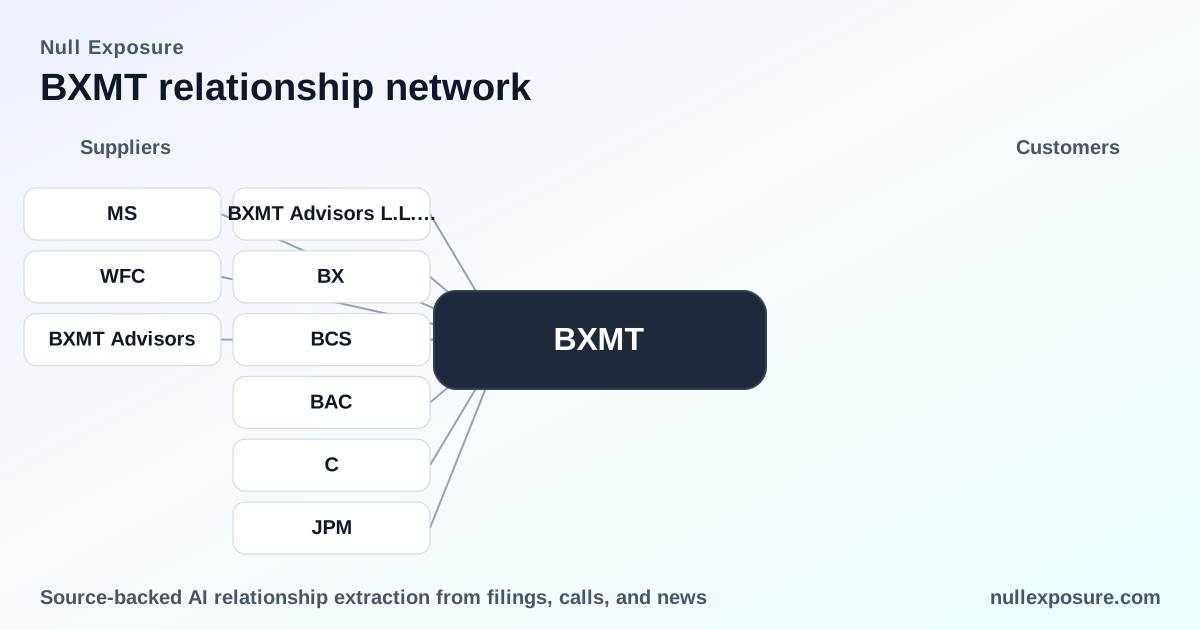
Blackstone Mortgage Trust (BXMT): Customer Relationships and What They Signal for Investors
Blackstone Mortgage Trust originates and manages senior secured commercial real estate loans across North America, Europe and Australia, and monetizes through interest income, loan origination and trading gains, and distributions to shareholders as a mortgage REIT. BXMT’s business converts scale in underwriting and sponsor relationships into yield generation, while bearing credit and geographic concentration risk tied to large, long‑duration loans. For a concise map of customer signals and monitoring priorities, visit https://nullexposure.com/ for ongoing coverage and relationship analysis.
Investor thesis — how BXMT makes money and where customers fit
BXMT lends to institutional real estate sponsors and owners, taking senior secured positions in commercial properties and collecting interest and fees; its return profile depends on loan yield, prepayment behavior, and the performance of underlying tenants and sponsors. The company distributes most earnings to shareholders as a REIT, so customer credit performance directly affects distributable EPS and the dividend, while geographic diversification and sponsor quality influence realized losses and recovery timelines.
Who counts as BXMT’s customers: a single visible relationship and its signal
- Global X SuperDividend REIT ETF: Global X includes BXMT among a concentrated set of high‑yield REIT holdings, and public reporting has linked that ETF’s positioning to investor focus on BXMT’s yield versus loan loss dynamics. A Sahm Capital news write‑up (May 2, 2026) noted that Global X’s SuperDividend REIT ETF holds BXMT and highlighted $433.9 million of charge‑offs that are pressuring distributable earnings. This relationship signals BXMT’s visibility to yield‑seeking funds and how ETF positioning amplifies investor attention when credit losses accelerate (Sahm Capital news, May 2026).
Operating model constraints and what they imply for customers
The company disclosures and portfolio metrics provide several company‑level signals that define how BXMT contracts and where counterparty risk sits:
- Long‑term contracting posture and exposure to tenancy economics. BXMT’s net lease joint venture leases show a weighted average remaining term of over 15 years with modest contractual rent escalators (~2% annually). That indicates a structural tilt toward long‑dated cash flows and sensitivity to secular tenant performance and inflation dynamics, rather than short‑term repricing opportunities (company filing, year‑end 2025).
- Customers are predominantly large, institutional sponsors. BXMT’s portfolio is composed primarily of senior loans secured by high‑quality, institutional assets sponsored by well‑capitalized owners and operators, indicating counterparty sophistication but also concentration risk when sponsor groups or market segments draw down simultaneously (company filing).
- Global footprint with near parity across regions. The loan book is geographically diversified: roughly 52% U.S. and 48% international across 131 loans with net book values totaling about $18.07 billion (net loan exposure $16.85 billion), pointing to cross‑border structural exposure and differing recovery regimes in stress scenarios (company filing).
- Material dependence on tenant and sponsor financial health. Company commentary states net lease investments are materially dependent on tenants’ ability to perform, meaning credit events among tenants cascade into distributable earnings pressure (company filing).
- Single operating segment focused on lending and related services. BXMT reports one operating segment that originates and acquires commercial mortgage loans and related investments, consolidating customer exposure management within a centralized underwriting and portfolio team (company filing).
Taken together, these constraints indicate long maturity of customer obligations, large‑enterprise counterparty focus, materiality of tenant/sponsor performance for cash flow, and geographic diversification that is significant but not immune to macro shocks.
What the ETF relationship actually tells investors
Global X’s inclusion of BXMT in the SuperDividend REIT ETF is not a contractual customer relationship for lending, but it is a market‑level customer of BXMT’s equity story: ETF demand influences BXMT’s investor base and liquidity premium. The Sahm Capital report (May 2, 2026) emphasized that funds attracted to yield will hold BXMT alongside other high‑yield REITs even while $433.9 million of charge‑offs reduce distributable EPS, demonstrating how credit news translates quickly into investor flows and valuation pressure.
Key takeaways for operators and research users
- Credit performance moves the dividend. The $433.9 million of charge‑offs cited in market commentary is directly consequential for distributable EPS and investor sentiment; monitor charge‑off trends and subsequent recoveries closely (news coverage, 2026).
- Sponsor quality and underwriting consistency are critical. Given BXMT’s emphasis on institutional sponsors, any deterioration among large counterparties concentrates downside risk despite perceived higher quality.
- Geographic diversification adds complexity, not immunity. The near 50/50 split between U.S. and international loan exposure requires monitoring legal and recovery frameworks across jurisdictions, especially in stress periods.
- Long lease and loan maturities lock in risk‑return. The long maturities embedded in the net lease JV create predictability in cash flows under benign conditions and amplify duration‑like exposure under volatility (company filing, Dec 31, 2025).
Monitoring framework for investors evaluating BXMT customer relationships
Prioritize these indicators when tracking BXMT:
- Quarterly charge‑offs and loan loss reserves relative to book value.
- Sponsor concentration metrics and any incremental exposure to single sponsor groups.
- Regional stress indicators (vacancy, rent trends) in the U.S., EMEA and APAC portfolios.
- Fund and ETF flows that disproportionately target yield — those flows can accentuate price moves when credit headlines hit. For ongoing relationship mapping and alerting, see https://nullexposure.com/ for investor tools and signals.
Risks that deserve active scrutiny
- Reputational and liquidity risk from high‑yield ETF positioning. Visibility in yield‑focused ETF products can drive rapid inflows and outflows, which translate into share price volatility even where underlying loan performance has lagged but not yet impaired.
- Cross‑jurisdictional recovery uncertainty. International loan exposure means differing foreclosure timelines and recovery rates that compress realized recoveries in stressed environments.
- Concentration in long‑dated leases. Long contractual terms limit BXMT’s ability to reprice to market rents mid‑cycle, so sustained local market deterioration will erode cash flows for extended periods.
Bottom line
BXMT operates as a large, sponsor‑focused commercial mortgage originator with long‑duration exposures, material dependence on tenant and sponsor performance, and near‑global geographic reach. Market relationships such as inclusion in high‑yield REIT ETFs amplify investor attention and can drive valuation volatility when credit headlines—like the reported $433.9 million of charge‑offs—hit the tape (Sahm Capital, May 2026). Investors and operators should weigh credit trajectory, sponsor concentration, and geographic recovery dynamics as the primary vectors that determine BXMT’s distributable cash flow and equity valuation.