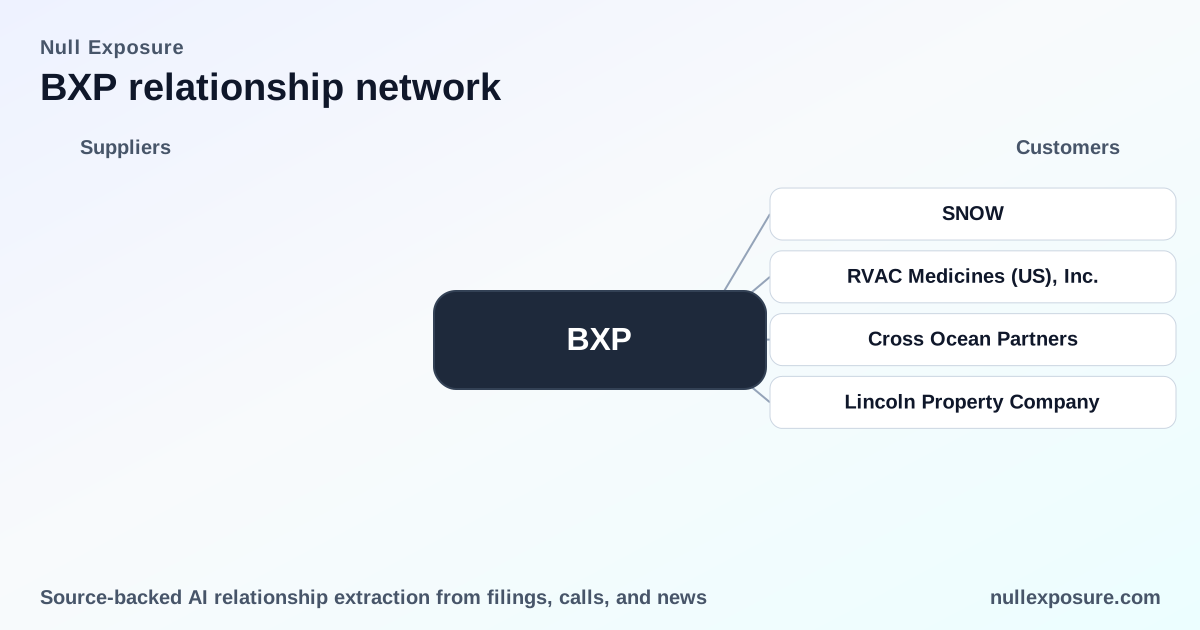
Boston Properties (BXP): Customer relationships that drive cash flow and optionality
Boston Properties is a gateway-market office REIT that monetizes via long‑term leasing of office, life‑science and retail space and fee income from in‑house property management, development and construction services. The business model layers predictable lease cash flows with opportunistic asset sales and third‑party services revenue, concentrating economic exposure in six U.S. gateway markets where rent premiums and tenant quality sustain valuation. For investors, the relevant lens is occupancy, weighted average lease term, anchor enterprise tenants and the company’s ability to rotate assets without impairing core cash generation.
For more on how we track tenant and transaction signals, visit https://nullexposure.com/.
What the operating model looks like — practical constraints that matter
Boston Properties runs a classic landlord/operator posture: long‑dated, cash‑yielding lease contracts and in‑house service capabilities. Company disclosures show a weighted‑average remaining lease term of approximately 7.8 years (by square feet) and a schedule of non‑cancelable operating lease payments extending into 2049, which translates to a predictable revenue base and limited short‑term re‑pricing risk. The portfolio is geographically concentrated in six North American gateway markets (Boston, Los Angeles, New York, San Francisco, Seattle and Washington, D.C.), which increases both pricing power in those submarkets and exposure to localized office demand cycles.
Other company‑level signals for investors:
- Counterparty mix skews to large enterprises and public institutions, including the U.S. Government as a major tenant by square feet, implying high tenant credit quality but also concentration risk when a few large occupiers drive a material share of GLA. (Company filing disclosures to Dec. 31, 2024.)
- Boston Properties acts as both lessor and service provider — it retains property management and generates third‑party fees from property management, leasing and development activities, which smooths operating visibility versus a pure net‑lease model.
- Relationship maturity is high: most leases are active and revenue‑recognizing, with portfolio occupancy reported in the high‑80s range historically (company Same Property portfolio metrics).
These workplace and contract characteristics make BXP a cash flow‑centric REIT whose upside depends on sustaining occupancy and executing asset rotation in core markets. If you want a concise feed of relationship signals, review the company page at https://nullexposure.com/.
Customer relationships and recent transactions that moved the needle
Below are every distinct counterparty referenced in the recent collection of relationship signals, each with a short, source‑attributed summary.
Federal Realty Investment Trust — buyer of Kingstowne retail
Federal Realty paid approximately $19.7 million to acquire the Kingstowne retail/movie‑theater asset from Boston Properties, representing a non‑core retail disposition by BXP in the Washington, D.C. market. Multiple trade reports including BizJournals (Apr. 29, 2026) and SimplyWall.st (May 2, 2026) covered the sale.
Snowflake — new large office lease at 7 Times Square
Boston Properties disclosed a notable leasing win with Snowflake for about 83,000 sq. ft. at 7 Times Square, a tenant commitment that strengthens occupancy and near‑term cash‑flow visibility in Manhattan. This leasing development was noted in investor alerts and MarketBeat coverage in March 2026.
The Bernstein Companies Inc. — purchaser of a 50% interest in Bethesda office
The Bernstein Companies bought the remaining 50% stake in the Marriott International headquarters office at 7750 Wisconsin Ave., Bethesda from BXP for roughly $83 million, reflecting an ownership rotation of a suburban D.C. asset. This transaction was summarized in MarketScreener coverage citing company disclosures (Apr. 2026).
RVAC Medicines (US), Inc. — tenant invoiced for rent by BXP
RVAC Medicines received invoices from Boston Properties Limited Partnership indicating monthly rent charges of $242,215.96 for premises the company occupies, which is a direct example of BXP collecting operating lease revenue from a life‑sciences tenant. The detail appears in an SEC‑linked filing reported by StockTitan (Mar. 2026).
Cross Ocean Partners — buyer in Cambridge (digital rights acknowledged)
Cross Ocean Partners participated with Lincoln Property Company in acquiring a suburban/Cambridge office asset (140 Kendrick Street) from BXP, with the transaction explicitly recognizing and transferring digital rights as part of the purchase and sale agreement. The announcement was covered by Newswire in March 2026 and reflects how intellectual property and operational rights are negotiated in modern commercial real estate sales.
Lincoln Property Company — joint buyer of 140 Kendrick Street
Lincoln Property Company partnered with Cross Ocean Partners to acquire 140 Kendrick Street for approximately $132 million; the asset sale was publicly disclosed in December 2025 and reported by Newswire in March 2026, highlighting BXP’s ongoing program of asset recycling in Greater Boston.
How these relationships change the investment picture
- Asset rotation is an active lever. The Kingstowne and 140 Kendrick dispositions illustrate BXP’s use of targeted sales to crystallize value and redeploy capital into higher‑growth or higher‑return projects. (BizJournals; Newswire; MarketScreener, 2025–2026.)
- Large enterprise leasing is a revenue driver. The Snowflake lease at 7 Times Square is an example of BXP securing anchor tenants that materially move occupancy and cash flow in marquee assets. (MarketBeat, Mar. 2026.)
- Service income and in‑house management reduce outsourcing risk. BXP’s retained property management services both protect tenant relationships and create fee revenue that offsets vacancy-driven volatility (company filings to Dec. 31, 2024).
Key takeaways for investors
- Predictable revenue base: Long‑term, weighted‑average lease durations (~7.8 years) create a steady cash flow foundation.
- Concentration tradeoff: Gateway‑market focus and large‑tenant exposure deliver pricing power but increase sensitivity to localized office-cycle risks and a few major counterparties.
- Active portfolio management: Recent asset sales and life‑science leasing wins indicate management is executing on a rotation and leasing strategy to preserve occupancy and FFO.
- In‑house services are strategic: Property management and development capabilities both support tenant retention and produce ancillary revenue streams.
If you want continuous monitoring of tenant moves, lease wins and disposition activity around BXP and peers, visit https://nullexposure.com/ for structured relationship signals and transaction roll‑ups.
Bold-facing the right signals — long leases, gateway concentration, and active asset rotation — clarifies where upside and risk intersect for Boston Properties as a cash‑flow focused, operator‑led office REIT.