Boyd Gaming (BYD) — Customer relationships that shape cashflow and strategic optionality
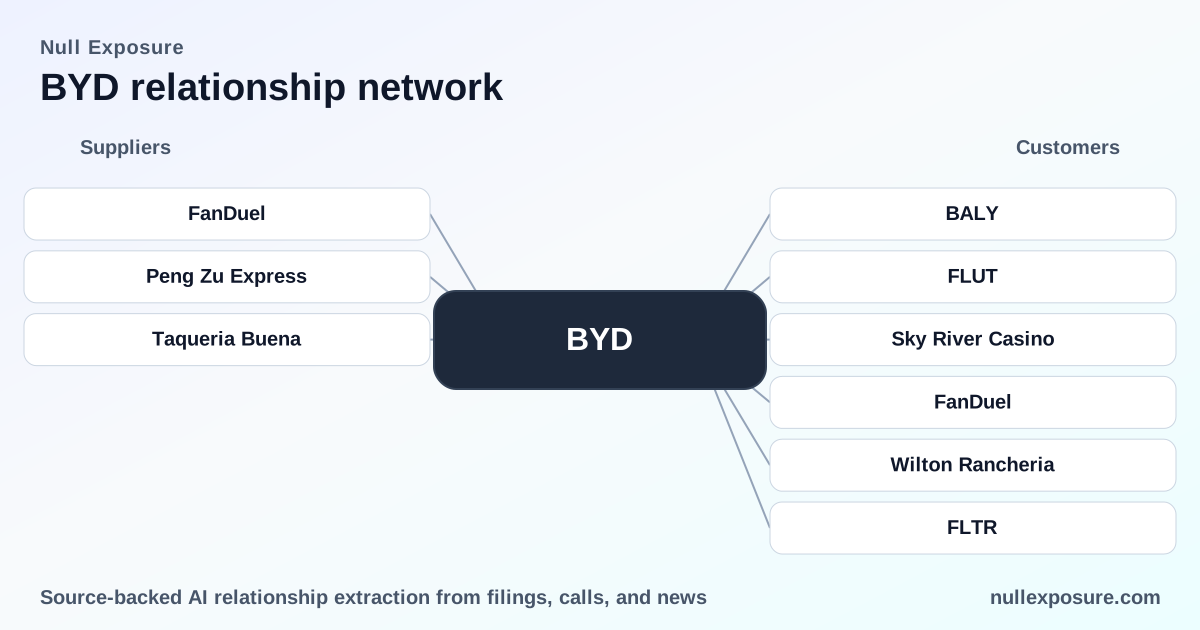
Boyd Gaming (BYD) is a multi-jurisdictional casino operator that monetizes through property-level gaming and hospitality operations, management agreements, marketing/licensing arrangements for online operations, and selective asset sales. Its revenue mix increasingly includes management fee income and structured marketing/licensing arrangements for digital gaming, while periodic asset dispositions (e.g., regional casino sales) free capital and reshape the footprint. For investors, the company’s customer and counterparty map reveals a hybrid operator: asset-heavy cash flow from owned casinos, plus recurring, contract-based revenue from managed properties and online partnerships. For primary access to the underlying relationship data, see https://nullexposure.com/.
How Boyd’s customer posture drives predictability and optionality
Boyd’s customer relationships imply a conservative, long-horizon contracting posture with a mix of property operations and service contracts. Company-level signals include:
- Long-term contracting: public excerpts reference multi-year marketing and management deals (including examples of 7–20 year terms), which drives predictable recurring revenue and smooths volatility from property-level cycles.
- Geographic focus on North America: several disclosures identify regulated markets in the United States and Canada, underscoring regulatory familiarity and concentrated regional exposure.
- Multiple relationship roles: Boyd functions both as an operator (owner/operator of casinos) and as a service provider/manager to tribal and third‑party owners; it also licenses online platforms to B2B customers.
- Counterparty mix: relationships span large strategic partners, regional operators and technology vendors — a balance that reduces single-counterparty concentration but creates cross-sector exposure (gaming operators, digital platforms, and industrial tech vendors).
- Explicit service-provider signal: Boyd’s management agreement to operate Sky River Casino is a named example of fee-based management revenue derived from an agreement with Wilton Rancheria (see Wilton Rancheria entry below).
These attributes combine to produce highly visible recurring cash flows from management and marketing agreements, with episodic upside or capital returns from asset sales.
The relationships — every counterparty the public record shows (one-line takeaways)
-
Bally’s Corporation (BALY / BALY-T) — Boyd agreed to sell Sam’s Town Hotel & Casino — Shreveport to Bally’s under a definitive agreement announced in late Feb/Mar 2026; the transaction is reported across PR Newswire and multiple trade outlets as an asset disposition for an undisclosed price. Source: PR Newswire and subsequent coverage (Feb–Mar 2026), e.g., PR Newswire press release (Mar 2026) and local reporting at KSLA.
(Representative sources: https://www.prnewswire.com/news-releases/boyd-gaming-to-sell-sams-town-shreveport-to-ballys-corporation-302697846.html; https://www.ksla.com/video/2026/02/28/sams-town-be-sold-ballys-corporation/) -
Cyngn, Inc. (CYN) — Cyngn’s DriveMod autonomy software is reported as being available on BYD forklifts, indicating a vendor–customer relationship where Boyd’s equipment is a platform for third‑party robotics software in FY2026 coverage. Source: company press and conference coverage (Mar–May 2026).
(Representative sources: FINVIZ and PR Newswire articles summarizing Cyngn product deployments, Mar–May 2026.) -
JD.com (JD) — JD.com and BYD entered a partnership to build and expand fast-charging EV stations in China, showing a strategic commercial collaboration between BYD’s industrial footprint and JD’s logistics/EV infrastructure ambitions (reported in FY2026 coverage). Source: sector write‑ups and market commentary (May 2026).
(Representative source: simplywall.st coverage summarizing the JD–BYD partnership, May 2026.) -
Penske Automotive Group (PAG) — Penske’s public remarks referenced BYD and MG as brands they are starting in Germany, implying BYD is an OEM counterparty in dealer and distribution networks referenced in Q1 2026 earnings commentary. Source: Penske earnings call transcript (May 2026).
(Representative source: InsiderMonkey transcript of Penske Automotive Group Q1 2026 discussion, May 2026.) -
Lithia (LAD) — Lithia’s earnings commentary notes BYD as one of the brands present in the U.K. retail footprint, indicating BYD’s presence in Lithia’s dealer network and early-stage retail distribution in FY2025/FY2026 remarks. Source: Lithia Motors investor transcript (May 2026).
(Representative source: Investing.com transcript quoting Lithia’s remarks, May 2026.) -
Flutter Entertainment / Flutter (FLUT / FLTR) — Flutter acquired Boyd’s remaining economic interest in FanDuel (the 5% stake) for a reported $1.6 billion transaction, a strategic monetization event that changes Boyd’s online revenue profile and future fee receipts. Source: financial press coverage and company filings (FY2025–FY2026).
(Representative source: simplywall.st coverage summarizing the Flutter purchase and related disclosures, Mar 2026.) -
FanDuel — Under the FanDuel arrangement, Boyd will continue to receive set per‑state fees from FanDuel’s online operations even after the equity sale, reflecting a contractual revenue stream tied to online gaming state-by-state economics reported around the closing of the Flutter transaction. Source: coverage analyzing the FanDuel sale and revenue-share implications (Mar 2026).
(Representative source: ReadWrite and trading coverage summarizing ongoing fee arrangements, Mar 2026.) -
Sky River Casino — Sky River is a managed property in northern California whose management fees contributed materially to Boyd’s Managed & Other segment growth; Boyd operates the property under a management agreement that produced material fee revenue in 2024–2025. Source: Boyd’s FY2025/2026 reporting and earnings summaries.
(Representative source: Boyd earnings press summaries and trading coverage referencing Managed & Other revenue contribution, Mar 2026.) -
Wilton Rancheria — Boyd manages Sky River Casino under a formal management agreement with Wilton Rancheria; the arrangement generated $88.4 million in management fee revenues in 2024, illustrating a named, explicit service‑provider relationship that is a recurring revenue stream. Source: Boyd’s SEC disclosures and FY2025 filings.
(Representative source: Boyd SEC/10‑Q discussion and trading summaries referencing the Wilton Rancheria management agreement, FY2025 disclosures reported Mar 2026.)
What these relationships imply for investors and operators
- Predictable recurring revenue: Management contracts such as the Wilton Rancheria/Sky River arrangement and long-dated marketing alliances create a recurring fee base that dampens property-level volatility. Management fees contributed materially to recent Managed & Other growth (Boyd disclosures, FY2024–FY2025).
- Asset-light optionality via monetizations: The sale of Sam’s Town Shreveport to Bally’s and the FanDuel stake sale to Flutter illustrate a willingness by Boyd to monetize non-core or high-value items to reallocate capital, boosting liquidity and lowering operating leverage risk.
- Cross-sector exposure: Relationships range from traditional gaming operators to retail/automotive and robotics vendors, creating diversified revenue channels but also exposing Boyd to macro cycles outside gaming (e.g., auto retail, EV infrastructure).
- Regulatory and geographic concentration: North America remains the core regulatory base—this supports expertise but concentrates regulatory and market risk regionally.
Final read for decision-makers
Boyd’s customer map shows a hybrid operator balancing owned cash-generative casinos with fee-based management and contractual marketing/licensing arrangements. That model produces durable baseline cash flow with clear levers for capital redeployment via asset sales or equity monetizations. For further access to the relationship-level evidence that underpins this summary, consult the full repository at https://nullexposure.com/.
For bespoke diligence or portfolio monitoring on BYD counterparties and contracts, visit https://nullexposure.com/ to explore the underlying source links and time-stamped coverage.