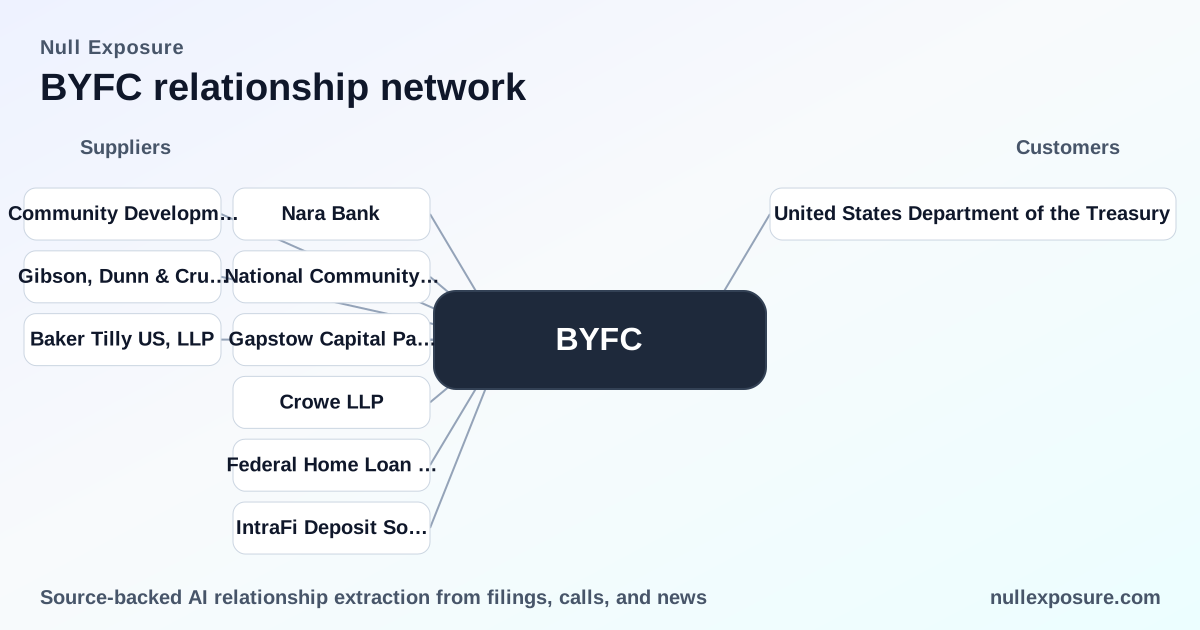
Broadway Financial (BYFC) — Customer relationships that shape capital, concentration, and credit risk
Broadway Financial Corporation operates as the holding company for Broadway Federal Bank and monetizes primarily through traditional community-banking activities: interest income on loans and investments, service charges on deposit accounts, and fee income tied to transactional activity. The company’s capital posture is actively managed through both deposit funding and liability-market transactions; it also accepts mission-oriented capital and government support when available. For an investor evaluating customer risk and counterparty exposure, the combination of a targeted geographic footprint, a handful of large deposit relationships, and a recent government preferred-stock investment are the most material inputs to valuation and downside scenarios. For a concise relationship map and tracking of counterparties, see NullExposure’s relationship pages: NullExposure homepage.
The single documented external customer relationship: U.S. Treasury equity injection
- United States Department of the Treasury — Broadway completed a private placement of $150 million of Senior Non‑Cumulative Perpetual Preferred Stock, Series C to the U.S. Treasury under the Emergency Capital Investment Program (ECIP). This is a direct equity-style capital infusion that strengthens regulatory capital ratios and reflects an explicit government role in Broadway’s capitalization. (Reported in a March 9, 2026 news item summarizing the company announcement on StockTitan.)
How these relationships actually drive revenue and capital
Broadway’s business model is uni‑dimensional in practice: one reportable segment — banking — where interest margin and fee income drive results. Interest income is generated through lending (including multi‑family loans amortized over 30 years) and investment securities; fee income comes from monthly account service fees and transaction-based deposit fees. Company filings as of December 31, 2024 confirm that the bank’s operating results are managed on a consolidated basis without segmented resource allocation, which makes large counterparty events immediately consequential to consolidated earnings.
The U.S. Treasury preferred-stock investment is not a fee or deposit relationship; it is capital, and it changes the balance-sheet composition. According to the March 2026 press coverage, the Series C preferred stock is perpetual and senior in nature, which improves loss‑absorbing capacity but also introduces a fixed cost profile through preferred dividends.
(For further relationship intelligence and to map counterparties across funding sources, consult NullExposure.)
Customer and funding profile — concentrated, mission‑driven, regional
Company disclosures (December 31, 2024) present a compact and mission-oriented customer base:
- Broadway serves a defined geographic market: two offices in California (Los Angeles and Inglewood) and one in Washington, D.C., with lending confined to Southern California and the D.C. area (including parts of Maryland and Virginia). This regional concentration limits diversification but concentrates local market expertise.
- The bank’s customer mix includes individuals, small and medium-sized businesses, non‑profits, large non‑profit entities, and local municipalities, reflecting a mission-driven Community Development Financial Institution (CDFI) posture.
- Deposit concentration is meaningful: five long‑time customers accounted for roughly 18% of deposits as of December 31, 2024 (and 28% in 2023), and one unnamed customer accounted for 88% of the balance of securities sold under agreements to repurchase. These figures indicate high counterparty concentration and dependency on a small set of major relationships (company filings, Dec 31, 2024).
Contract mix and tenure — what the agreements imply for liquidity and margin
Broadway’s contractual landscape combines long-duration lending with short-term funding mechanisms:
- Multi‑family loans typically amortize over 30 years, producing stable long-term interest cash flows.
- Funding and liquidity components are short‑term: repurchase agreements with daily maturities (securities sold under agreements to repurchase totaled $66.6 million as of Dec 31, 2024), term certificates with maturities from one month to five years, and loan commitments generally issued for 60 days or less (company filings).
- Fee revenue contains subscription-like monthly service fees (recognized over the service period) and usage‑based transactional fees (recognized at a point in time).
This mix creates an inherent maturity mismatch: long-duration assets funded in part by short-duration liabilities, which elevates liquidity risk in stressed market conditions unless capital buffers or committed liquidity facilities are robust.
Materiality and spend bands — scale of exposures
Two scale signals are material for investors evaluating downside:
- Uninsured deposits were approximately $268.8 million of total deposits as of December 31, 2024 — a nontrivial uninsured pool that can be sensitive to flight risk.
- Repurchase agreements represented roughly $66.6 million in short-term funding as of the same date, highlighting reliance on wholesale-like deposit and securities financing channels.
Together with the presence of a government preferred stock investor, these figures define the financial backbone: capital support combined with concentrated short-term funding.
Risk profile, operational posture, and maturity of relationships
- Relationship stage is largely mature — Broadway reports long-standing customers that the company expects to retain in the near term.
- Relationship roles are typical for a bank: Broadway functions as a seller of loans and as a service provider for deposit accounts, while it also accepts deposits (it acts as buyer of funding when negotiating rates for large deposits).
- The business is mission-focused (CDFI) and operates a unified banking segment, which informs underwriting priorities and product focus.
These characteristics result in a profile where relationship criticality and concentration are the dominant operational constraints: a small number of large counterparties, short-term funding buckets, and a mission-driven deposit base that is geographically concentrated.
Investment implications — what investors should weight
- Positive: The $150 million ECIP preferred-stock investment from the U.S. Treasury provides immediate capital relief and strengthens regulatory buffers; this reduces insolvency tail risk and supports future lending capacity (StockTitan report, March 2026).
- Negative: High counterparty concentration in deposits and repurchase funding creates a single-point liquidity risk; one unnamed counterparty accounted for 88% of repurchase obligations as of Dec 31, 2024. The uninsured deposit pool and short-term repo exposure demand active liquidity management.
- Structural: The bank’s long‑term lending book (30‑year multi‑family amortizations) coupled with short-term liability profiles requires careful net interest margin and liquidity stress testing — capital injections improve headroom but do not eliminate funding volatility.
Key takeaway: Broadway’s creditworthiness and market value are now a balance between strengthened capital (government preferred equity) and persistent funding concentration and maturity mismatch. Investors should prioritize monitoring deposit concentration metrics, repo counterparty continuity, and any evolution in the bank’s funding mix.
Final note and next steps
For portfolio risk teams and credit analysts, the immediate focal points are counterparty continuity for repurchase agreements, changes in uninsured deposit behavior, and the contractual terms of the preferred stock (dividend rate and redemption mechanics). For continuing coverage and granular counterparty mapping, visit NullExposure for updates and relationship tracking.