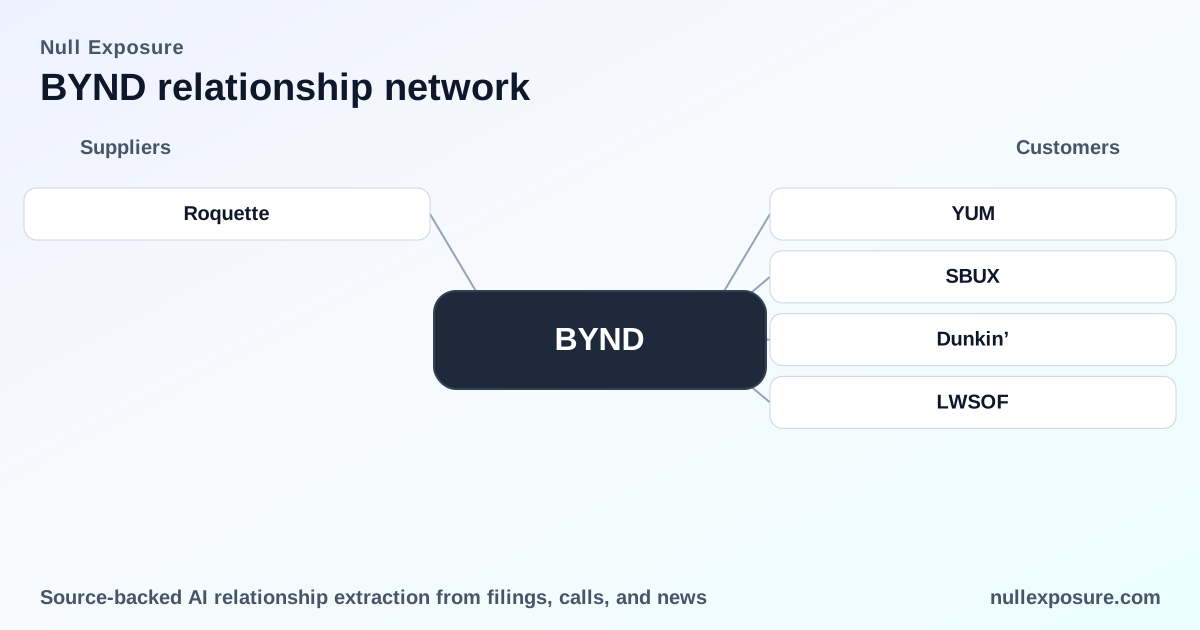
Beyond Meat (BYND) — Customer Map and Commercial Implications for Investors
Beyond Meat manufactures and sells plant-based meat products to global retail and foodservice partners, monetizing primarily through product sales distributed via large retailers, club stores, natural grocers and restaurant partners; the business is driven by distribution scale, marquee retail placement, and foodservice co‑branding rather than long-term purchase contracts. For investors, the key read is whether Beyond can convert headline distribution wins into recurring shelf velocity and margin recovery while managing concentrated SKUs and spot-driven ordering patterns. Learn more about how we track partner signals at https://nullexposure.com/.
Business model and operating constraints: Beyond sells finished products across mainstream grocery, mass, club and food‑away‑from‑home channels, mostly on spot or short‑term purchasing cycles rather than fixed long‑term volume commitments. Company filings and disclosures flag a heavy reliance on distributors and large retail placements; this creates revenue sensitivity to assortment decisions at key accounts and high operational exposure to promotional cadence and seasonal ordering. Beyond’s products are global in reach (available in 65+ countries as of Dec 2024) and heavily concentrated around flagship SKUs such as the Beyond Burger, which historically accounted for roughly half of revenue—a material concentration risk. These characteristics point to a contracting posture that is largely spot/transactional, counterparty mix that is large enterprise‑centric, and an active, global relationship footprint rather than small, lock‑in contracts.
If you want a concise partner intelligence briefing built for investment committees, visit https://nullexposure.com/ for our structured summaries.
How each named customer and partner figures into the current commercial picture Below I cover every customer relationship cited in the recent signal set and give a plain‑English takeaway with source.
Kroger (KR)
Kroger has rolled out Beyond Meat’s new Beyond Chicken Pieces across more than 2,000 Kroger stores nationwide, reflecting core‑channel shelf expansion that should drive incremental retail sales volume if in‑store placement is sustained. According to a MarketBeat instant alert and company press notices in April 2026, Kroger is a material retail partner for Beyond’s frozen and chilled launches (MarketBeat; Apr 2026).
Sprouts (SFM)
Sprouts will carry Beyond Meat’s avocado‑oil breakfast sausage line as part of a multi‑retailer launch, signaling targeted natural‑channel distribution for premium SKUs. This was reported in a StocksToTrade roundup on Apr 22, 2026 (StocksToTrade; Apr 22, 2026).
Wendy’s (WEN)
Wendy’s tested a Georgia pilot of a plant‑based burger across 19 locations, which positions Wendy’s as a limited foodservice trial partner rather than a nationwide menu conversion. The TradingView community discussion referenced this FY2026 pilot (TradingView; May 2026).
KFC / Yum Brands (YUM)
Beyond announced high‑profile foodservice partnerships that include KFC in China, indicating strategic penetration into quick‑service menus in large international markets and the foodservice channel. Vegconomist covered these foodservice tie‑ins in March 2026 (Vegconomist; Mar 9, 2026).
Starbucks China (SBUX)
Starbucks China is cited alongside KFC as a foodservice partner—this reflects Beyond’s targeted international QSR collaborations that help the company access high‑frequency consumer channels in Asia. Vegconomist reported the Starbucks China partnership in March 2026 (Vegconomist; Mar 9, 2026).
Starbucks (SBUX)
Beyond’s mention with Starbucks more broadly points to strategic co‑branding opportunities in foodservice with a global coffee chain, useful for scale and trial across high‑traffic outlets. This relationship was noted in coverage of Beyond’s foodservice partnerships (Vegconomist; Mar 9, 2026).
Costco (COST)
Industry commentary places Beyond increasingly in the frozen aisle at club formats such as Costco, which changes purchase dynamics from fresh to frozen SKUs and can affect price, margin and inventory cycles. IndexBox analyzed the frozen‑aisle strategic pivot in May 2026 (IndexBox; May 2026).
Walmart (WMT)
A recent Walmart distribution deal expanded Beyond’s presence across U.S. stores, an important mass‑market channel that drives volume but also subjects pricing and promotional pressure. TradingView and IndexBox referenced the Walmart expansion in early May 2026 (TradingView; May 2026; IndexBox; May 2026).
Good Times Restaurants / Bad Daddy’s (GTIM)
Good Times (owner of Bad Daddy’s Burger Bar) added the Beyond Burger to its menu historically, showing legacy foodservice relationships that provide product placement in casual‑dining concepts. This was documented in an earlier RestaurantNews item (RestaurantNews; Jul 2020).
McDonald’s (MCD)
McPlant and other high‑profile conversations around McDonald’s are noted as brand‑level partnerships that have not historically translated into material sales for Beyond, underscoring the gap between headline collaborations and recurring revenue. TradingView commentary captured this nuance in May 2026 (TradingView; May 2026).
Big Geyser
Beyond signed a distribution deal with Big Geyser to place a functional beverage line (Beyond Immerse) into over 26,000 retail locations, showing product diversification into beverages and reliance on large distributor networks for fast scaling. This was reported on Apr 22, 2026 (StocksToTrade; Apr 22, 2026).
Whole Foods Market / Whole Foods
Whole Foods is listed across multiple press mentions as a launch channel for new Beyond Sausage and related SKUs, aligning Beyond with natural‑channel premium placement. SimplyWallSt and StocksToTrade noted Whole Foods in April–June 2026 rollout coverage (SimplyWallSt; May 2026; StocksToTrade; Apr 22, 2026).
Tesco
Trials of a smash‑burger concept at Tesco UK indicate limited testing in major European grocery chains, consistent with a measured European rollout strategy. TradingView captured the Tesco trial mention in May 2026 (TradingView; May 2026).
Hard Rock Cafe
Hard Rock Cafe partnered to bring the latest Beyond Burger to its venues nationwide, representing branded experiential distribution in the casual dining and entertainment channel. SimplyWallSt referenced this partnership in FY2026 coverage (SimplyWallSt; 2026).
Erewhon
Erewhon availability for Beyond Burger and Beyond Beef IV points to selective premium market placements in upscale natural grocers, which can support higher ASPs but limited scale. SimplyWallSt cited Erewhon availability in FY2026 notes (SimplyWallSt; 2026).
Dunkin’
Legal outcomes involving a trademark dispute tied to a Beyond Sausage sandwich at Dunkin’ highlight brand and litigation risk associated with co‑promotions in QSR — a $39M damages award against Beyond was reported in 2026 coverage. Green Queen summarized the legal matters in March 2026 (Green Queen; Mar 2026).
Lawson / LWSOF
A partnership with convenience store Lawson in China expanded Beyond into 2,300 Lawson stores, demonstrating the company’s focus on convenience retail and international execution in high‑frequency channels. Vegconomist reported the Lawson expansion in March 2026 (Vegconomist; Mar 9, 2026).
What this partner map implies for investors
- Distribution wins are necessary but not sufficient: national rollouts at Kroger, Walmart, Costco and club/convience partners provide addressable volume but convert into sustainable revenues only if assortment and in‑store velocity hold.
- Revenue structure is spot‑driven and distributor‑mediated: company disclosures describe a largely transactional sales model through distributors, which increases sensitivity to retailer assortment decisions and promotional intensity.
- SKU concentration is material: flagship category concentration around Beyond Burger and prioritized new SKUs means product success or retail de‑listings have outsized P&L impact.
For institutional clients needing a custom partner risk scorecard or ongoing monitoring of these relationships, visit https://nullexposure.com/ to see how we translate signals into investment signals.
Key takeaway: Beyond’s commercial strategy is clear—scale through marquee retail and foodservice placements—but investor returns will depend on converting headline distribution into steady sell‑through, margin recovery and diversification away from a handful of core SKUs.