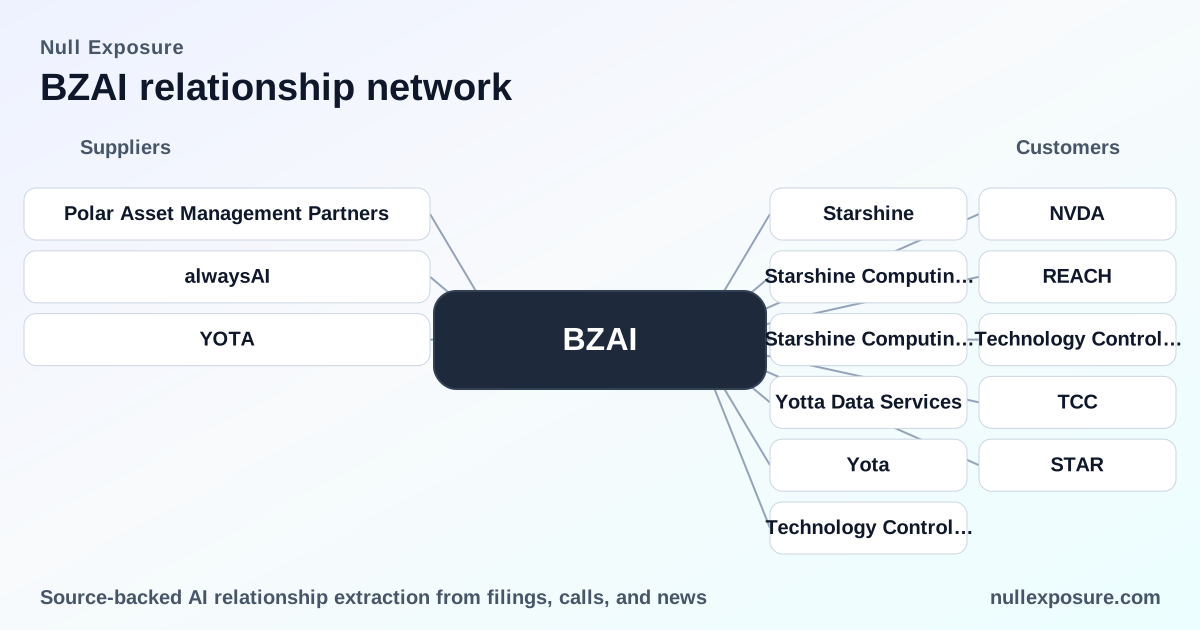
Blaize Holdings (BZAI) — Customer relationships driving early commercial scale
Blaize sells AI-enabled edge computing hardware, software and services—monetizing through multi-year, enterprise and sovereign contracts that bundle compute cards, pre-integrated software stacks and professional services. Recent wins position Blaize as a technology supplier to large regional integrators and sovereign programs across Asia, the Middle East, and India, converting R&D into recurring and project revenue via high-dollar purchase orders and alliances. For deeper relationship intelligence, see https://nullexposure.com/.
How Blaize makes money and what the partnerships mean for investors
Blaize is a seller of full-stack edge AI solutions: GSP-based compute hardware, a low-code/no-code software platform, and integration services. The company targets large enterprise and sovereign customers with long procurement cycles, driving lumpy, high-ticket revenue rather than high-volume commodity sales. Recent contract disclosures show the monetization model is a mix of upfront hardware shipments and ongoing platform and services revenue — a structure that amplifies top-line volatility but supports attractive revenue per customer when deployments scale.
- Business posture: Blaize emphasizes long sales cycles with large enterprise counterparts and sovereign programs; this requires investment in sales and professional services and produces concentrated, high-value deals.
- Revenue mix: Hardware, software platform (AI Studio/analytics), and services are all explicit commercial channels for revenue, which increases per-account lifetime value but raises execution risk on delivery and integration.
Explore how these relationships are tracked and analyzed at https://nullexposure.com/.
Constraints and what they signal about operating risk
The company-level signals from public disclosures convey several operating constraints:
- Contracting posture and concentration: Management explicitly warns that sales cycles with large enterprise customers are long and costly; this points to concentrated, project-based revenue and a dependence on a handful of large agreements to drive near-term growth.
- Role and product mix: Blaize is a clear seller of hardware, software, and services; its product set spans compute cards (hardware), a programmable architecture and low-code platform (software), and professional integration/analytics (services). This vertical breadth increases addressable market but requires multi-disciplined delivery capabilities.
- Criticality and maturity: Large sovereign and infrastructure customers make Blaize’s solutions mission-critical in some deployments (e.g., public safety, national AI infrastructure), which elevates contract importance but also requires higher assurances on ruggedization, security, and lifecycle support.
These constraints are company-level signals derived from management commentary and product descriptions in public filings and calls.
Relationship roundup — every partner mentioned in recent disclosures
Starshine / Starshine Computing Power Technology / Starshine Computing Power Technology Limited / STAR
Blaize disclosed a $120 million multi-year contract to deploy hybrid AI infrastructure across Asia with Starshine, and reported initial server shipments generated roughly $10.4 million of Q3 revenue tied to that program. Source: Blaize Q2/Q3 2025 earnings call transcripts and multiple March 2026 news reports (e.g., Yahoo Finance, TS2).
Yotta / Yotta Data Services / Yota (name variants)
Blaize is the technology supplier powering a $56 million edge AI initiative for Yotta in India, with management saying initial deliveries are in progress and Yotta is the end-customer for that program. This positions Blaize in large-scale, sovereign-aligned cloud/edge projects in South Asia. Source: Company disclosures and press coverage (StockTitan, TS2, Investing.com; FY2025–FY2026 reporting).
NeoTensr
Blaize entered a contract with NeoTensr for up to $50 million in revenue in the first year, following a separate >$20 million order recognized in late 2025; fulfillment is expected to begin in Q2 of the stated fiscal period. This represents a sizable channel/order flow from an Asia Pacific technology partner. Source: MarketScreener and related April–May 2026 press reports.
NVIDIA (NVDA)
Management described a hybrid architecture for the Starshine deployment where Blaize inference servers operate alongside NVIDIA GPUs in the data center, emphasizing Blaize’s role in inference-efficiency at the edge and in hybrid configurations. This underscores interoperability with dominant GPU platforms rather than a purely displacing relationship. Source: Q2 2025 earnings call transcript (March 2026 reporting).
Technology Control Company (TCC)
Blaize announced a strategic partnership with Saudi Arabia’s Technology Control Company to deliver ruggedized, energy-efficient hybrid AI boxes and services in support of the Kingdom’s Vision 2030 initiatives, with initial revenue expected in 2026 tied to these sovereign deployments. Source: Q3 2025 earnings call commentary and FY2025 press releases (Globe and Mail, StockTitan).
Reach Group / Reach Digital / REACH
A new partnership with Reach Group (announced at GITEX Global 2025) strengthens Blaize’s presence in the Middle East, focusing on practical AI solutions and regional infrastructure initiatives — a channel for enterprise and public-sector projects in the region. Source: Q3 2025 earnings call transcript and GITEX-related announcements (March–May 2026).
Winmate Inc.
Blaize signed a Memorandum of Understanding with Winmate, a Taiwan-based rugged hardware manufacturer, targeting sovereign and mission-critical edge AI deployments, signaling a focus on hardened form factors and regional manufacturing/assembly partnerships. Source: SahmCapital press coverage (April–May 2026).
Nokia (NOK) and PT Datacomm Diangraha (partner mention)
Press reports describe a strategic alliance among Nokia, Blaize, and PT Datacomm Diangraha to deploy hybrid AI inference infrastructure across Indonesia and Southeast Asia. This triangular partnership positions Blaize within telecom-led edge rollouts in the region. Source: SahmCapital coverage and related news (April 2026).
What investors should watch next
- Execution on delivery timelines: Large, multi-year contracts create material revenue swings; management’s ability to meet delivery schedules and collect on receivables will determine near-term cash flow.
- Customer concentration risk: A few contracts (e.g., $120M Starshine, $56M Yotta, up to $50M NeoTensr) dominate disclosed backlog; any slippage would disproportionately affect results. Underwriting and delivery discipline are critical.
- Product breadth vs. delivery capability: Selling hardware, software, and services increases upsell potential but requires rigorous field engineering and partner orchestration; the Winmate and Nokia alliances are evidence management is building delivery pathways.
Key takeaway: Blaize’s commercial progress is defined by a small set of very large, regionally strategic contracts that materially lift revenue when shipments occur, but also concentrate execution risk. For ongoing coverage of Blaize customer signals and contract tracking, visit https://nullexposure.com/.