BuzzFeed’s customer footprint: asset sales, platform partners, and what it means for revenue quality
BuzzFeed monetizes by selling advertising and content services tied to its large, engaged audience and by franchising or selling brands and content verticals. The company operates as a seller of digital advertising and long-form content services, recognizing revenue largely on a gross basis for direct ad buys, while supplementing cash flow through selective asset divestitures and licensing deals. Investors should assess the business as a media operator with short-term, usage-based commercial contracts, high platform distribution dependency, and meaningful revenue concentration that asset sales are actively reducing. For a deeper look at the competitive and customer landscape, visit https://nullexposure.com/.
Why the customer relationships matter now
BuzzFeed’s commercial posture is shaped by three structural characteristics: short-term, usage-based advertising contracts; a customer base that includes very large enterprise advertisers and platform partners; and a revenue profile concentrated in a few key relationships. These characteristics create both operational flexibility and quarter-to-quarter revenue volatility. The company’s recent strategy — selling brands such as First We Feast and Complex — converts audience assets into immediate liquidity and narrows operating scope, improving near-term balance sheet resilience while reducing recurring revenue streams tied to those brands.
- Contracting posture: Advertising customers generally sign short-term, monthly or quarterly agreements and pay based on delivered impressions or actions, not long-term fixed contracts. This yields revenue that tracks platform performance and campaign activity rather than multi-year predictable receipts.
- Counterparty profile and criticality: The customer mix includes Fortune 500 advertisers and platform distributors; one customer historically accounted for ~30% of revenue, creating high concentration risk that needs continuous monitoring.
- Geography and scale: Revenue is predominantly North American but the company maintains global advertiser relationships and international licensing.
These operating signals influence credit and commercial underwriting: high concentration and platform dependence increase downside sensitivity, while usage-based revenue and asset sales preserve flexibility.
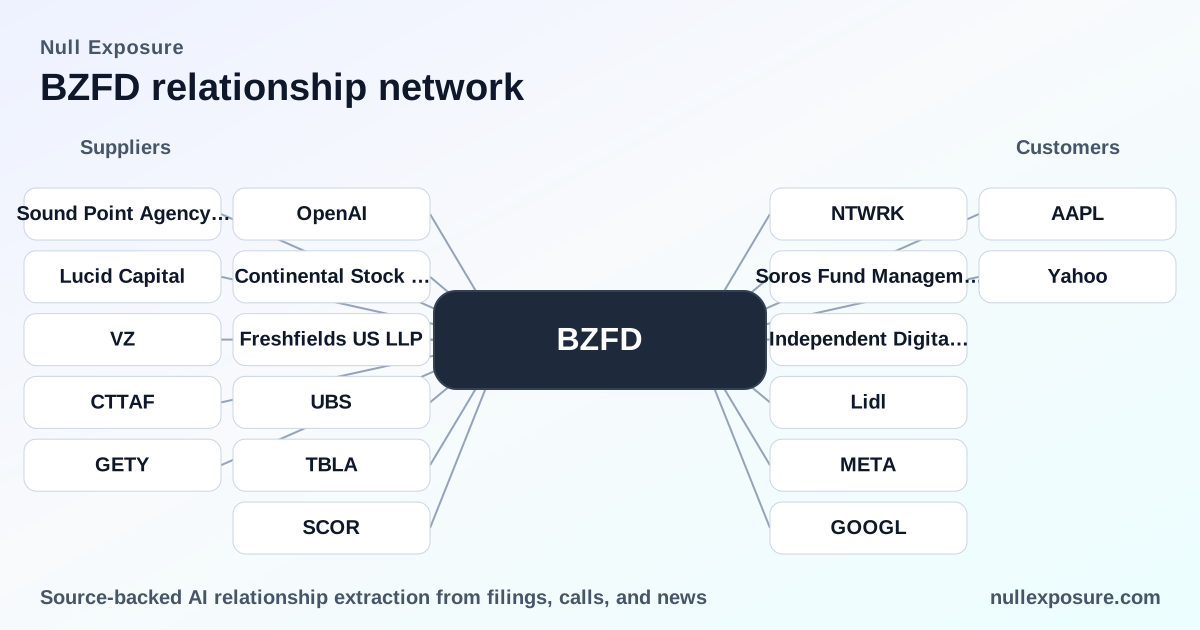
Relationship map — the counterparties and recent deals you need to know
Below I cover every relationship surfaced in the results, with concise commercial summaries and source notes.
-
Soros Fund Management LLC — BuzzFeed closed the sale of the culinary brand First We Feast to a consortium led by an affiliate of Soros Fund Management for $82.5 million in cash, a decisive monetization of a non-core asset that improves liquidity and reduces brand-level cost and complexity (BuzzFeed press release, March 9, 2026; FinancialContent coverage, May 2026).
-
NTWRK — BuzzFeed sold the Complex brand to NTWRK earlier in the year for $108.6 million plus $5.7 million in related fees received from NTWRK, reflecting the company’s program of divesting premium properties for cash (BuzzFeed press release, March 9, 2026).
-
Independent Digital News and Media Ltd (The Independent) — BuzzFeed entered a long-term license and strategic support arrangement in which its UK staff for editorial and commercial roles will move to The Independent while BuzzFeed supplies global content and technical support, signalling a shift to licensing and back-end services in that market (BuzzFeed press release, March 9, 2026).
-
Lidl — Tasty UK continues to operate commercial partnerships such as the Fiver Feast video series with Lidl, demonstrating BuzzFeed’s continued ability to monetize vertical content through branded integrations and retailer-sponsored formats in international markets (BuzzFeed press release, March 9, 2026).
-
Meta / Facebook — BuzzFeed has a creator-content deal reported to be valued at roughly $10 million for producing creator-led material for Meta platforms; separately, a historic class-action claim alleged sharing of certain subscriber data with Facebook, a legal risk to monitor alongside ongoing platform partnerships (Wall Street Journal report cited by Hollywood Reporter, March 2026; TopClassActions reporting on FY2022 allegation).
-
YouTube / GOOGL — BuzzFeed distributes advertising across its owned properties and via third-party platforms, with YouTube identified as a primary distribution partner for video and monetized content, underscoring platform-driven audience reach and revenue dependency (company overview cited in StockTitan, FY2025).
-
Apple News (AAPL) — Apple News is named among the primary third‑party platforms where BuzzFeed distributes and monetizes content, reflecting a multi-platform distribution strategy that extends ad inventory beyond owned channels (company overview noted in StockTitan, FY2025).
-
NILE & Co. — NILE & Co. acquired assets related to BuzzFeed’s Goodful and As/Is businesses for $0.5 million, an example of smaller disposals of niche content verticals as BuzzFeed repositions its portfolio (MarketScreener coverage, October 2025).
-
PodcastOne (PODC) — PodcastOne announced a partnership with BuzzFeed to launch an original podcast series, Phone A Fangirl, showing that BuzzFeed leverages third‑party audio networks to expand content monetization and tap podcast ad sales channels (GlobeNewswire, October 17, 2025).
-
Yahoo — Following BuzzFeed’s acquisition of HuffPost, the company gained syndication and traffic opportunities across Verizon Media properties including Yahoo, illustrating historical platform syndication and traffic partnerships that drive audience scale (BuzzFeed announcement on the HuffPost acquisition, FY2020).
What these relationships mean for revenue quality and risk
BuzzFeed’s customer map shows a deliberate tilt toward converting non-core brands into cash while keeping platform and enterprise advertising relationships as the backbone of recurring revenue. That strategy reduces operating complexity but introduces two persistent investor-level tradeoffs:
- Liquidity and de-risking through asset sales. Sales to Soros and NTWRK materially improve cash and reduce fixed cost for the divested verticals, strengthening the balance sheet in the near term (March 2026 press coverage).
- Revenue volatility from short-term, usage-based contracts. Majority advertising revenue is recognized when impressions or actions occur, and advertisers are not bound by long-term commitments, so top-line can swing with campaign demand and platform algorithm changes. This is compounded by historical customer concentration: one customer represented ~30% of revenue for FY2024 (company disclosures).
- Platform dependence and legal/regulatory overhang. Distribution via YouTube, Apple News, and Meta expands reach but intensifies dependency on platform policies and contractual economics; the company also faces legacy legal risk tied to data-sharing alleged in FY2022.
- Enterprise partnerships remain strategic growth channels. Deals with Meta and PodcastOne show expansion into creator content and audio advertising, offering higher-margin service lines compared with pure programmatic inventory.
Bottom line and investor action
BuzzFeed is executing a pragmatic pivot: monetize core audience through advertising and services while converting select brands into cash. Key investor focus should be on customer concentration metrics, quarter-to-quarter ad demand trends, and the cadence of further asset sales or licensing deals. For immediate reference on counterparties and ongoing signals, explore additional research at https://nullexposure.com/.
Bold takeaways: short-term, usage-based contracts dominate; platform distribution drives scale and risk; recent asset sales materially improve liquidity but reduce recurring revenue base. Monitor concentration exposure and advertising demand as primary drivers of valuation volatility.