BuzzFeed (BZFDW): Customer Map and Commercial Implications for Investors
Thesis: BuzzFeed monetizes a diversified digital-media engine through three primary revenue streams—advertising inventory sold on a usage basis, custom and licensed content services, and commerce-driven affiliate transactions—with the firm executing short-term, transactionally billed contracts against a predominately North American enterprise customer base. For investors assessing revenue durability, the 2024 Form 10‑K discloses a mix of high-volume platform partners and large retailers that drive commerce and advertising flows, but also a concentration risk where one unnamed customer accounted for 30% of revenue in FY2024. Learn more about how these commercial dynamics affect company risk profiles at https://nullexposure.com/.
What the filing tells investors about how BuzzFeed contracts and gets paid
BuzzFeed operates as a merchant of attention and content for enterprise customers. Advertising revenue is principally recognized on a per-impression or per-day basis, while content and branded work are captured via licensing and bespoke services. Contracts are typically short-term (monthly or quarterly) and therefore revenue from many clients is cadence-driven rather than time‑locked. The company services large enterprise counterparties and reports both a strong U.S. revenue footprint and international activity through regional offices.
Key operating signals from the FY2024 10‑K:
- Contracting posture: Short-term commercial arrangements and a mix of licensing and per-use advertising billing.
- Customer type and concentration: A customer base dominated by large enterprises, with one customer representing 30% of total revenue in FY2024.
- Revenue drivers: Advertising (usage-based impressions and fixed-day buys), content/licensing, and commerce affiliate transactions that generate hundreds of millions in shopper-driven transactions.
- Geography: Revenue is heavily U.S.-weighted, with international revenue representing a smaller share but supported by global offices.
These are company-level signals derived from BuzzFeed’s FY2024 filing.
Named customers called out in the 2024 filing — what each relationship means
Below I cover every relationship listed in the public results, with a concise description and the filing source.
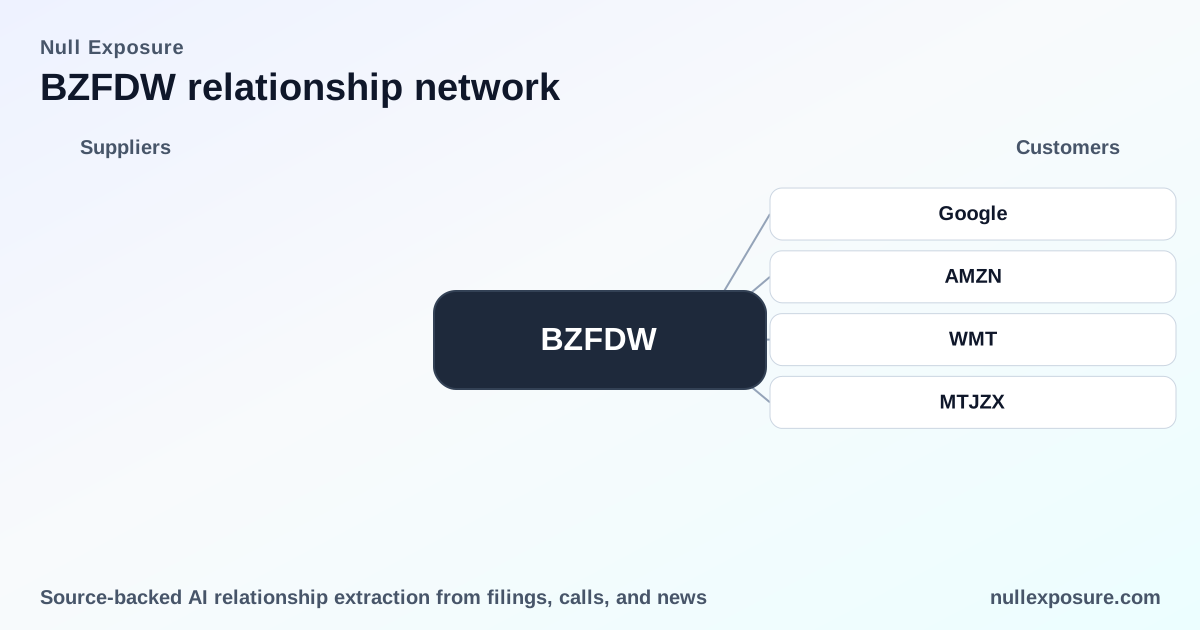
BuzzFeed states it derives a significant amount of revenue from the affiliate and advertising exchanges of Google, indicating Google’s platforms are an important traffic and monetization conduit for ad inventory and programmatic placements. According to BuzzFeed’s Form 10‑K for the year ended December 31, 2024, Google is explicitly named as a revenue source in advertising exchanges.
Amazon
BuzzFeed reports that editorially-led content informed by audience insights drives hundreds of millions of dollars in annual transactions on behalf of large retailers, including Amazon, signaling a major commerce partnership where BuzzFeed’s editorial and commerce capabilities convert readers into retail transactions. This is stated in the company’s FY2024 Form 10‑K.
AMZN
The filing includes an additional mention of Amazon under the ticker-style name AMZN using the same language about hundreds of millions in commerce transactions, effectively duplicating the Amazon reference in the FY2024 10‑K; the duplicate listing confirms the materiality of Amazon-related commerce flows in BuzzFeed’s disclosure.
Walmart
Walmart is listed alongside Amazon and Target as one of the largest retailers for whom BuzzFeed’s content and commerce efforts generate significant transactional volume, per BuzzFeed’s FY2024 Form 10‑K, indicating Walmart is a key partner for affiliate-driven commerce revenue.
MTJZX
MTJZX appears in the filing as an identifier within the retailer list that includes Amazon, Target, and Walmart; the same sentence links MTJZX to the commerce transactions generated by editorial content. The FY2024 10‑K contains this reference, suggesting either an alternate ticker identification for a retailer or a filing artifact that nonetheless sits in the company’s list of major retail commerce partners.
Target
Target is named in the FY2024 10‑K as one of the retailers on behalf of whom BuzzFeed’s editorial commerce efforts generate hundreds of millions of dollars in transactions annually, placing Target in the same commerce partner cohort as Amazon and Walmart.
Commercial and risk implications for investors and operators
BuzzFeed’s commercial architecture creates a distinct set of investment considerations:
- Revenue concentration is material. One customer represented 30% of FY2024 revenue, which elevates counterparty risk and creates sensitivity to that customer’s procurement decisions or platform changes.
- Cash flow profile is transactional and short-cycle. The preponderance of monthly/quarterly payment terms and usage-based ad billing produces high revenue volatility tied to audience metrics and seasonal advertiser budgets.
- Customer quality is high but exposed. BuzzFeed’s counterparties are large enterprises and Fortune 500 retailers, which improves credit quality but also concentrates bargaining power; large buyers can pressure pricing or shift spend to competitors.
- Commerce is a material monetization lever. Editorial-led commerce transactions are significant in absolute terms—hundreds of millions annually—driving not just ad CPMs but also affiliate revenue and partner dependency.
- Geographic configuration is U.S.-centric. The bulk of revenue is domestic (United States $177.6m of $189.9m reported for 2024), so macro or regulatory headwinds in the U.S. advertising market disproportionately affect results.
Operationally, this means management must balance scaling commerce and licensing with diversification away from any single large customer and sustaining audience engagement that underpins usage-based ad revenue. For credit-oriented investors and underwriters, short-term contract length and usage billing increase earnings volatility, while large enterprise relationships increase counterparty leverage.
If you want a structured view of these customer dynamics and their implications for underwriting and portfolio decisions, NullExposure’s platform provides transaction-level relationship analytics and customer concentration flags at https://nullexposure.com/.
Bottom line: where to focus diligence
BuzzFeed’s FY2024 disclosures position the company as a content and commerce operator monetized through usage-based advertising and branded/licensed content with meaningful commerce partnerships. Primary investor focus should be on customer concentration, the durability of commerce partnerships (Amazon/AMZN, Walmart, Target), and the stability of programmatic ad flows tied to Google. Operational improvements should prioritize contract diversification, longer-term deals where possible, and international revenue growth to reduce single-customer risk.
For investors building exposure models or stress-testing revenue scenarios, prioritize scenario analysis around the top customer that accounted for 30% of revenue, changes in programmatic pricing, and the trajectory of commerce transaction volumes. More detailed relationship analytics and historical trend context are available at https://nullexposure.com/.