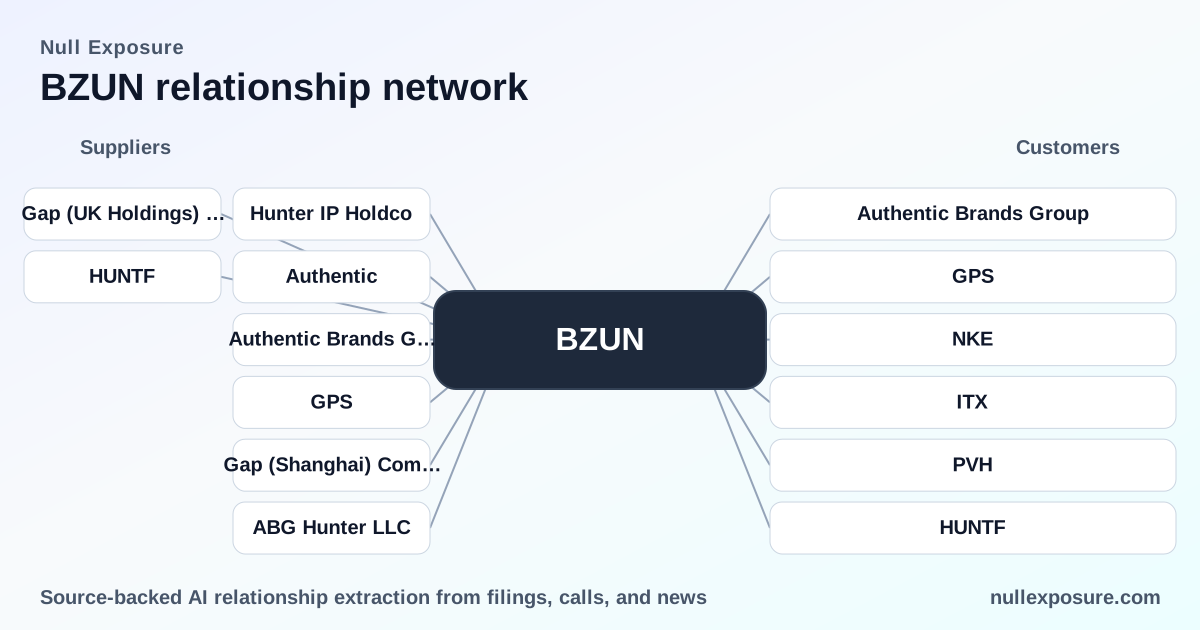
Baozun’s customer map: which brand partnerships drive operations and why investors should care
Baozun (BZUN) operates as a full‑service e‑commerce operator for global brands in Greater China, monetizing through integrated digital storefront management, logistics and fulfillment, marketing and retail operations including offline expansion. Revenue derives from long‑term commercial contracts, licensing and service fees tied to partner sales volume and brand expansion, and Baozun supplements margin with proprietary retail and fulfillment capabilities that scale across clients.
For an investor or operator evaluating Baozun’s customer exposure, the following review parses every public relationship captured in recent media and earnings coverage and explains how each partnership feeds Baozun’s operating model. For a concise dossier and ongoing monitoring, visit https://nullexposure.com/.
Why the customer roster matters: concentration, criticality and contract posture
Baozun’s business is structured around a small number of large, strategic brand relationships rather than a broad retail marketplace model. That structure creates three investment‑relevant characteristics:
- Concentration: Several headline clients (apparel and footwear brands) generate outsized operational scale; this amplifies revenue sensitivity to individual account performance.
- Criticality: For partners that outsource China operations entirely—Gap is the clearest example—Baozun functions as the local operator, making its services mission‑critical to partner market success.
- Contracting posture and maturity: Public disclosures and press releases show a mix of long‑term exclusive license deals, service agreements and even M&A-style consolidation (an outright purchase of Greater China retail assets), indicating Baozun pursues durable commercial commitments and occasional structural integration of partner assets.
No discrete customer‑level constraints were reported in the source set; as a company‑level signal, that absence supports the view that contracts are negotiated privately and executed as operating partnerships rather than public constraint filings. This implies revenue visibility depends on contractual renewal cycles and the health of the apparel/footwear sector in China.
Counterparty-by-counterparty: what the record shows
Gap / Gap Inc. (GPS / GAP)
Baozun operates Gap’s Greater China business and has taken an active role in store expansion and omnichannel execution; media reports note Baozun acquired Gap’s Greater China business and has driven a sharp rollout of physical stores and digital momentum. According to WWD’s 2022 coverage, Baozun had operated Gap’s e‑commerce in China for many years and completed a transaction for the business, and more recent reporting (FY2026) documents store expansion into the 160+ store range as Baozun executes Gap’s China strategy (see WWD and China Daily reporting from 2022–2026: https://wwd.com/business-news/retail/gap-sells-greater-china-business-baozun-50-million-1235412590/, https://www.chinadaily.com.cn/a/202603/27/WS69c63060a310d6866eb40427.html).
Authentic Brands Group
Baozun has a long‑term, exclusive licensing agreement to design, manufacture, market and distribute Hunter brand products in Greater China, reflecting Baozun’s role beyond pure platform services into licensed product management and retail rollout. This arrangement was announced in a corporate press release in 2023 (see Authentic Brands Group release, FY2023: https://corporate.authentic.com/press-releases/authentic-brands-group-partnership-baozun).
Hunter (HUNTF)
Baozun is the commercial operator for Hunter in Greater China, supporting both online and offline expansion—Baozun has documented store openings and an expanded physical footprint in FY2025–FY2026 as part of that brand relationship. Earnings call transcripts and company commentary detail new store launches across Tier‑2 cities during 2025–2026 (see Baozun earnings excerpts, FY2025–FY2026: https://www.insidermonkey.com/blog/baozun-inc-nasdaqbzun-q3-2025-earnings-call-transcript-1651191/, https://www.insidermonkey.com/blog/baozun-inc-nasdaqbzun-q4-2025-earnings-call-transcript-1725340/).
Nike (NKE)
Public reporting lists Nike among the brands for which Baozun operates online businesses in China, positioning Baozun as a third‑party operator for major athletic brands’ digital channels. WWD’s market coverage from FY2022 includes Nike in the roster of managed online operations (see WWD, FY2022: https://wwd.com/business-news/retail/gap-sells-greater-china-business-baozun-50-million-1235412590/).
Calvin Klein (PVH)
Calvin Klein is cited in public coverage as another international apparel brand whose China online operations have been run by Baozun, reinforcing Baozun’s focus on premium and mass apparel licensing and platform services. The mention appears in retail reporting that catalogues Baozun’s client set (see WWD, FY2022: https://wwd.com/business-news/retail/gap-sells-greater-china-business-baozun-50-million-1235412590/).
Zara (Inditex / ITX)
Baozun is listed in media reports alongside other large fashion players as an operator of online businesses for brands such as Zara, indicating exposure to fast‑fashion client workstreams and high‑volume order fulfilment requirements. This client mention appears in the same retail overview reporting from FY2022 (see WWD, FY2022: https://wwd.com/business-news/retail/gap-sells-greater-china-business-baozun-50-million-1235412590/).
Lanvin Group (LANV)
Baozun has taken minority shareholder positions in strategic partnerships tied to Lanvin Group brand representation, becoming a preferred partner for brands within the group; this reflects Baozun’s strategy to cement preferential operating rights alongside equity exposure. Coverage of Lanvin Group investment and partner roles cites Baozun’s minority stake and partner status (see WWD coverage, FY2021: https://wwd.com/fashion-news/designer-luxury/lanvin-group-fosun-new-investors-itochu-1234969539/).
What these relationships imply for revenue and risk
- Revenue drivers: Baozun’s top‑line scales with partner store openings, seasonal product cycles and growth of digital sales for marquee brands—Gap’s China expansion is a direct volume lever; Hunter and licensed brands add higher‑margin licensing and offline retail services.
- Operational leverage: The combination of logistics, marketing and retail operations creates fixed‑cost leverage; successful onboarding of multiple large brands amplifies gross profit but also concentrates execution risk.
- Renewal and concentration risk: A small set of large partners creates revenue concentration; contract renewals, brand strategy shifts or a single large partner’s underperformance will materially affect the P&L.
- Strategic posture: Baozun leverages selective equity partnerships and exclusive licensing (for example with Hunter) and has completed business acquisitions, signaling a proactive approach to capture more of partner economics beyond pure services.
Investment takeaways
- Positive operational characteristic: Baozun’s role as an exclusive operator or acquirer of local retail assets for major Western brands (notably Gap) creates durable revenue streams tied to partner expansion plans.
- Key risk: concentration of revenue among large apparel partners and the need to execute at scale across logistics and retail channels.
- Monitoring checklist: track renewal notices and renewal economics with Gap and other headline clients, watch store opening cadence reported by partners, and follow licensing/press releases for new exclusive agreements.
For a focused investor briefing or continuous monitoring of Baozun’s customer relationships, view our coverage hub at https://nullexposure.com/.