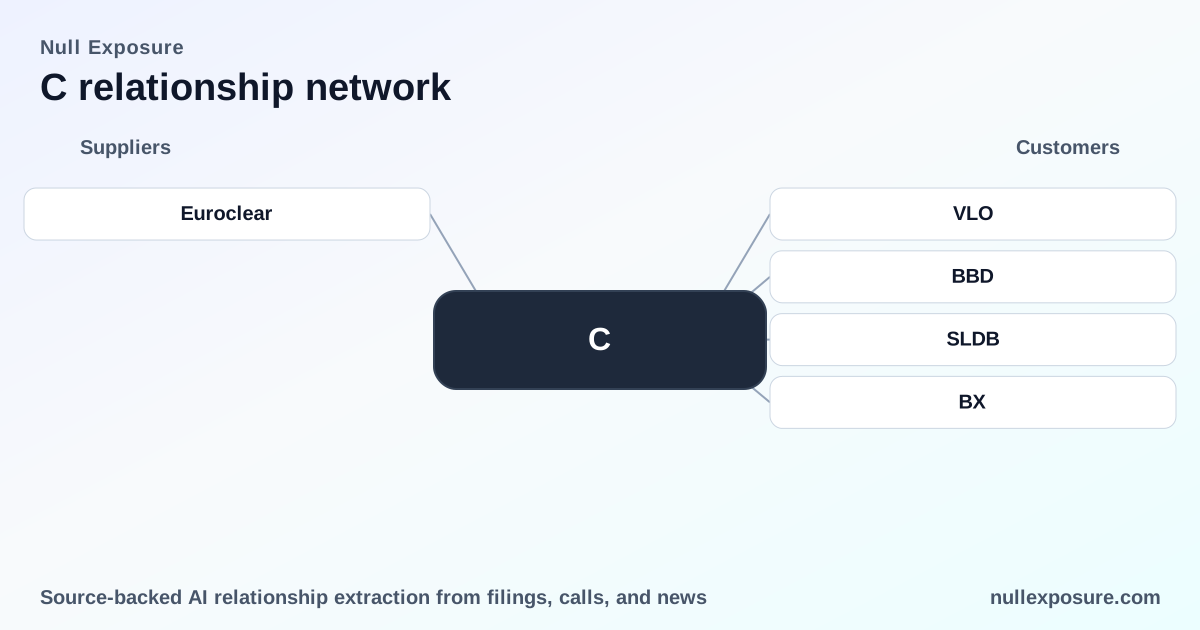
Citigroup (C) as a Customer Counterparty: Where the Fees, Loans and Advisory Flow
Citigroup operates as a global diversified financial services platform that monetizes through four durable channels: net interest income from lending and deposits, fee and commission income from Treasury & Trade Solutions and Securities Services, capital markets and underwriting fees, and advisory/transaction fees from M&A and financing mandates. For investors, Citigroup’s customer footprint is a direct signal of recurring fee streams (TTS, deposit servicing), episodic high‑margin transactions (underwriting, ASRs, M&A advisory) and balance‑sheet deployment (loan facilities, warehouse financing). Explore Citi’s client map to understand how its relationships translate to fee diversification, regional exposure, and contingent liabilities. For a concise enterprise view, visit https://nullexposure.com/.
What the recent relationship feed shows at a glance
Citigroup’s client activity in filings and press over the last 18 months demonstrates the bank operating in four consistent roles: underwriter/book‑runner, depositary/depositary bank for ADS programs, credit/agent lender, and financial/advisory lead. These activities span geographies (global footprint), industry sectors (energy, healthcare, industrials, airlines) and transaction types (ASRs, IPOs, debt offerings, credit agreements). Below is a compact, source‑tagged record of the relationships cited in the dataset.
Detailed relationship log (concise summaries, source noted)
- AGRO — Citigroup acted as a joint book‑running manager on Adecoagro’s common offering (FY2025). Source: StockTitan news (Mar 9, 2026).
- BDX (Becton Dickinson) — Citigroup Global Markets Inc. served as a lead dealer manager on the company’s tender offers (FY2026). Source: Becton Dickinson press release (Mar 2026).
- ANSC — Citigroup Global Markets served as capital markets advisor to Agriculture & Natural Solutions Acquisition Corp. (FY2024). Source: PR Newswire (2026).
- STT-P-G (State Street) — Citigroup Global Markets Inc. was a representative of the underwriters on a public notes offering (FY2023). Source: WilmerHale recap (Nov 2023).
- AXS (Axis Capital) — Citi amended and provided secured letters of credit through Citibank Europe on an ongoing $300m facility (FY2026). Source: InsiderMonkey / press coverage (Mar 2026).
- JRVR (James River) — Citi acted as financial advisor on the sale of James River’s reinsurance business (FY2023). Source: ReinsuranceNews (Mar 2026).
- BNR (Burning Rock) — Citibank, N.A. served as depositary of ADSs and handled voting instructions for the AGM (FY2025). Source: GlobeNewswire / ManilaTimes (Dec 2025).
- AAL (American Airlines) — Citi is the exclusive issuer for the U.S. AAdvantage co‑branded card portfolio and expanded partnership into Admirals Club (FY2026). Source: American Airlines press release (May 2026).
- SNY (Sanofi / SNY transaction) — Citigroup led as global coordinator on a syndicated transaction alongside other global banks (FY2026). Source: WebWire press (May 2026).
- BRBI — Citibank served as depositary for an ADR program tied to BR Partners units (FY2025). Source: Brazilian ADVFN coverage (2025).
- SLDB (Solid Biosciences) — Leerink and Citigroup acted as joint lead placement agents for a private placement (FY2026). Source: GlobeNewswire (Mar 2026).
- BTGO (BitGo Holdings) — Citigroup acted as book‑running manager on the IPO filing (FY2025). Source: 01Net / Ad‑hoc news (May 2026).
- WTTR (Select Water Solutions) — Citigroup Global Markets Inc. is listed in the prospectus supplement for a securities registration (FY2026). Source: SEC filing posted on StreetInsider (May 2026).
- BMA (Banco Macro) — Citigroup Global Markets retained as dealer manager on a cash tender offer (FY2026). Source: Yahoo Finance / investor release (Mar 2026).
- PCLA (Picocela) — Citibank, N.A. acted as depositary bank handling a 1‑for‑30 ADS reverse split (FY2026). Source: Investing.com (2026).
- KBON / KBONW (Karbon Capital Partners) — Citigroup served as sole book‑running manager for the SPAC IPO and warrants (FY2025). Source: RenaissanceCapital / Yahoo (2026).
- PSO (Pearson) — Citigroup Global Markets Limited executed share purchases on the LSE as part of a buyback (FY2026). Source: Stockopedia / Reuters (Feb 2026).
- LPG (Dorian LPG) — Citibank provided loan financing to fund vessel delivery (~$62.9m). Source: RigZone and Offshore‑Energy reports (Mar 2026).
- ORC (Orchid Island Capital) — Repo borrowings show Citigroup Global Markets as a counterparty with sizable balances (FY2025/26). Source: Company investor release / Globe and Mail (Nov 2025–Mar 2026).
- EQIX (Equinix) — Citi acted as an underwriter/joint lead manager on senior notes offerings (FY2026). Source: NationalToday / PR Newswire (Mar 2026).
- HT‑P‑C (Hersha Hospitality) — Citibank provided property refinancing (e.g., Cadillac Hotel) with a $232m facility on record (FY2022). Source: CommercialObserver (2022).
- LHC (Leo Holdings / Digital Media Solutions) — Citigroup Global Markets acted as financial advisor and private placement agent in the SPAC business combination (FY2020). Source: SPACInsider / DigitalMediaSolutions release (2020–2026 recap).
- QFIN (Qudian / 360 DigiTech listing) — Citi participated across Hong Kong and international bookrunning and sponsorship roles on global offerings (FY2019–2022). Source: FinancialContent / market materials.
- DBTX (Decibel Therapeutics) — Citigroup was joint book‑runner on an IPO (FY2021). Source: GlobeNewswire prospectus (2021).
- MTAL (Metals / CSA acquisition) — Citi engaged as placement agent and financial advisor on equity raises and acquisition advisory (FY2023). Source: SPACInsider (2026 recap).
- VRE (Veris Residential) — Citigroup provided financing support as part of a commercial real‑estate sale financing syndicate (FY2023). Source: RE‑NJ (2026 recap).
- SOFI (SoFi) — Citigroup added as co‑lead underwriter on a $1.5bn follow‑on equity offering (FY2026). Source: SimplyWall.St (May 2026).
- BKV (BKV Corporation) — Citigroup named joint book‑runner on a public offering (FY2025). Source: StockTitan (Mar 2026).
- ASIC (Ategrity Specialty Insurance) — Citigroup, TD Securities and Wells Fargo served as joint book‑running managers on the IPO (FY2025). Source: ReinsuranceNews / PR channels (Jun 2025–Mar 2026).
- PED / PEDEVCO — PEDEVCO expanded and drew on a Citibank‑led reserve‑based lending facility (facility draws and borrowing base adjustments reported FY2025–26). Source: Company press releases and SACM coverage (2025–Mar 2026).
- NVGS (Navigator Holdings) — Citigroup acted as joint book‑runner on a secondary offering tied to a selling shareholder and repurchase plan (FY2026). Source: QuiverQuant / Globe and Mail (May 2026).
- AIXI / XIAOI — Citibank served as depositary bank implementing ADS ratio changes and cancellations (FY2026). Source: Investing.com / TipRanks (May 2026).
- ACVA / ACV Auctions — A revolving warehouse facility and warehouse financing established with Citibank as lender (FY2025). Source: Sec filings and TradingView (2025).
- PLNT (Planet Fitness) — Entered accelerated share repurchase agreements with Citibank (ASR activity and securitization work) including a $350m ASR (FY2025). Source: Ropes & Gray / company releases (Dec 2025–Mar 2026).
- UTHR (United Therapeutics) — Multiple accelerated share repurchase agreements with Citibank totaling $1.5bn initial (part of $2.0bn program) (FY2025–26). Source: Company filings and media (Mar 2026).
- MSGM (Motorsport Games / MSGM) — Secured a $3m revolving line of credit from Citibank N.A. (FY2026). Source: GlobeNewswire / TaiwanNews (Mar 2026).
- DIS (Walt Disney Company) — Citibank served as designated agent in a 364‑day credit agreement providing up to $5.25bn (FY2026). Source: Marketscreener / SEC filing summaries (Feb 2026).
- MPLX, BKR, CNH, ARE, COR, TEL, etc. — Across energy, industrial and REIT issuers, Citigroup consistently appears as joint book‑runner or lead manager on large debt and equity offerings (FY2025–26). Source: respective press releases and marketwire notices (2025–2026).
- Numerous depositary roles — Citibank, N.A. frequently serves as depositary for ADS programs (e.g., DDI, VSA, YOUL and many foreign issuers). Source: Globe and Mail / company announcements (2025–2026).
- Syndicated lending and letter of credit facilities — Citibank acts repeatedly as administrative agent or lead bank on amended credit agreements and LOC facilities (examples: ALHC, PNRG, NBR, KRMN). Source: Latham, company press releases and TradingView (2026).
(Entries above are drawn from the recent press and filings compiled March–May 2026; specific items and dates referenced in each line above.)
For a full systematized index and original source links for each item, visit the Citigroup customer relationships hub at https://nullexposure.com/.
What these relationships reveal about Citi’s operating model
- Contracting posture: The feed shows a mix of short‑term episodic mandates (underwriting, placement, ASRs) and multi‑year service relationships (TTS, depositary services, syndicated loan agency) — consistent with a hybrid business model that converts episodic advisory wins into longer deposit and servicing flows.
- Concentration & criticality: Citi’s attachment to large cross‑border transactions (e.g., Equinix debt, McCormick bridge financing, Disney credit facility) signals high criticality for corporate clients executing global financings; loss of such mandates would impact fee run‑rate materially.
- Maturity: Several relationships are mature and ongoing (TTS deposits, long‑running depositary mandates), while others are transactional and one‑off. Citi’s Services segment generates recurring operational fees that smooth cyclicality from Markets and IB fees.
- Geography: Activity is clearly global—North America, LATAM, EMEA and APAC roles appear across the log—supporting Citigroup’s stated footprint and regional segmentation.
- Spend band signal: Presence on large debt and lending facilities and participation in high‑value ASRs and bridge financings implies counterparty spend and exposure often in the $100m+ band, supporting material NII and fee generation.
Investment implications and risk checklist
- Revenue diversity: Citi’s mix of transactional high‑margin underwriting and recurring servicing reduces dependence on any single revenue source; this is a core strength for valuations.
- Balance‑sheet dependency: Lending and warehouse facilities create on‑balance exposures that increase capital intensity; monitor provisioning and RWA trends tied to these client relationships.
- Reputational and operational risk: Deposit‑servicing and depositary roles create operational dependence; any custody/depositary failure would have outsized reputational and regulatory impacts.
- Pipeline sensitivity: Market‑sensitive underwriting fees (IPO windows, high‑yield issuance) can be volatile; Citi’s fee income will track capital markets cycles closely.
Bottom line
Citigroup converts a high volume of transactional capital markets work into long‑term servicing and deposit flows. The dataset shows Citi executing across the full client lifecycle—advisory, underwriting, depositary, lending—across global sectors—supporting both recurring Services revenue and episodic fee spikes. For a structured, source‑linked dossier of these relationships and to track updates to Citi’s client map, see https://nullexposure.com/.