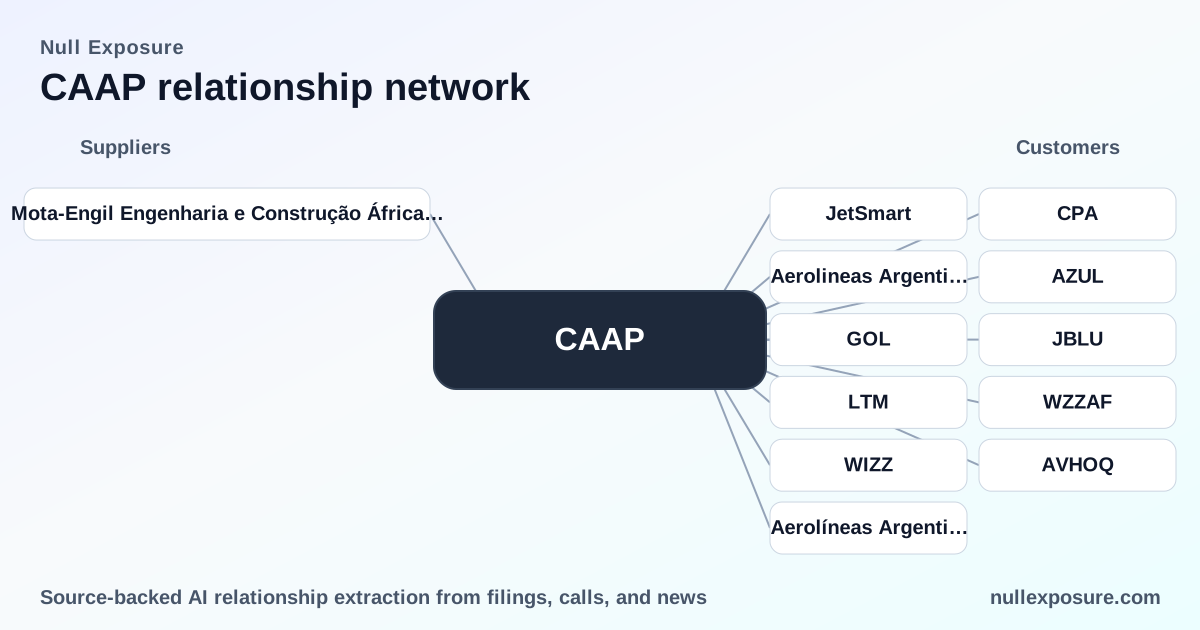
Corporación América Airports (CAAP): the airline relationships that drive passenger flows and cash
Corporación América Airports acquires, develops and operates airport concessions across multiple Latin American and Eurasian markets, monetizing through long-term concession economics—a mix of aeronautical tariffs, concession fees and growing non-aeronautical retail and parking revenue. CAAP’s operating model converts airline schedule and network decisions directly into footfall and commercial revenue, so airline customers are the primary demand engine for both volume and yield. Read the company overview and source work at https://nullexposure.com/.
Why airline relationships matter to valuation
CAAP functions as an essential infrastructure landlord with long-duration concession contracts and geographically diversified airports. That posture creates predictable, asset-backed cash flows but leaves revenue exposed to airline route planning, seasonal schedule changes and regional connectivity trends. The customer base is broad across legacy carriers and low-cost operators, which limits single-counterparty concentration risk, while the dependence on passenger volumes keeps earnings cyclically sensitive.
- Contracting posture: CAAP operates under concession agreements and acts as a service provider/landlord to airlines rather than as a pure operator contracting for passenger sales.
- Concentration: Customer mix includes major regional incumbents and fast-growing low-cost carriers, supporting diversified route risk but with meaningful exposure where legacy carriers dominate large hubs.
- Criticality: Airlines are critical demand drivers—their frequency and route decisions translate directly into airport revenue and commercial spend.
- Maturity: The concession model is mature and capital-intensive, generating recurring, asset-backed cash flow over long horizons.
Explore deeper company signals and relationship detail at https://nullexposure.com/.
Relationship roll call: who CAAP serves (what the filings and calls say)
Aerolíneas Argentinas
Aerolíneas Argentinas expanded seasonal routes and contributed to domestic traffic growth that CAAP highlighted in its commentary on passenger flows. This relationship is cited in CAAP materials and market write-ups referencing FY2026 passenger metrics (Finviz and StockTitan, March 2026).
JetSmart / JetSMART
JetSmart’s incremental capacity was called out as a meaningful contributor to nearly 11% domestic traffic growth in CAAP’s 2025 Q3 earnings discussion, signaling stronger low-cost carrier penetration on CAAP-managed networks (CAAP 2025 Q3 earnings call, discussed March 2026).
GOL
GOL supported international connections through seasonal routes—specifically Mendoza–Rio de Janeiro—and was referenced in CAAP passenger commentary as part of international traffic gains (StockTitan passenger report, January 2026; published March 9, 2026).
LATAM (LTM)
LATAM was repeatedly identified as a primary legacy carrier driving both domestic and international connectivity gains and was credited with new and resumed routes that lifted international traffic 16% in CAAP commentary (CAAP 2025 Q3 earnings call and StockTitan/Finviz coverage, March 2026).
Wizz Air (WIZZ / WZZAF)
Wizz Air established a new base at Yerevan’s Zvartnots Airport, deploying aircraft and adding multiple European routes—an explicit example of traffic growth off CAAP-managed infrastructure in Armenia (StockTitan filing and CAAP 2025 Q3 call references, March 2026).
Azul (AZUL)
Azul launched a new route between Montevideo and Campinas during the quarter, presented by CAAP as a supply-side improvement that should support future traffic—an example of regional carrier route expansion feeding CAAP volumes (CAAP 2025 Q3 earnings call, March 2026).
Copa (CPA)
Copa increased frequencies on Córdoba–Panama and other regional routes; CAAP referenced Copa among carriers that strengthened connectivity and supported both domestic and international traffic lifts (StockTitan and CAAP 2025 Q3 commentary, March 2026).
JetBlue (JBLU)
JetBlue increased frequencies on international routes alongside Avianca, noted by CAAP as a contributor to stable domestic traffic and higher international connectivity in the quarter (CAAP 2025 Q3 earnings call transcript, March 2026).
Air Canada
Air Canada was named among international carriers contributing to quarter-over-quarter connectivity gains and positive passenger trends across CAAP airports (InsiderMonkey transcript of CAAP Q4 2025 earnings commentary, May 2026).
Delta (DAL)
Delta’s route reactivations were listed by CAAP as part of a set of international carriers that supported a ~15% uplift in Argentina’s international traffic during the period (AlphaStreet earnings flash summarizing CAAP Q4 2025, May 2026).
Emirates
Emirates was cited as a route reactivation that materially aided international traffic recovery in Argentina, reinforcing the importance of flag and long-haul carriers to CAAP’s international passenger mix (AlphaStreet and InsiderMonkey coverage of CAAP Q4 2025, May 2026).
China Eastern
China Eastern was included among carriers whose route reactivations supported international traffic growth—an indication of broader intercontinental demand recovery that benefits CAAP airports with international services (AlphaStreet and InsiderMonkey, May 2026).
ITA Airways
ITA Airways’ route activity was also listed as a positive contributor to international passenger recovery, cited in CAAP quarterly summaries of airline partners supporting connectivity (AlphaStreet and InsiderMonkey, May 2026).
Avianca (AVHOQ)
Avianca increased international frequencies alongside JetBlue, and CAAP highlighted those frequency changes as part of the quarter’s stable domestic and growing international throughput (CAAP 2025 Q3 earnings call, March 2026).
What this relationship map implies for investors
- Revenue sensitivity to airline scheduling is high. CAAP’s topline swings with frequency and route decisions from an extensive but not unlimited set of carriers. CAAP’s public commentary shows a clear linkage between airline route reactivations and measurable traffic gains (CAAP 2025 Q3 and Q4 commentary, March–May 2026).
- Customer mix reduces single-counterparty risk. The presence of both legacy carriers (LATAM, Aerolíneas Argentinas, Copa) and low-cost players (JetSmart, GOL, Wizz Air) creates a diversified demand base that limits catastrophic concentration while keeping seasonal and tactical risk.
- Connectivity improvements are tangible growth levers. CAAP’s disclosures repeatedly credit route launches and frequency increases—across both regional and intercontinental carriers—with driving measurable international and domestic traffic lifts (StockTitan, Finviz, AlphaStreet, May 2026).
- No explicit contractual constraints surfaced in the relationship review. The relationship dataset returned no flagged contractual constraints, which is a company-level signal indicating no identified counterparty red flags in the sources surveyed.
Bottom line: runway and risk
CAAP’s cash flows are tied to airline network economics: improved international connectivity and low-cost carrier expansion lift passenger volumes and retail spend; conversely, any network retrenchment compresses near-term revenue. For investors evaluating CAAP, the airline relationship set is broad and strategically balanced—enough to dilute single-airline exposure while keeping CAAP vulnerable to macro or industrywide traffic shocks. For ongoing tracking of route-level developments and filings, visit Null Exposure for structured coverage: https://nullexposure.com/.