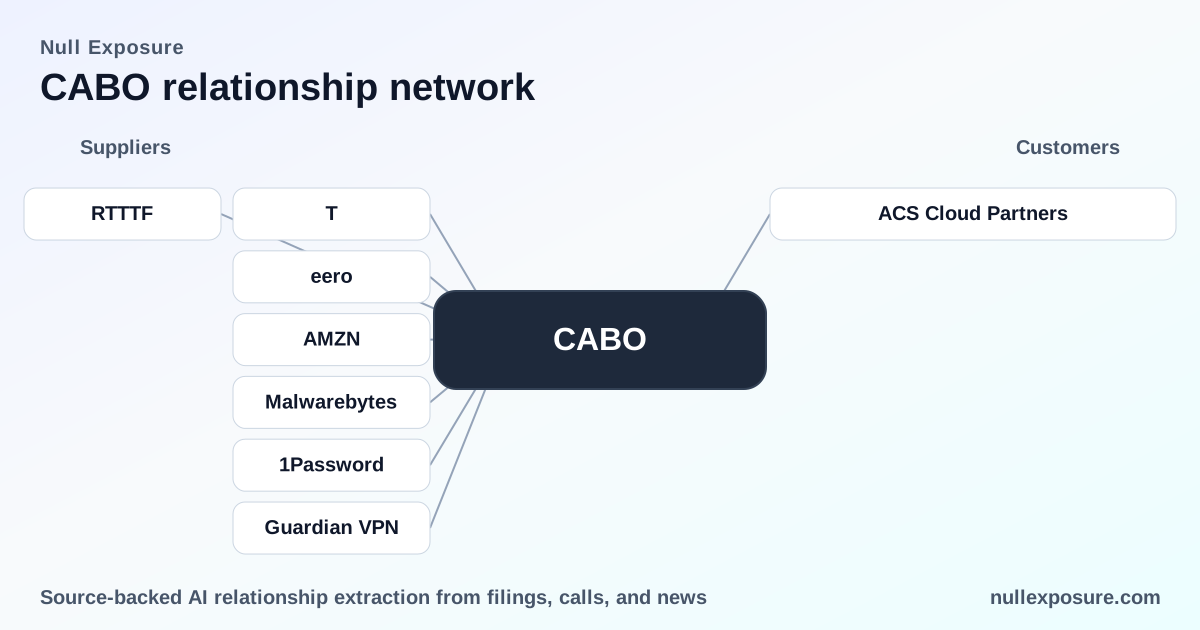
CABO Customer Map: How Cable One Monetizes Local Broadband and Where ACS Cloud Partners Fits In
Cable One (CABO) is a regional broadband operator that monetizes primarily through recurring subscriptions to residential and business data, video and voice services, supplemented by wholesale and enterprise contracts. The company sells month-to-month consumer packages and longer-term business agreements, collects fees on a gross basis for certain pass-through items, and is executing distribution expansion initiatives (including channel partnerships) to accelerate business services growth. For investors, the case is straightforward: stable, subscription-driven cash flows tempered by geographic concentration and a mix of short-term consumer churn risk and higher-value business contracts. Learn more at https://nullexposure.com/.
How Cable One actually operates and what that implies for customer risk
Cable One’s operating model is dominated by subscription economics and a split customer base that creates predictable revenue layers but also sensitivity to churn and concentration.
- Subscription-first revenue model. The company reports the bulk of revenues from subscription fees across residential data, video and voice lines; most consumer subscriptions are month-to-month without cancellation penalties, while revenues tied to explicit contract terms are recognized over one- to five-year periods. This implies steady recurring revenue but higher volatility if promotional pressure or local competition intensifies.
- Large base of individual customers with an enterprise tilt. CABO serves roughly 1.1 million residential and business customers as of December 31, 2024, with the bulk of the base made up of individual residential subscribers and a growing mix of small, mid-market and enterprise business customers that carry higher average revenue per user.
- Geographic concentration matters. Approximately 74% of customers are located in seven states (Arizona, Idaho, Mississippi, Missouri, Oklahoma, South Carolina and Texas), making local economic cycles and state-level regulation material to revenue stability.
- Revenue mix and commercial maturity. The company generates the majority of revenue from services: residential data ~58.6%, business data ~14.4%, residential video ~14.1% (2024 reported mix). This underscores a transition toward data-centric monetization where business services incrementally raise contract lengths and ARPU.
- Roles and cashflow framing. Cable One functions principally as a service provider and seller to end-customers, and as a principal in pass-through billing for certain taxes and franchise fees—reported on a gross basis—so headline revenue includes items remitted to authorities.
- Operational state. The customer relationships are active and continue to form the operating backbone of Cable One’s results.
Collectively, these signals indicate a mature regional broadband operator with subscription durability but with concentration and churn risks that are mitigated by deliberate growth in business and wholesale sales.
Documented customer relationships and immediate relevance
ACS Cloud Partners — press syndication via Sahm Capital (Dec 8, 2025)
Sparklight Business (Cable One’s business brand) launched a Partner Solutions Program and onboarded ACS Cloud Partners as the program’s first nationwide agency partner, signaling an explicit push into channel-led business sales that should accelerate enterprise and broker-driven bookings. According to a press release syndicated by Sahm Capital on December 8, 2025, the onboarding is the opening phase of a multi-stage channel expansion effort.
ACS Cloud Partners — StockTitan news repost (Dec 8, 2025)
A StockTitan news post the same day reiterated that ACS Cloud Partners is the inaugural agency partner in the new Sparklight Business Partner Solutions Program, reinforcing that CABO is actively building channel partnerships to extend distribution of its business services. The StockTitan item (Dec 8, 2025) replicates the public launch narrative and underscores management’s channel strategy.
Both items reflect the same commercial relationship and corroborate that CABO is executing a channel play to push business services through third-party broker/agency partners rather than relying solely on direct sales.
What the ACS Cloud Partners linkage means tactically and financially
- Distribution leverage. Bringing ACS Cloud Partners into a formal Partner Solutions Program converts direct-sales capacity into an expandable channel model, which should lower marginal customer acquisition costs for business customers and speed geographic penetration within existing passings.
- Mix shift potential. If channel adoption scales, expect a higher share of business data revenues (currently ~14.4% of total revenue) and a modest increase in contracted, multi-year business arrangements, which improves revenue visibility versus month-to-month residential subscriptions.
- Limited single-partner concentration. The filings and press clippings do not indicate material contractual exclusivity or financial dependence on ACS Cloud Partners; this is a distribution relationship rather than a revenue concentration risk at the vendor level.
Financial context that shapes customer-read risk
Cable One reports an operating margin of 25.3% (TTM) alongside a negative net profit margin of -21.9% and diluted EPS of -49.71, reflecting timing, non-operating items or one-off charges in the accounting period that investors must reconcile with operational strength. Total revenue TTM is approximately $1.4738 billion, with gross profit of $1.0876 billion, confirming healthy top-line scale behind the subscription base. These figures, combined with the subscription posture, mean that operational cash generation is durable but headline profitability can swing on non-operating items and corporate actions.
Investment implications and key risks
- Key upside: Channel expansion (ACS Cloud Partners and similar partners) can accelerate higher-margin business services growth, stabilize ARPU, and lengthen contract tenor—improving cash flow predictability.
- Key downside: Heavy geographic concentration (74% in seven states) plus a large portion of month-to-month residential subscriptions creates exposure to local competition and churn; material fiber or fixed-wireless entrants in core states would pressure growth and retention.
- Balance of roles: Cable One’s role as principal on certain pass-through fees inflates revenue but also shows operational control of billing flows; differentiation should be measured by ARPU trends and business-services contract length changes.
- Catalysts to watch: ramp-up of partner program results (signed customers, ARPU lift from channel deals), sequential business data revenue growth, and management disclosures on churn and contract durations.
Bottom line
Cable One runs a subscription-led broadband business with an active push into channel-driven business sales—exemplified by the onboarding of ACS Cloud Partners to its Partner Solutions Program. For investors, the thesis is steady, recurring cash flow with upside from enterprise monetization and downside from geographic concentration and consumer churn volatility. For a deeper read on how these customer relationships influence CABO’s commercial trajectory, visit https://nullexposure.com/.