Caring Brands (CABR): Licensing-led cosmetics play with concentrated execution risk
Caring Brands, Inc. operates as a wellness consumer products company that monetizes through product sales and intellectual property licensing in the over-the-counter and cosmetics markets. The company combines direct-to-market consumer SKUs with selective licensing arrangements that extend manufacturing and marketing rights for specific formulations. For investors, the business reads as an experimental consumer healthcare roll-up: modest current revenue, heavy insider ownership, and strategic licenses that could scale revenue if commercial execution follows. For a deeper look at relationship-level signals, visit https://nullexposure.com/.
The headline relationship every investor needs to track
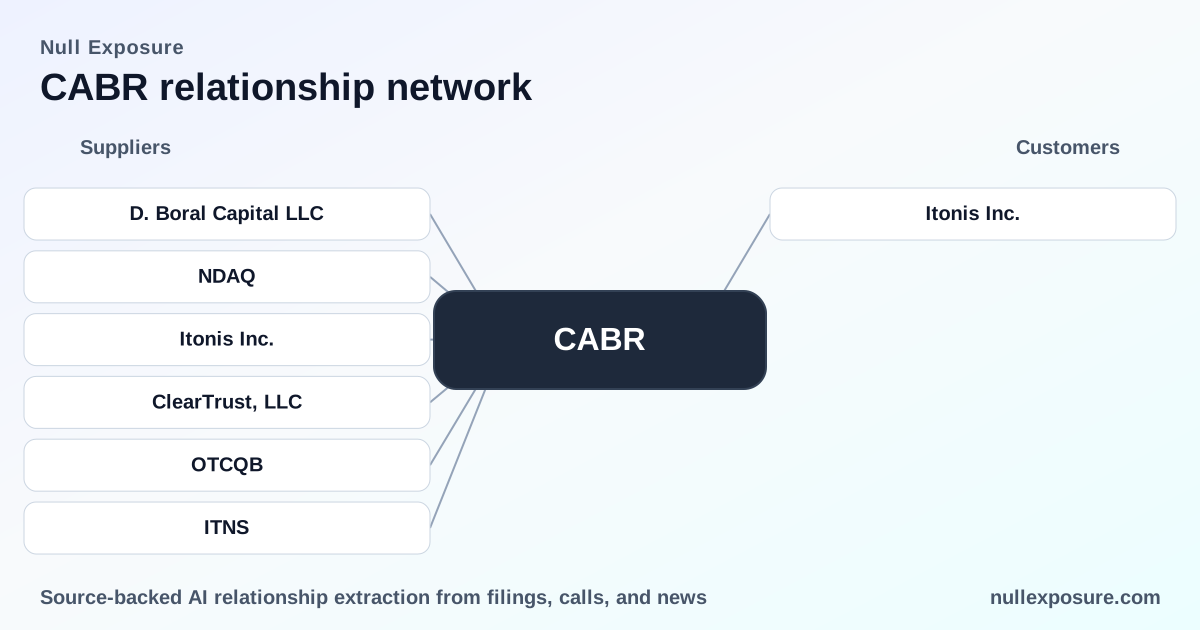
Caring Brands disclosed an exclusive worldwide license agreement with Itonis Inc. for Emesyl, a hair enzyme booster technology. According to a GlobeNewswire release dated January 5, 2026, the company announced the deal as an exclusive global license to manufacture and market Emesyl, effective in FY2026. This is a strategic rights transfer intended to expand Caring Brands’ product portfolio and to push a science-driven cosmetic into broader commercialization channels. Source: GlobeNewswire (Jan 5, 2026) — https://www.globenewswire.com/news-release/2026/02/03/3231066/0/en/Caring-Brands-Secures-Two-New-U-S-Patents-Strengthening-Hair-Enzyme-Booster-Technology.html
Relationship-by-relationship briefing
Itonis Inc. — Caring Brands secured an exclusive worldwide license to manufacture and market Emesyl, positioning the company to commercialize a hair enzyme booster technology under its brand umbrella. This agreement is reported in Caring Brands’ public release in early FY2026 and represents a non-dilutive route to expand product offerings via licensed proprietary technology. (GlobeNewswire, Jan 5, 2026) — https://www.globenewswire.com/news-release/2026/02/03/3231066/0/en/Caring-Brands-Secures-Two-New-U-S-Patents-Strengthening-Hair-Enzyme-Booster-Technology.html
How these relationships shape the operating model
The Itonis license is representative of Caring Brands’ contracting posture: the company pursues exclusive IP and licensing arrangements that give it rights to manufacture and market specific formulations. This posture signals a preference for capturing product-level economics without necessarily owning upstream R&D or manufacturing assets outright.
- Concentration: Revenue and capability concentration is high. Caring Brands reports negligible trailing revenue (reported TTM revenue: $4,215) and relies on a small number of commercialized items and licensing events to drive growth.
- Criticality: Licensed assets are strategically critical. Agreements like the Itonis license are material to product pipeline expansion; failure to commercialize licensed technologies would materially constrain growth.
- Maturity: Early-stage commercial profile. Negative EBITDA (-$3,085,025) and sharply negative operating margins reflect pre-scale operations and heavy reliance on transactional licensing and small-volume product sales.
- Contracting posture: Exclusive, product-centric agreements dominate. The company structures exclusivity into licenses to obtain market differentiation, but exclusive deals also increase execution risk if Caring Brands cannot scale distribution.
These operating characteristics create a classic small-cap consumer-health risk/reward profile: asymmetric upside if commercialization executes, asymmetric downside if distribution or manufacturing lags.
Financial health and governance signals investors should weigh
Caring Brands’ public financial signals are stark and actionable:
- Market capitalization: $14.6 million.
- Trailing revenue: $4,215 (TTM).
- EBITDA: -$3.09 million; operating margin: deeply negative.
- Ownership: insiders control ~61.6% of shares; institutional ownership is under 1%.
High insider ownership aligns management and shareholders but concentrates control and reduces free-float liquidity. The company’s current scale — very low revenue, negative profitability, and limited institutional participation — positions it as a high-beta micro-cap investment where partnership outcomes determine the valuation trajectory.
What the Itonis license practically implies for roll-out and revenue
An exclusive license for Emesyl gives Caring Brands the legal and commercial levers to develop, manufacture, and market a hair enzyme booster product. Practically:
- The deal accelerates product pipeline breadth without immediate capital outlay for R&D, but it transfers execution risk entirely to Caring Brands’ commercialization capability.
- Revenue realization depends on successful formulation, regulatory compliance for OTC/cosmetic claims, manufacturing scale-up, and distribution placement—each step is a binary inflection for investor returns.
Investors should treat licensed assets as conditional value drivers: they are valuable on paper only if product launches meet retail and consumer demand hurdles.
Risk profile and near-term catalysts
Key risks and catalysts for CABR investors:
- Catalysts: successful product launch timelines for Emesyl, meaningful retail listings, and evidence of repeatable sales growth would re-rate the stock from speculative to growth-stage.
- Risks: failure to commercialize licensed products, manufacturing or supply disruptions, and continued negative cash flows that force dilutive financing.
Given the company’s thin revenue base and negative margins, each announced licensing or patent event creates headline upside but does not substitute for scalable sales.
Practical investor takeaways
- Short-term thesis: CABR is a high-risk micro-cap that monetizes through product sales and selective licensing; the Itonis license is a near-term growth vector but not yet a revenue guarantee.
- Key monitorables: product launch milestones for Emesyl, retail/distribution agreements, manufacturing readiness, and any changes in ownership or fresh institutional interest.
- Valuation framing: with a market cap of roughly $14.6M and minimal revenue, valuation is effectively a bet on future operating leverage from licensed technologies and commercial execution.
For ongoing monitoring of CABR’s partner agreements and other small-cap customer signals, see https://nullexposure.com/.
Final read
Caring Brands is executing a licensing-first playbook in a fragmented consumer-health market. The Itonis agreement is strategically meaningful but operationally conditional — it is an enabler, not a payoff. Investors must trade on execution evidence: tangible retail traction, margin improvement, and clear revenue lift. If those follow, the current market capitalization will reflect realized product economics; until then, CABR is a concentrated, execution-dependent holding.