Credit Acceptance (CACC): Dealer relationships that underwrite growth and risk
Credit Acceptance operates as a captive-like financier to independent and franchised U.S. auto dealers, monetizing by underwriting and servicing retail installment contracts for subprime and non-prime consumers and by selling ancillary products to dealers. The company’s economics derive from interest income and fees on financed receivables, onboarding and servicing relationships with dealers that both generate origination volume and concentrate credit and operational risk in a dealer network. For investors, CACC is a platform play that converts dealer origination pipelines into a recurring finance and servicing margin. Learn more about our coverage at NullExposure. NullExposure
How Credit Acceptance converts dealer sales into durable margins
Credit Acceptance’s business model is straightforward and vertically integrated: dealers originate retail installment contracts; CACC purchases or funds those loans, then administers servicing and collections under dealer servicing agreements. The company captures economics through yield on financed contracts and fees tied to servicing and ancillary products such as vehicle service contracts. That vertical control — from enrollment to collections — is the core driver of profitability and the source of operational leverage.
The model creates a concentrated counterparty map: the company’s revenue is generated exclusively in the United States through a nationwide dealer network, and CACC treats consumers as the funded obligors while dealers function as both originators and resellers of ancillary products. According to company disclosures covering fiscal years through 2024, all revenues were derived from U.S. operations and active dealer counts rose materially to over 15,000 by year-end 2024, demonstrating scale in origination reach.
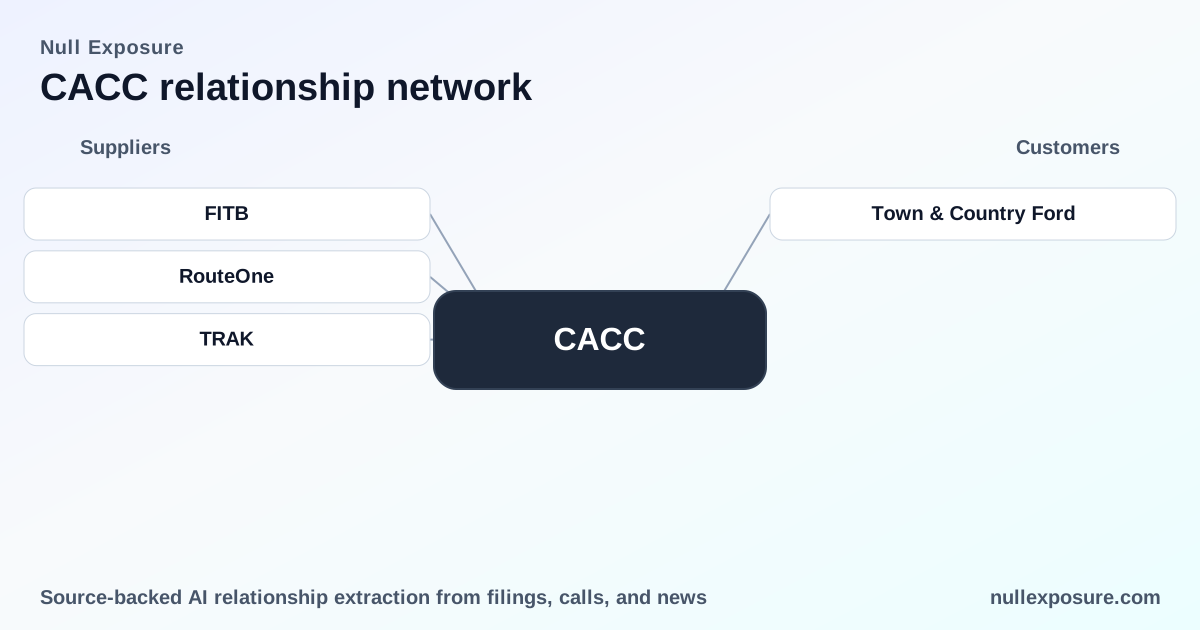
A single customer mention: Town & Country Ford — a dealer-level proof point
Town & Country Ford is cited in investor-facing commentary as an example of a franchised, family-owned dealership that enrolled in Credit Acceptance’s program and experienced improvement in repeat and referral business after enrollment. The reference was made in a Q4 2025 earnings discussion transcribed and published in March 2026. This is a dealer-level marketing and retention vignette that underscores CACC’s value proposition to franchised dealerships. (Source: insider transcript of the Q4 2025 earnings call, published March 9, 2026 via InsiderMonkey.)
Operating constraints that shape investor decisions
Several company-level operational signals emerge from filings and public disclosures. These constraints are not tied to any single dealer partner but collectively define CACC’s contracting posture, concentration, criticality, and maturity.
- Contracting posture — dealer-centric, standardized servicing agreements. Dealers enroll and execute Dealer Servicing Agreements that transfer servicing, administration, and collection responsibilities to Credit Acceptance, creating predictable contractual rights and obligations that support centralized portfolio management. This is a company filing disclosure.
- Counterparty type — consumer obligors are individuals. Public filings and litigation references identify consumer borrowers as the funded obligors; recent legal filings seek remedies on behalf of consumers, signaling litigation exposure tied to consumer-level practices.
- Geography and concentration — 100% U.S.-derived revenue. For the three years ending December 31, 2024, all revenues were generated in the United States, which concentrates macro and regulatory risk in a single national market.
- Relationship roles — multi-role engagement with dealers: reseller, seller, and service provider. CACC enables dealers to sell vehicles (reseller role), markets ancillary vehicle service contracts to dealers (seller role), and assumes servicing and collections responsibilities (service provider role), as described in company filings.
- Materiality and maturity — legacy consumer loans pre-2020 are immaterial. The company states that Consumer Loans assigned prior to January 1, 2020 are no longer material to consolidated financials, indicating a portfolio lifecycle reset and a focus on more recent originations.
- Relationship stage and scale — active and growing dealer network. The company reports dealer enrollments and counts of Active Dealers (those that received funding during a period) increasing to 15,463 by year-end 2024, which signals both market penetration and operational scale.
- Segment clarity — single-reportable segment focused on financing and related services. The business operates as one reportable segment representing its core financing solutions for dealers, concentrating strategic exposure in one operating line.
These constraints collectively portray a company that contracts tightly with originators (dealers), centralizes servicing, and concentrates revenue geographically, while limiting legacy tail risk from older assigned loans.
What the Town & Country Ford mention signals about dealer partnerships
The Town & Country Ford anecdote functions as a marketing proof point: it demonstrates how enrollment with Credit Acceptance can lift dealership retail performance metrics (repeat and referral business) and strengthen local reputation in adverse conditions. This underscores two operational dynamics: first, CACC’s proposition is as much distribution support as capital, and second, dealer goodwill and retention depend on demonstrated sales lift. (Source: Q4 2025 earnings call transcript published March 9, 2026 via InsiderMonkey.)
Risks that investors must weigh
- Regulatory and litigation exposure is visible at the consumer level. Public complaints seeking injunctive relief, restitution, and disgorgement increase legal and compliance risk, given that consumer practices are core to the financed contracts.
- Geographic concentration amplifies domestic policy risk. With all revenues sourced in the U.S., changes in federal or state lending regulations, or concentrated state-level litigation trends, could materially affect earnings.
- Operational concentration on dealers creates counterparty dependency. While the dealer network is large and growing, failures in underwriting discipline or systemic dealer-level conduct could transmit quickly to CACC’s balance sheet given the company’s servicing and credit exposure.
- Product maturity and legacy exposure are limited but not zero. The company identifies pre-2020 assignments as immaterial, which reduces legacy credit tail risk, but investor scrutiny should focus on vintage performance of post-2020 originations.
Implications for investors and operators
For investors assessing CACC, the thesis is binary: you are buying a specialized finance platform with strong dealer distribution, centralized servicing, and meaningful operational leverage — alongside concentrated domestic and legal risks. Monitor dealer enrollment trends, vintage performance, and regulatory developments closely. Operators in the dealer channel should view CACC as both a capital partner and a service provider that can materially influence customer retention and local reputation.
If you are screening counterparties or modeling stress scenarios, prioritize scenario analyses that stress consumer delinquencies, dealer origination volumes, and legal-cost assumptions. For an actionable look across dealer relationships and constraint signals, our research hub provides structured investor briefings and relationship maps. NullExposure
Bottom line
Credit Acceptance’s model converts dealer-originated retail installment contracts into a durable financing margin through centralized servicing and ancillary sales — a high-margin, scale-sensitive financial platform with concentrated domestic and legal risk vectors. Town & Country Ford is one public example of how dealer enrollment translates into local sales impact, but investors should weigh that marketing evidence against the company-level constraints already disclosed in filings and litigation materials.