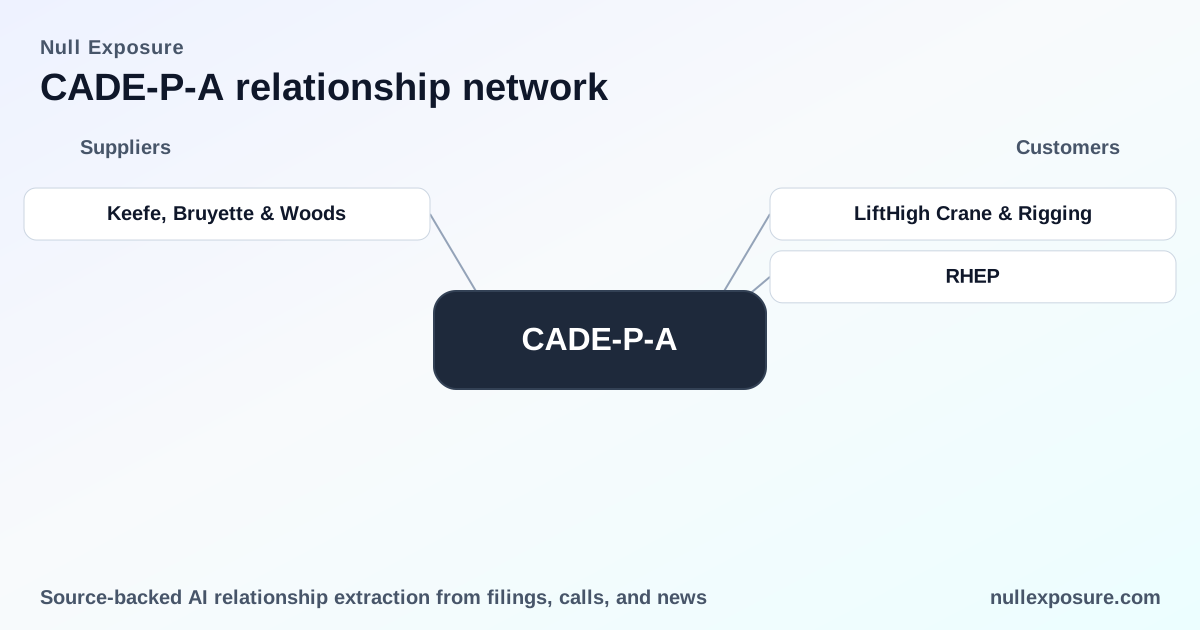
Cadence Bank (CADE-P-A) — Customer Relationships and What They Tell Investors
Cadence Bank monetizes by extending commercial lending, structured credit, and deposit services across regional sectors; its customer footprint in public reporting captures routine lending activity, workout and forbearance management, and participation in merger-driven valuation dynamics. The visible relationships point to a traditional regional bank credit book with active borrower remediation and balance-sheet event risk tied to an announced sale, useful inputs for investors tracking credit quality and transaction timing. For deeper coverage of counterparties and credit signals, visit https://nullexposure.com/.
What the visible customers reveal about Cadence’s business model
The sample of customer relationships here is small but telling. Loans and credit facilities dominate the customer interactions—a revolving credit facility and a pair of government-backed notes under forbearance—indicating that Cadence’s revenue from interest and fee income flows from commercial lending, while loss mitigation and workout activity represent an active operational focus. The presence of a market commentary tied to Cadence’s sale to Huntington Bancshares also underscores transaction execution risk and valuation impact for security holders.
Relationship review — names, plain-English summaries, and sources
LiftHigh Crane & Rigging
LiftHigh secured a revolving credit facility with Cadence Bank, signaling a classic commercial lending relationship where Cadence provides working capital or equipment financing to a construction-sector borrower. According to BIC Magazine coverage on March 9, 2026, Cadence served as the lender on this credit facility (BIC Magazine, March 9, 2026).
Huntington Bancshares (HBAN)
Huntington Bancshares appears in commentary tied to the announced all-stock sale of Cadence Bank; investor analysis updated merger-related assumptions and forward valuation expectations following the deal announcement. A market note on Simply Wall St on May 2, 2026 discusses revised growth, profitability, and P/E forecasts reflecting the Huntington transaction (Simply Wall St, May 2, 2026).
Regional Health Properties (RHEP) — first record
Regional Health Properties entered into forbearance agreements with Cadence Bank covering a $5.0 million USDA Note and an $800,000 SBA Note to address payment defaults, indicating Cadence is actively negotiating temporary relief rather than immediate foreclosure. TradingView reported the forbearance deals on March 9, 2026, noting Cadence’s role in restructuring near-term payments (TradingView, March 9, 2026).
RHEP — duplicate record
A second record reproduces the same forbearance disclosure for Regional Health Properties, reinforcing that the same borrower-creditor workout was captured by multiple aggregators. The identical TradingView item dated March 9, 2026 documents Cadence’s forbearance arrangements for the USDA and SBA notes (TradingView, March 9, 2026).
How these relationships translate to credit posture and counterparty risk
- Contracting posture: Cadence executes traditional loan documentation — revolving credit facilities and government-backed notes — and employs forbearance agreements as a remedial contracting tool when borrowers default. This reflects an operational posture of active credit management and negotiated workouts rather than immediate collateral seizure.
- Concentration signal: The sample is limited and sector-diverse (construction rigging, healthcare real estate, and a strategic banking acquirer). No single large borrower dominates the visible set, but the dataset size prevents definitive statements about portfolio concentration.
- Criticality: For the listed counterparties, the bank is a critical financier; for Cadence’s overall capital position, each listed exposure is small relative to bank-scale assets, though cumulative workout activity can pressure provisions and near-term earnings.
- Maturity and stress indicators: The presence of forbearance shows near-term payment stress for certain loans. Revolving facilities typically imply shorter-term working capital usage, while USDA and SBA notes have structural repayment profiles that can be renegotiated under distress.
Investment implications and risk drivers
Investors should focus on three actionable themes:
- Credit migration and provisioning: Forbearance agreements indicate active credit remediation that will affect near-term loss provisioning; monitor subsequent borrower performance or charge-offs. The RHEP forbearance is a direct signal of borrower stress and lender remediation.
- Deal execution and valuation: The Huntington all-stock transaction re-frames Cadence’s terminal valuation and investor return pathways; market commentary already reflects downgraded growth and profitability assumptions post-announcement.
- Operational execution on workouts: The LiftHigh revolving facility is routine lending; the mix of routine credit and workout situations suggests Cadence’s operations balance origination with restructuring, which requires consistent underwriting and loss-absorbing capital.
Sources and record transparency
Each relationship above is tied to a public item retrieved in March–May 2026. The LiftHigh credit facility was reported by BIC Magazine on March 9, 2026. The Huntington-related valuation commentary was published on Simply Wall St on May 2, 2026. The Regional Health Properties forbearance agreements were reported on TradingView on March 9, 2026. These items collectively demonstrate Cadence’s lending activity and transaction-driven valuation context.
For a consolidated view of counterparties and to track updates to these commercial relationships, see https://nullexposure.com/.
Bottom line — what investors should take away
Cadence’s visible customer interactions reflect a commercial lending franchise that actively manages stressed exposures through forbearance while continuing routine lending. The announced sale to Huntington reframes valuation and strategic priorities; credit quality trends and workout outcomes will determine near-term earnings volatility and reserve requirements. Monitor subsequent borrower performance, charge-off trajectories, and regulatory disclosures to assess how these relationships translate into realized credit losses or recoveries.
Key takeaway: track forbearance roll-offs and Huntington transaction milestones—those two vectors will drive the most material short- to medium-term changes in Cadence’s risk and valuation profile.