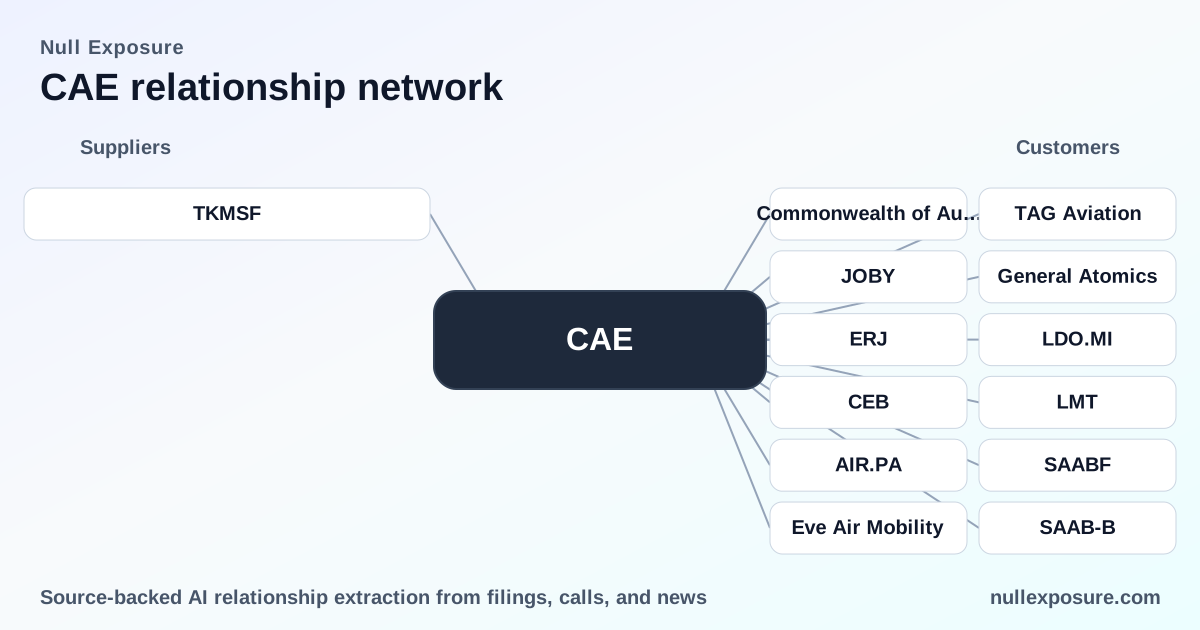
CAE’s customer map: durable training revenues anchored in defense and next‑gen air mobility
CAE builds and sells simulators and runs global training networks that convert aircraft and defense programs into recurring, high‑margin service revenue. The company monetizes through three channels: capital equipment sales (full flight simulators and interfaces), long‑term training services contracts and recurring course/completion fees, and strategic partnerships to certify new aircraft types — a model that generates predictable cash flow and defense program stickiness.
For a concise view of CAE’s customer relationships and program risk, see more at NullExposure.
Why investor focus should be on contracts and certification pipelines
CAE’s economics depend on multi‑year program wins and the cadence of new aircraft certifications. Large, long‑duration defense contracts provide revenue visibility, while partnerships with OEMs and eVTOL entrants create an additional growth vector tied to certification activity. The company’s balance between capital sales (lumpy) and training services (steady, recurring) reduces revenue volatility, and program execution—scheduling, simulator delivery and instructor staffing—drives margin outcomes.
Key operating signals for investors:
- Contracting posture: CAE wins long‑term, anchor contracts (10+ years on defense programs) that lock in training volumes and recurring margin streams.
- Concentration: Revenue spans defense primes, major OEMs and new entrants in urban air mobility; no single customer disclosed in these items dominates CAE’s total revenue but several partnerships are strategically significant.
- Criticality: Training is mission‑critical for defence readiness and pilot certification; CAE’s simulators are often the de‑facto standard for type rating and recurrent training.
- Maturity: The business combines mature, steady commercial airline training and defense program services with an early‑stage growth play in eVTOL and advanced air mobility programs.
If you want a systematic tracker for these customer ties, visit NullExposure for ongoing coverage.
Client and partner relationships: the roll call
Below are each of the reported relationships from recent coverage, presented in plain English with source context.
-
Commonwealth of Australia — CAE secured a CA$270+ million, 10‑year Future Air Mission Training System contract, reinforcing its pipeline in defense training platforms. Source: Simply Wall St coverage summarizing the win (March 2026).
-
JOBY / Joby Aviation — Joby partnered with CAE to develop and qualify flight simulation training devices that Joby will use to train commercially‑rated pilots for its eVTOL aircraft. Source: Joby Aviation news release (March 10, 2026).
-
Cebu Pacific — Cebu Pacific extended its training services agreement with CAE, announced at the Singapore Airshow, continuing CAE’s commercial airline training footprint in Asia. Source: ASDNews coverage (first seen March 9, 2026).
-
Embraer — CAE will deliver a breakthrough full flight simulator (FFS) and coordinate training for Embraer‑CAE Training Services to support Eve Air Mobility pilot training. Source: ASDNews (first seen March 9, 2026).
-
ERJ (Embraer reference) — The same Embraer/EVE development was reported under the ERJ ticker context, reiterating CAE’s role in certifying and training for Embraer‑related air mobility programs. Source: ASDNews (first seen March 9, 2026).
-
BETA Technologies (BETA) — BETA selected CAE to design and develop its pilot and maintenance technician training program for the ALIA eVTOL aircraft, a partnership that dates to BETA’s program development phase. Source: PR Newswire announcement (FY2021 reporting point, referenced March 2026).
-
Cebu Pacific (duplicate entry) — Additional reporting again documents the Singapore Airshow agreement extension with CAE, confirming media traction around that renewal. Source: ASDNews (March 9, 2026).
-
Embraer Eve Air Mobility (InsiderMonkey mention) — CAE publicly stated pride in being selected by Joby and Embraer Eve Air Mobility, confirming its role as a preferred training partner for new air mobility entrants. Source: InsiderMonkey earnings call transcript coverage (March 9, 2026).
-
ERJ (InsiderMonkey duplicate) — The InsiderMonkey transcript echoes Embraer/Eve selection language, underscoring repeated public messaging around the collaboration. Source: InsiderMonkey (March 9, 2026).
-
Joby Aviation (InsiderMonkey duplicate) — CAE reiterated selection by Joby during its public comments, highlighting eVTOL training pipeline momentum. Source: InsiderMonkey (March 9, 2026).
-
Airbus — CAE cited Airbus among a broad set of partners across defense and civil programs, indicating ongoing OEM relationships beyond a single supplier role. Source: InsiderMonkey transcript summary (March 9, 2026).
-
InterGlobe — CAE and InterGlobe inaugurated a new pilot training center in Mumbai to support India’s aviation growth, expanding CAE’s footprint in one of the world’s fastest‑growing commercial markets. Source: MarketBeat / tmcnet reporting (April 15, 2026; first seen May 2, 2026).
-
General Atomics — CAE includes General Atomics among its defense and technology partners, reflecting engagement across unmanned and advanced systems programs. Source: InsiderMonkey (March 9, 2026).
-
Leonardo — CAE lists Leonardo as a partner in simulation and training work, signaling relationships with multiple European defense OEMs. Source: InsiderMonkey (March 9, 2026).
-
LMT / Lockheed Martin (ticker LMT referenced) — Lockheed Martin is named among CAE’s partners, illustrating CAE’s integration with top U.S. defense primes for platform‑specific training solutions. Source: InsiderMonkey (March 9, 2026).
-
Lockheed Martin (duplicate entry) — A second mention reinforces the Lockheed relationship in CAE’s public statements. Source: InsiderMonkey (March 9, 2026).
-
Eve Air Mobility (ASDNews) — CAE Training Services is contracted to train the first wave of Eve Air Mobility pilots, supporting Embraer Eve’s initial operational roll‑out. Source: ASDNews (first seen March 9, 2026).
-
TAG Aviation — CAE and TAG Aviation extended a long‑standing partnership to continue supporting pilot training excellence, confirming CAE’s role with business aviation operators. Source: ASDNews (March 9, 2026).
-
Saab — CAE referenced a partnership agreement with Saab announced in November covering the GlobalEye airborne early warning platform, demonstrating specialized defense system training capability. Source: InsiderMonkey earnings coverage (March 9, 2026).
-
SAABF (Saab reference duplicate) — Reporting under the SAABF designation restates the GlobalEye partnership and program execution relevance. Source: InsiderMonkey (March 9, 2026).
-
MESA — Historical coverage notes that regional carriers like Mesa send pilots to CAE for simulator training and type ratings, illustrating CAE’s entrenched role in regional pilot pipelines. Source: AirlineGeeks feature (originally 2018; referenced March 10, 2026).
-
InterGlobe (Marketbeat duplicate) — A secondary MarketBeat listing reiterates the Mumbai training center inauguration, confirming multiple outlets covered the expansion. Source: MarketBeat (May 2, 2026).
-
Saab / SAAB‑B (InsiderMonkey duplicates) — Additional InsiderMonkey entries repeat Saab partner mentions in the context of CAE’s reported quarter, reinforcing the defense partnership narrative. Source: InsiderMonkey (March 9, 2026).
Operational constraints and company‑level signals
There are no specific external constraint records attached to individual relationships in this set; treat the following as company‑level signals that describe operational reality:
- Long duration contracting: CAE’s business benefits from multi‑year defense and airline contracts that create predictable training demand and lock in capacity utilization.
- Program maturity mix: The portfolio blends mature airline training centers with early‑stage eVTOL certification projects; that diversifies growth sources while demanding investment in new device qualification.
- Criticality and stickiness: Training and simulator provisioning are sticky, because type ratings and platform‑specific qualifications create switching friction for customers.
- Execution risk: Delivery schedules for full flight simulators and instructor networks determine short‑term margin volatility even as long‑term contracts underpin revenue visibility.
Bottom line: where this matters for investors
CAE’s revenue model is resilient because its competitive position converts aircraft and defense procurements into recurring service cash flow. Defense contract wins like Australia’s 10‑year program and a string of OEM/eVTOL partnerships reinforce both near‑term backlog and a longer runway of certification‑driven demand. Watch two axes closely: execution on simulator deliveries and the pace of commercial eVTOL certifications.
For ongoing tracking of CAE’s client wins and program updates, visit NullExposure.