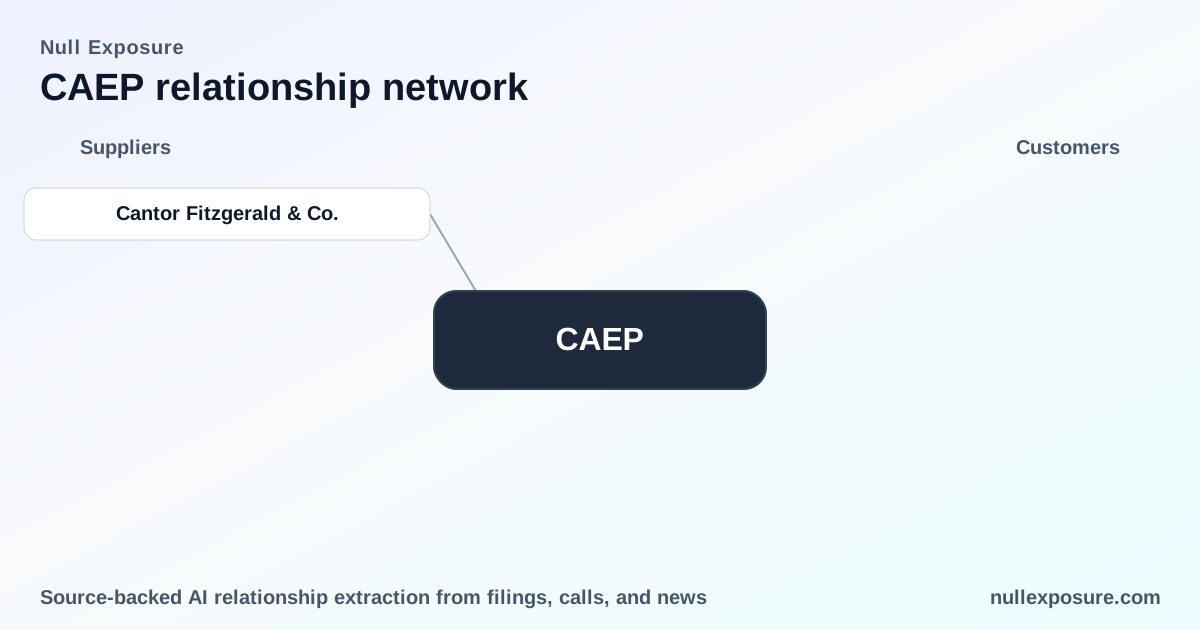
Cantor Equity Partners III (CAEP): A short thesis for investors
Cantor Equity Partners III, Inc. is a NASDAQ-listed shell vehicle that monetizes by completing a business combination; its value is driven by the sponsor’s ability to source and execute an attractive merger or asset acquisition that converts cash-in-trust into operating equity. CAEP’s economics are inherently transactional and sponsor-dependent: liquidity is held in trust, upside transfers on consummation of a deal, and investor outcomes hinge on the quality of the post-combination company and the sponsor’s capital-markets access. For primary research on CAEP position-level signals and client activity across Cantor’s capital markets franchise, visit https://nullexposure.com/.
How CAEP operates and what that implies for counterparties
CAEP is a classic blank‑check vehicle: short operating history, high reliance on sponsor expertise, and zero operating revenues prior to a merger (company filings show no revenue or operating margin prior to a business combination). That structure generates four operating-model characteristics investors must track:
- Contracting posture — transactional and short-term: agreements and counterparties are oriented around a single transformational event (the business combination) rather than ongoing operating contracts.
- Concentration — sponsor- and capital-markets concentrated: outcomes depend on the sponsor’s origination and underwriting relationships rather than diversified operating revenue streams.
- Criticality — high for sponsor and target, low for legacy operations: CAEP’s operational value is critical only at the point of deal execution and shareholder vote.
- Maturity — pre-operating / pre-revenue: the company is effectively a holding vehicle until a combination closes.
These are company-level signals; there are no relationship-specific constraints flagged in the dataset.
What the relationship signals show about Cantor’s role
The collected media notices record Cantor acting repeatedly as a bookrunner, co-manager, placement agent, or capital‑markets advisor across a broad roster of issuers (biotech, technology, and industrials) in 2025–2026. That pattern underlines Cantor’s active franchise in equity financing and placement activity — a capability that benefits CAEP principally through deal sourcing and distribution depth. A mid‑cycle check of these counterparties provides visibility into the types of financings and sectors where Cantor deploys capital-markets muscle. For deeper company-level analyses and deal flow monitoring see https://nullexposure.com/.
Detailed transaction and counterparty log (each entry in the feed)
-
CTGO — Contango Ore closed a $50 million underwritten offering where Cantor acted as a co‑manager alongside National Bank of Canada Capital Markets and ATB Cormark Capital Markets; the notice is captured by Finviz on March 9, 2026. Source: Finviz (2026-03-09) — https://finviz.com/news/309173/contango-ore-closes-50-million-underwritten-offering-of-common-stock-and-pre-funded-warrants
-
ETOR — eToro’s IPO pricing and bookrunning list includes Cantor among additional book‑running managers for the offering as reported in March 2026. Source: FXNewsGroup (2026-03-09) — https://fxnewsgroup.com/forex-news/retail-forex/etoro-ipo-prices-620-million-offering-at-4-26-billion-valuation/
-
ZURA — Zura Bio priced a public offering that listed Cantor as one of the managers alongside Leerink and Piper Sandler, indicating Cantor participation in biotech follow-on financing (reported March 10, 2026). Source: Intellectia (2026-03-10) — https://intellectia.ai/news/stock/zura-bio-prices-public-offering-of-182-million-shares
-
MCHP — Microchip Technology announced that a live webcast of its Cantor-hosted presentation would be available on Microchip’s site, reflecting Cantor’s conference and investor‑relations activity (Microchip press release, March 10, 2026). Source: Microchip IR (2026-03-10) — https://ir.microchip.com/news-events/press-releases/detail/1373/microchip-technology-to-present-at-thecantor-global-technology-industrial-growth-conference
-
ANL — Adlai Nortye announced a $150.0 million private placement where Leerink, Cantor, Lucid, H.C. Wainwright & Jones served as joint placement agents (press notices April–May 2026). Source: GlobeNewswire (2026-04-16 / 2026-05-02) — https://www.globenewswire.com/news-release/2026/04/16/3275172/0/en/adlai-nortye-announces-150-0-million-private-placement-equity-financing.html
-
BETA — Beta Technologies’ upsized IPO filings list Cantor as a co‑manager alongside BTIG and Needham in the company’s NYSE listing coverage (reporting referenced March 2026). Source: VermontBiz / TradingCalendar (reported 2025–2026) — https://vermontbiz.com/news/2025/november/04/beta-launches-upsized-ipo-nyse-raises-over-1-billion and https://www.tradingcalendar.com/post/beta-technologies-ipo
-
SLDB — Solid Biosciences announced an oversubscribed $240 million private placement with Cantor acting as co‑lead placement agent (GlobeNewswire/Bitget coverage, March–May 2026). Sources: GlobeNewswire (2026-03-06) — https://www.globenewswire.com/news-release/2026/03/06/3251037/0/en/solid-biosciences-announces-oversubscribed-240-million-private-placement.html and Bitget (2026-05-03) — https://www.bitget.com/amp/news/detail/12560605244368
-
CNTB — Connect Biopharma announced a $20.2 million private placement where Leerink and Cantor acted as joint placement agents (GlobeNewswire / Bitget reports, March–May 2026). Source: GlobeNewswire (2026-03-30) — https://www.globenewswire.com/news-release/2026/03/30/3264500/0/en/connect-biopharma-announces-20-2-million-private-placement-financing.html
-
PVLA — Palvella Therapeutics priced an upsized public offering with TD Cowen, Cantor, Stifel, Mizuho, LifeSci Capital, Oppenheimer, Canaccord and H.C. Wainwright serving as joint bookrunners (GlobeNewswire and Bitget coverage, March–May 2026). Source: GlobeNewswire (2026-02-26 / 2026-03-02) — https://www.globenewswire.com/news-release/2026/02/26/3245154/0/en/Palvella-Therapeutics-Announces-Pricing-of-Upsized-Public-Offering.html and https://www.globenewswire.com/news-release/2026/03/02/3258187/0/en
-
BLSH — Bullish upsized its IPO range while listing Cantor among additional book‑running managers together with Deutsche Bank and Societe Generale (Bullish press coverage, 2025–2026). Source: Bullish / news-insights (2026-05-02) — https://www.bullish.com/news-insights/bullish-upsizes-initial-public-offering-and-increases-expected-price-range
-
SNSE — Sensei Biotherapeutics acquired Faeth and disclosed Cantor and Citi as capital‑markets advisors for the concurrent financing, indicating advisory engagement rather than pure underwriting (CityBiz, March 2026). Source: CityBiz (2026-03-10) — https://www.citybiz.co/article/808056/sensei-biotherapeutics-acquires-faeth-therapeutics/
-
GOCO — GoHealth’s trading debut and $914 million raise listed Cantor as a co‑manager alongside SunTrust Robinson Humphrey and Loop Capital Markets (FierceHealthcare historical note, 2020; cited in feed). Source: FierceHealthcare (referencing GoHealth press release) — https://www.fiercehealthcare.com/tech/gohealth-shares-jump-trading-debut-after-raising-914-million
-
CLDX — Celldex Therapeutics completed a $300–$345 million public offering where Leerink Partners, TD Cowen, Guggenheim and Cantor acted as joint bookrunners across multiple press releases in March–April 2026. Sources: GlobeNewswire / QuiverQuant / SahmCapital (April–May 2026) — https://www.globenewswire.com/news-release/2026/04/02/3267105/0/en/celldex-announces-pricing-of-300-million-public-offering-of-common-stock.html and https://www.quiverquant.com/news/Celldex+Therapeutics+Completes+$345+Million+Public+Offering+of+Common+Stock
-
LGN — Legence announced an upsized secondary offering listing Cantor among a broad syndicate of bookrunners that included Morgan Stanley, BMO, MUFG, RBC, SocGen and others (GlobeNewswire, April 8, 2026). Source: GlobeNewswire (2026-04-08) — https://www.globenewswire.com/news-release/2026/04/08/3269763/0/en/Legence-Announces-Pricing-of-Upsized-Secondary-Underwritten-Public-Offering-of-Class-A-Common-Stock.html
-
XGN — Exagen’s IPO underwriting roster included Cowen, Cantor and William Blair as underwriters according to a MarketBeat notice in February 2026. Source: MarketBeat (2026-02-17) — https://www.marketbeat.com/instant-alerts/exagen-nasdaqxgn-price-target-lowered-to-1000-at-btig-research-2026-02-17/
(Several feed entries are duplicate press reposts of the same financings above; each duplicate reiterates Cantor’s participating role in the same transactions as captured by GlobeNewswire, SahmCapital, Bitget, QuiverQuant, TradingCalendar and other aggregators across March–May 2026.)
Constraints and red flags
- The dataset contains no explicit constraints flagged for CAEP’s customer relationships; therefore there are no relationship‑specific legal, counterparty or contract constraints called out in this feed. This is a company‑level signal: no constraints reported.
Investment implications and risk framing
- Primary driver: CAEP’s value depends on the sponsor’s ability to source a combination and the post‑deal equity performance; the relationships captured show Cantor’s active role as underwriter/placement agent in 2025–2026 and therefore represent an ecosystem from which CAEP can source targets and distribution.
- Execution risk: Sponsor dependence and lack of operating revenue make CAEP a binary ticket; investor returns are triggered by deal quality and market reception.
- Distribution advantage: Cantor’s repeated placement and bookrunning roles across biotech and tech deals are a positive signal for distribution capability, which translates to a higher probability of successful capital raises for prospective targets.
Bottom line: CAEP is a sponsor‑driven blank‑check instrument whose upside is tightly coupled to Cantor’s capital‑markets reach. The transaction log above confirms Cantor’s active placement activity in FY2025–FY2026 across a diversified roster of issuers — a useful proxy for CAEP’s potential deal‑sourcing and execution capacity. For ongoing signal tracking and deeper counterparty diligence, explore research at https://nullexposure.com/.